Bytes and Biases: How Big Data is Building the Social Polarization
11 min readSarbendu Basu

How often do you nod your head and think that the world around you has become more polarized than it was say 15 years ago?
Have you recently cut connection with an old school friend or a college buddy because you feel they have a more ‘extreme’ and ‘polarized’ view despite their elite education and strong upbringing?
Have your old school / college WhatsApp groups had major spats among closest of friends on political or religious issues, making you wonder why there’s such a rise in polarized, extreme views suddenly?
Before you blame the political leaders for their polarized views and rants- think again!
Political leaders had always been making polarized rants since times immemorial!!
That’s almost what their job description is- they are supposed to represent vehemently, a particular point of view, a particular segment or community view!
Its just that in the recent last decade or two, their views seems to be echoing more and sticking on to a large number of educated, enlightened people. People who are supposedly well informed, well off and well educated!
Ever wondered why?
Big Data, Digital Footprints, and the Polarization of Information: The Rise of Confirmation Bias
The reason is simple. This segment is the internet savvy, content consuming lot!
With the smart phone in hand and ever decreasing data cost and ever increasing internet content- these are the smart lot!
They use Facebook, Twitter, Instagram, WhatsApp to socialize, Amazon, Myntra, Flipkart, Blinkit to shop, web based emails to communicate, Linkedin, Naukri to build and communicate their professional status, makemytrip, yatra.com to book tickets and mostly Google to not only search various trivia but also news articles apart from inshorts or other online short news services to read news!
In the digital age, our every click, like and share is meticulously recorded, analyzed, and used to tailor content that suits our preferences. This phenomenon, driven by big data and the collection of digital footprints, has significantly contributed to reinforcing confirmation bias, resulting in a polarized world.
Cookies Not Very Savory!
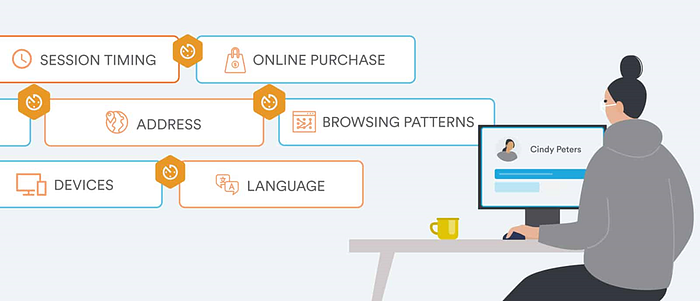
Big data refers to the vast and complex datasets generated by our online activities. Digital footprints are the traces of our online behavior, including the websites we visit, the articles we read, the social media posts we engage with, and the purchases we make. Cookies are small pieces of data stored on our devices by websites to remember our preferences and actions. Together, these elements have revolutionized how information is delivered to us, but not without consequences.
Echoes of Your Clicks
Did you recently read an article on the latest tax law on a news site? And now, everything from your Google News to email newsletters, to your Insta reels, has articles and news on tax laws?
Big data and digital footprints allow companies to create detailed profiles of users based on their online behavior. These profiles are used to deliver personalized content, including news articles, advertisements, and social media posts. While this customization enhances user experience, it also fosters confirmation bias, the tendency to seek out and interpret information that confirms our pre-existing beliefs.
Trapped in the Echo Chamber
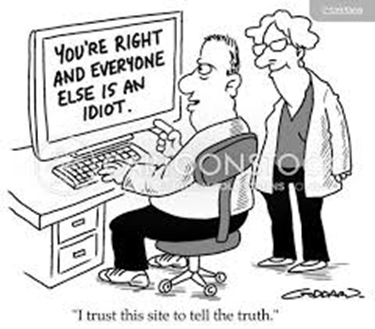
Confirmation bias is a cognitive bias that leads individuals to favor information that aligns with their beliefs and ignore or discredit opposing viewpoints.
With algorithms designed to maximize engagement by providing content that users are likely to interact with, individuals are increasingly exposed to information that reinforces their beliefs.
For example: Did you spend sometime looking at the cute Golden Retriever puppy reel in Instagram while relaxing after a tiring day, at your home? Don’t worry- you will now be flooded with reels of puppies and Golden Retrievers and your google news articles will now show you articles on “Which Dog breed are the cutest” or “Funny dogs” etc etc.
Giving you another not so cute example: Make a couple of Google search on “Many cases of student suicides in Kota, India”- open the top 3 search results and scroll through the content and spend 5 mins each. Now here onwards , you will get flooded by internet articles on grim stories of student suicides, ominous articles and opinion pieces how student suicides are on the rise etc etc in all digital interfaces- not only in your Google news but also you will start getting mailers of Reddit and Quora articles that talk of this ominous subject, your FB or Instagram feeds will also show you reels on same subject. Every digital interaction point- will feed you the same subject. The more you get- more you read- and that increases the concentration of the contents on same subjects bombarded to you. Shortly you will be convinced that it is THE major burning issue the “Everyone is talking about”!
Now if you meet someone else- who may give you real statistics and agues that the issue is contained and is not really a major issue anymore- You will feel violated!
It is going against the hundreds of online voices (if not thousands) and hundreds of online ‘news articles’ and gruesome pictures that you had seen online!- You will start resenting the person who had used logic and facts to argue!
This echo chamber effect amplifies polarization, as people become more entrenched in their views and less open to alternative perspectives.
The Demise of Balanced News
In the past, news articles aimed to provide balanced viewpoints, offering a comprehensive perspective on various issues. The nuanced editorial articles on the “The Statesman” or The “Deccan Chronicle” were the Sunday muse of the educated and elite.
Content gradually started to get democratized with advent of electronic media.
Reach started to exponentially move up (or move down the pyramid- as some would argue). With larger reach came the demand of more sensationalized and ‘easier to consume’ content.
Advent of internet and social media platform opened up the possibility of “Bespoke News”- the news and viewpoints- that one would “Like” and ‘subscribe’ to.
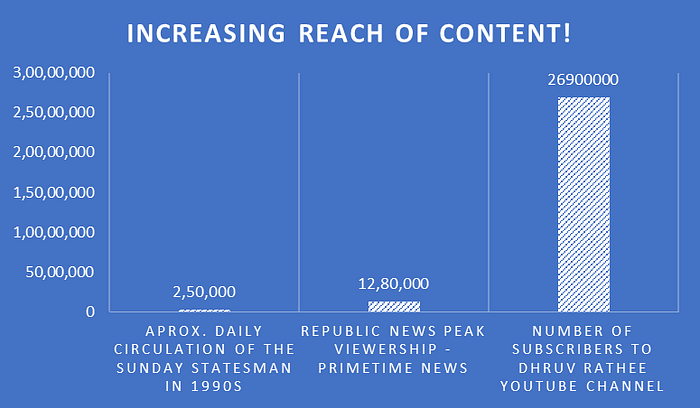
Content moved away from providing balanced and nuanced information for readers to form their “own informed opinion” , to more “ready to eat” quick format- where the opinion is already formed- and suitable bespoke ‘news’ that fits to the existing opinion is only served to the plate.
This shift has resulted in a fragmented media environment where individuals receive skewed information tailored to their preferences.
Till the late 1990s journalism and news in India were driven by maverick journalists like Kuldeep Nair, Arun Shourie or N. Ram- who were known for their in-depth research and balanced fact driven journalism
By late 1990s- ‘balance’ in Journalism was no longer sought after trait- and we saw the birth of an era of sensationalism in journalism with Barkha Dutt, Rajdeep Sardesai and the inimitable Arnab “Fox” Goswami.
Balance didn’t seem to be the priority and TRP driven mass preference driven content was given priority…but still news was produced for mass consumption- it was still not bespoke.
The late 2010s- the rise of streaming and rise of “Bespoke” content. Journalists were replaced by “youtubers”/ “content creators”/ “podcasters”. One didn’t need to labor to form their own opinion after reading facts and information. We started serving ‘chosen’ pieces that fits to the existing bias and opinions- making the bias stronger, opinion more rigid- and thus getting the likes and subscriptions to the channel.
Dividing Lines: The Impact of Polarization
The polarization of information has far-reaching consequences. It fuels extreme viewpoints, stokes division, and undermines social cohesion.
In a polarized world, individuals are more likely to view those with opposing beliefs as adversaries, leading to increased conflict and reduced trust in institutions. This environment also fosters the rise of extreme jingoism and rabid anti-globalization sentiments, as individuals rally around nationalist and isolationist ideologies.
The Cambridge Analytica Playbook

One of the most infamous examples of the power of big data and digital footprints in shaping political discourse is the “Cambridge Analytica” scandal.
Cambridge Analytica, a political consulting firm, used a method that combined “big data” and “small data” to influence people.
Big data is a huge amount of information collected from many people. Cambridge Analytica used Facebook data (likes, shares, friends) from millions of users to predict their interests and biases.
Small data is more detailed and personal. It involves knowing in details individual preferences and characteristics on multiple parameters. By analyzing this, Cambridge Analytica created detailed psychological profiles of users (e.g., their personality traits and political views).
Then they used the indicators of ‘small data’ to categorize millions of people and made personalized ads and messages to target each user based on their bias and profile.
An super simplified example would be:
Small data study: Lets imagine we study a large sample of people in minute details of their behaviour, preferences- like say whether one likes CocaCola or Mirinda, drives an SUV or Sedan, buys Jeans or Khakis, watches comedy movie or action movie and ofcourse if they like Trump or Biden (for example). Based on this they arrive at a likely profile of a Trump supporter , say he /she generaly drinks Coke, prefers SUV, buys Jeans and prefers action movies. (Cambridge Analytica- collected these by running “Your Personality Type” quizzes in Facebook!!! , Do you know anyone who had taken these “Your Personality Type” quizes in Facebook? :) )
Big data use: Now equipped with this knowledge one tries to find how many of the millions of Facebook users- prefer SUV, drinks Coke etc. By this one will have a fair idea how many are staunch Trump Supporters (Say a 50 parameter to 50 parameter match) , how many are fence sitters, how many are Biden supporters.
Now on this identified big data- targeted ads and contents are shown that will influence their voting behaviour. Means- to someone who is worried about job security- ads showing Trump claiming to bring jobs back to America will be shown, while someone else who is against illegal immigrant- will see ads and content showing Trump speaking up against immigrants!
In short, Cambridge Analytica combined lots of general data (big data) with specific personal details (small data) to influence people’s opinions and decisions, especially in elections.
As per their own admission Cambridge Analytica influenced over 200 plus elections world over- in countries like the United States, United Kingdom (Brexit refferendum) India, Kenya, and Brazil.
Musk’s Twitter Takeover: The Quest for Influence
In 2022 Elon Musk acquired Twitter on an USD 44 Billion deal. Following is an illustration just to elaborate the deal size.
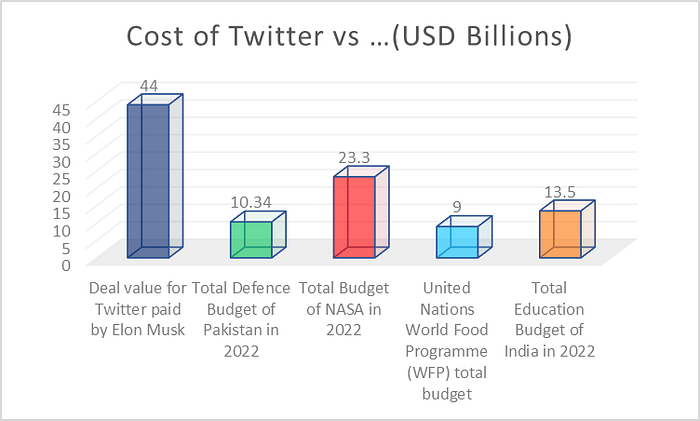
What made twitter (or X) so valuable? Their FCF definitely doesn’t justify that kind of valuation in pure finance terms
This strategic acquisition of Twitter by Elon Musk underscores the critical role that social media platforms play in shaping political discourse. Twitter, with its vast user base and real-time information dissemination, is a powerful tool for influencing public opinion. By acquiring Twitter, Musk aims to wield significant influence over the political narrative and direction of the United States.
His vision for Twitter includes promoting free speech and reducing content moderation, which could further exacerbate the spread of polarized information.
Navigating the Digital Maze: Practical Solutions
The use of big data, digital footprints, and cookies to target specific information to users has created a polarized world where confirmation bias thrives.
The decline of balanced news and the rise of extreme viewpoints pose significant challenges to social cohesion and democratic processes. The Cambridge Analytica scandal and Elon Musk’s acquisition of Twitter highlight the profound impact of digital platforms on political discourse.
Let’s tackle the digital divide and reduce polarization with some practical steps:
- Mix Up Your News: Don’t stick to just one news source. Exploring different outlets can give you a balanced view. It’s like adding a variety of toppings to your pizza!
Example: If you usually get your news from one major site, try checking out international news sources too.
- Think Critically: Always question the information you read. Who wrote it? Why? It’s like being a detective , dig deeper and uncover the truth.
Example: Before sharing that shocking headline, do a quick search to verify its accuracy.
- Join Diverse Conversations: Engage in discussions with people who have different views. It’s like adding spices to your food , it makes things more interesting. Dont always try to make them see your point of view- try to understand theirs as well. I mean come on!- you dont get paid to educate everyone!!
Example: Participate in online forums or social media groups that encourage respectful debates on various topics.
- Fact-Check Before You Share: Use fact-checking tools to verify information. Its like doing a spell check! Saves you from “Foot in your mouth”- disease!!
Example: Use platforms like Snopes or FactCheck.org to ensure the news you’re sharing is accurate.
- Demand Ethical Algorithms: Push for transparency in how platforms curate content. It’s like asking your neighborhood vegetable vendor on how fresh his wares are.
Example: Use platforms that has transparent, balanced and unbiased contents.
By taking these steps, you can help reduce digital polarization and promote a more balanced online experience.
More in big-data

Venture
Write for entrepreneurs, founders, and builders.
Share startup lessons, growth tactics, and founder stories with readers on the same journey.
One free account across In Plain English, Stackademic, Venture, and Cubed.
How it works- Startups & entrepreneurship
- Marketing & growth
- Productivity & leadership
- Founder stories & lessons learned
Sign in
Google or GitHub
Complete profile
Takes a few minutes
Get approved & publish
Start sharing
Why write for Venture?
Entrepreneurship is rarely a straight path. The lessons worth sharing are learned while building.


Comments
Loading comments…