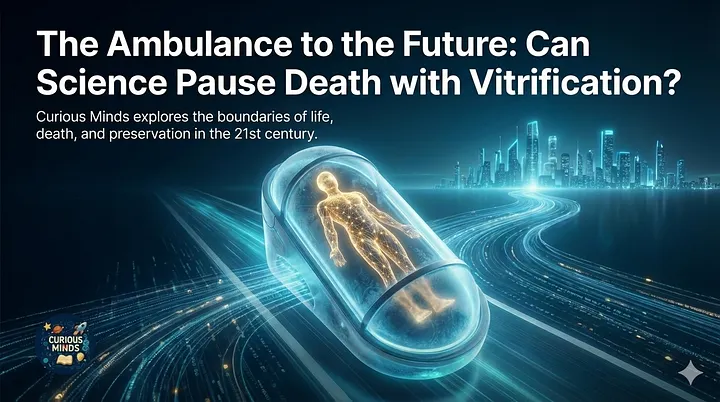
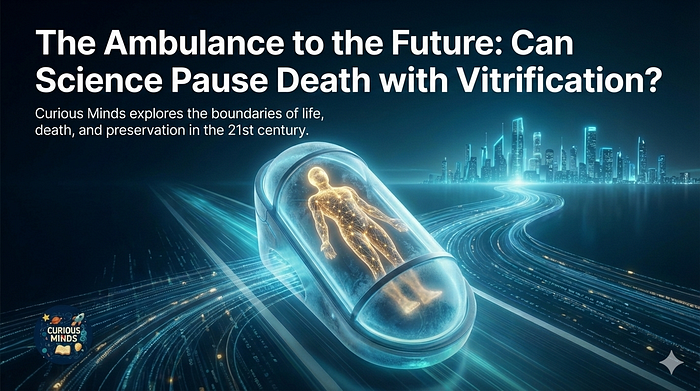
Curious Minds: The Ambulance to the Future: Can Science Pause Death with Vitrification?
Exploring the boundaries of life, death, and preservation in the 21st century.
6 min readBalajee Viswanatha Rao
Quick Listen If you’d rather listen than read, here’s the podcast episode that covers the key points. Tune in! 🎧 Spotify | Apple Podcasts | Amazon Music | YouTube
The monitor flatlines. The heart stops. In a standard hospital room, the doctor checks the clock and calls “Time of Death.”
But for a specialized team waiting in the hallway, the clock has just started.
They don’t rush in with a body bag. They rush in with ice baths and medications to support blood pressure. This is the SST team — Standby, Stabilization, and Transport. They aren’t preparing for a funeral. They are preparing to pause biology itself.
It’s easy to think of this as science fiction, or perhaps a morbid curiosity to start the New Year. But this isn’t about the end. It’s about a futuristic technology that views death not as a finality, but as a solvable problem.
Here is the one transformative idea you need to understand: Cryonics is not about raising the dead; it is about preserving the dying until medicine catches up.
❄️ Not Your Average Ice Bath
Let’s clear up the biggest misconception immediately. Many people think cryonics is just freezing people.
If you did that — treated a human body like a bag of peas in the freezer — you would destroy the person. Water expands when it freezes, forming sharp, jagged ice crystals. If you freeze a human body, those crystals act like millions of tiny daggers, shredding cells from the inside out. You would be left with biological mush.
Modern cryonics uses a process called Vitrification.
When the SST team intervenes, they replace the blood with a medical-grade antifreeze known as a cryoprotectant. As the temperature drops to -196 degrees Celsius, the body doesn’t freeze. It solidifies. It becomes like glass — a solid state with no ice crystals.
Think of it like watching a movie on your laptop when the battery dies. The screen goes black. Is the movie gone? No. It is just paused, waiting for a charger. Cryonics attempts to put the human body into that “paused” state, preserving the physical map of “you” — your neurons and cells — until future technology can press play again.
🐇 The Rabbit in the Room
Is this just a fantasy? Or is there proof that biology can survive the trip?
While no human has ever been revived from cryopreservation, we have compelling data from the animal kingdom.
Researchers at 21st Century Medicine conducted a prize-winning experiment to see if memory structures could survive vitrification. They chemically fixed and vitrified a rabbit brain. When they rewarmed it and looked under an electron microscope, the results were stunning: the ultrastructure — the synapses and cell membranes — appeared extremely well preserved.
But structure is one thing; function is another.
In a separate experiment, scientists successfully vitrified a rabbit kidney. They rewarmed it and transplanted it back into a rabbit. It worked. The kidney regained life-sustaining function. This was a critical demonstration that an organ can be vitrified, rewarmed, and function again.
What if this fails? Critics argue that the cryoprotectants used are toxic in large doses. Right now, we know how to put them in to preserve the structure, but getting them out without damaging the cells is a massive hurdle. We have the pause button, but we haven’t invented the play button yet.
💶 The Price of Forever
For decades, the giant in this field was Alcor in Arizona, currently caring for around 200 “patients” in steel dewars. But as of 2025, the landscape is shifting.
Tomorrow Bio, a Berlin-based startup, recently secured a massive €5 million seed round to expand operations. This is crucial because Venture Capitalists don’t usually back science fiction; they back scalable models. This investment signals that “smart money” sees cryonics moving from high-risk speculation to long-term operation.
Tomorrow Bio has already preserved 20 humans and 10 pets. But immortality (or the chance of it) isn’t cheap.
- Whole Body Preservation: ~€200,000 to €230,000.
- Brain Only: ~€75,000.
The logic behind the “Brain Only” option is that “you” are your connectome — your memories and personality. It is essentially a storage box for your soul, waiting for a key we haven’t invented yet.
🔓 Redefining the End
It’s easy to feel like we’re spiraling into a dystopia where only the rich can buy time — but here’s where the story turns.
This technology forces us to ask a deeply human question: What is death?
We have a legal definition: when your heart stops and a doctor signs a paper. But cryonicists argue that “legal death” is just a label for “current medical failure.” If you had a heart attack in 1920, you were “dead.” If you have that same heart attack in a 2025 ER, you are simply “a patient in critical condition.” Technology moves the line of death.
Companies like Tomorrow Bio operate in this grey zone. They are transparent — they tell you this is a “chance,” not a promise. It’s like buying a lottery ticket where the jackpot is a second life.
Closing Thought
The “Ambulance to the Future” is waiting. The engine is running.
As we look at the rapid funding and scientific progress in 2025, we have to wonder: If a loved one passes away and enters this process, in the future, when we speak of them… do we say they are dead?
Or do we simply ask: “Is she paused?”
Stay curious, stay kind — and maybe keep a sweater handy. It’s getting cold out there.
Join the Conversation
Do you view cryonics as a valid scientific pursuit or a denial of nature? Let me know in the comments below!
✅Sources
- Tomorrow.Bio Raises €5M in Funding, FinSMEs, 2025, https://www.finsmes.com/2025/05/tomorrow-bio-raises-e5m-in-funding.html
- Not just science fiction: Tomorrow.Bio has preserved 20 people and 10 pets for future revival, Tech.eu, 2025, https://tech.eu/2025/05/26/not-just-science-fiction-tomorrow-bio-has-preserved-20-people-and10-pets-for-future-revival/
- Alcor Life Extension Foundation, Wikipedia, 2024, https://en.wikipedia.org/wiki/Alcor_Life_Extension_Foundation
- Physical and biological aspects of renal vitrification, PMC — NIH, 2009, https://pmc.ncbi.nlm.nih.gov/articles/PMC2781097/
- Aldehyde-Stabilized Cryopreservation procedure Wins Brain Preservation Prize, Cryonics Archive, 2016, https://www.cryonicsarchive.org/docs/cryonics-magazine-2016-02.pdf
- Human Cryopreservation Services and Pricing, Tomorrow Bio, 2025, https://www.tomorrow.bio/human-cryopreservation
- Why does cryonics cost so much?, Tomorrow Bio, 2025, https://www.tomorrow.bio/knowledge/why-does-cryonics-cost-so-much
- The Death of Death in Cryonics, Cryonics Archive, n.d., https://www.cryonicsarchive.org/library/death-of-death/
- Rabbit brain is cryogenically frozen, then thawed with no apparent damage, ZME Science, 2016, https://www.zmescience.com/medicine/rabbit-brain-cryogenics-0523532/
- Cryopreservation of organs by vitrification: perspectives and recent advances, PubMed, 2004, https://pubmed.ncbi.nlm.nih.gov/15094092/
Disclaimer
This article is for educational purposes based on verified information as of January 2026. No human has yet been revived from cryopreservation. Always consult medical and legal professionals regarding end-of-life planning.
More in technology


Venture
Write for entrepreneurs, founders, and builders.
Share startup lessons, growth tactics, and founder stories with readers on the same journey.
One free account across In Plain English, Stackademic, Venture, and Cubed.
How it works- Startups & entrepreneurship
- Marketing & growth
- Productivity & leadership
- Founder stories & lessons learned
Sign in
Google or GitHub
Complete profile
Takes a few minutes
Get approved & publish
Start sharing
Why write for Venture?
Entrepreneurship is rarely a straight path. The lessons worth sharing are learned while building.
Frequently Asked Questions
Common questions about this topic
What is the SST team and what does it do?
The SST team (Standby, Stabilization, and Transport) is a specialised group that intervenes immediately after legal death to stabilise a recently deceased person using interventions such as ice baths, blood pressure support medications, and replacement of blood with cryoprotectants to prepare the body for cryopreservation.
What is the fundamental purpose of cryonics?
The fundamental purpose of cryonics is to preserve dying bodies or brains in a stable, non-ice-crystal state so that the physical structures that encode a person—neurons and their connections—are maintained until future medical technologies may be able to restore function.
How does modern cryonics differ from simply freezing a body?
Modern cryonics uses vitrification rather than simple freezing: biological fluids are replaced with cryoprotectants and cooled to about −196°C so tissues solidify into a glass-like state without forming destructive ice crystals that would shred cells.
What is vitrification in the context of cryonics?
Vitrification is the process of replacing blood with medical-grade cryoprotectants and lowering temperature so tissues become a solid, glass-like state without ice crystal formation, thereby preserving ultrastructure such as synapses and cell membranes.
Has any human been revived from cryopreservation?
No human has ever been revived from cryopreservation.
What experimental evidence supports the idea that structures survive vitrification?
Experiments include a rabbit brain that was chemically fixed and vitrified then rewarmed with electron microscopy showing extremely well-preserved ultrastructure, and a rabbit kidney that was vitrified, rewarmed, transplanted back, and restored life-sustaining function.
What major scientific hurdle remains for restoring function after cryopreservation?
A major hurdle is removing toxic cryoprotectants without damaging cells and developing the means to restore function—the article describes having a reliable 'pause' but not yet having the 'play' button to revive preserved humans.
Which organisations and companies are prominent in cryonics as described?
Alcor Life Extension Foundation has been a longstanding provider caring for around 200 patients in dewars, and Tomorrow Bio is a Berlin-based startup that secured a €5 million seed round and has preserved around 20 humans and 10 pets.
What are typical costs for cryopreservation according to the information provided?
Typical costs reported are approximately €200,000 to €230,000 for whole body preservation and about €75,000 for brain-only preservation.
Why do some people choose brain-only preservation?
Some people choose brain-only preservation because the brain (connectome) is considered the physical storage of memories and personality, so preserving the brain is viewed as preserving the essential map of personal identity until future technology might restore it.
How do cryonicists view legal death?
Cryonicists view legal death as a label for current medical failure rather than an absolute finality; they argue that what is legally called death can shift as medical technology advances and that preservation can pause the biological state for potential future revival.
How do cryonics companies present the likelihood of revival?
Cryonics companies present preservation as a chance, not a promise; they are transparent that current methods offer a possibility of future revival rather than any guarantee, likening the choice to buying a lottery ticket with a potential long-term payoff.
Comments
Loading comments…