OpenClaw Shows the Future of AI Agents
4 min readJonathan Capriola
But It Also Reveals the Missing Security Boundary
The recent OpenClaw architecture highlights something most teams still misunderstand about agent systems.
The real risk is not model intelligence.
It is execution.
OpenClaw demonstrates what modern agent orchestration looks like: planners coordinating multiple agents, calling tools, interacting with APIs, and triggering real-world actions. But as autonomy increases, a new question emerges:
Who actually authorizes execution at runtime?
Today, most AI stacks treat execution as an implementation detail. Policies live in documents. Governance lives in dashboards. Audits happen after the fact.
Meanwhile, agents operate at millisecond decision speeds.
That mismatch creates the gap.
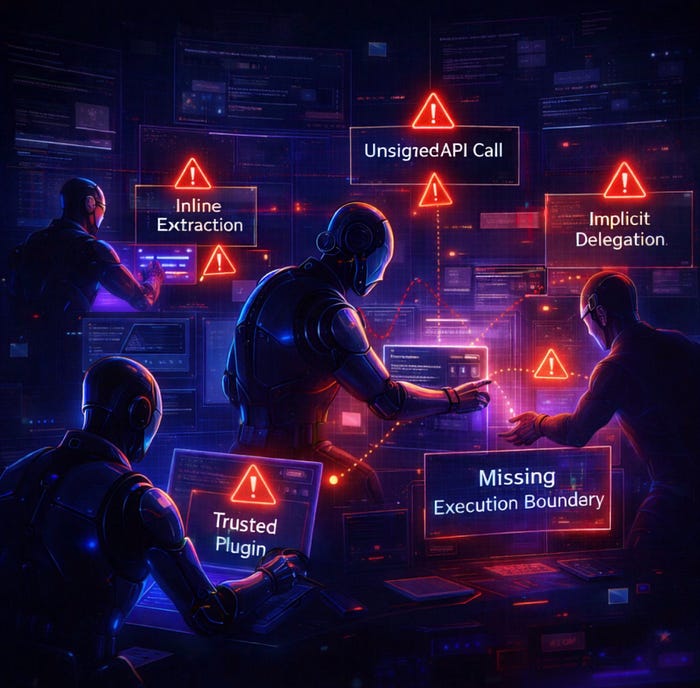
The Shift From Automation to Delegated Authority
When an OpenClaw planner sends a tool request, the system crosses a boundary:
• tool.call
• api.request
• wallet.send
• db.write
• agent.message
At that moment, the system is no longer just automating.
It is exercising delegated authority.
And delegated authority requires verification.
Not prompts.
Not guidelines.
Not quarterly governance reviews.
Execution-time authorization.

Where A2SPA Fits
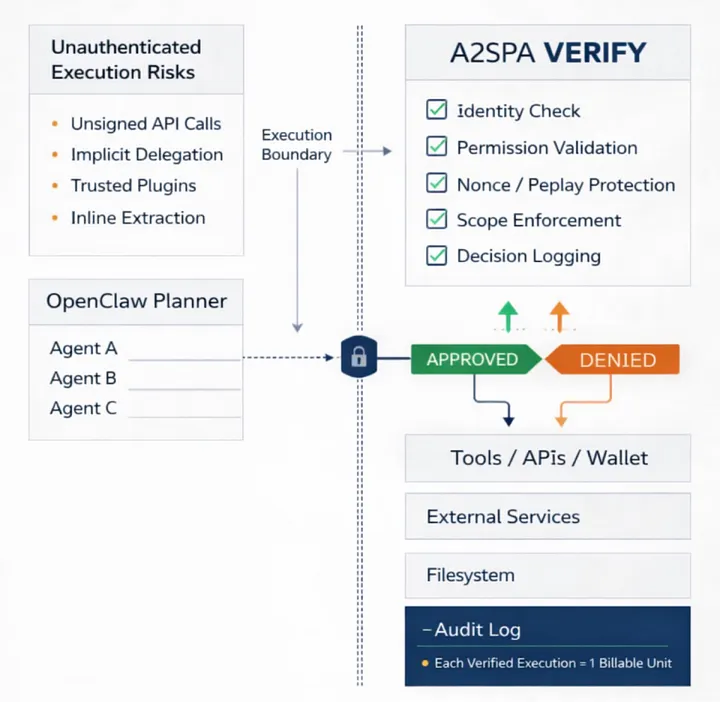
Instead of acting as another orchestration layer, A2SPA defines a deterministic execution boundary underneath systems like OpenClaw.
Think of the architecture like this:
OpenClaw
→ Plans and coordinates agent behavior.
A2SPA
→ Verifies whether execution is allowed at runtime.
Tools / APIs / Wallets
→ Perform the actual action only after authorization.
The verification layer enforces:
• Identity validation
• Scope enforcement
• Replay protection
• Intent-to-action binding
• Immutable decision logging
This shifts governance from advisory to authoritative.
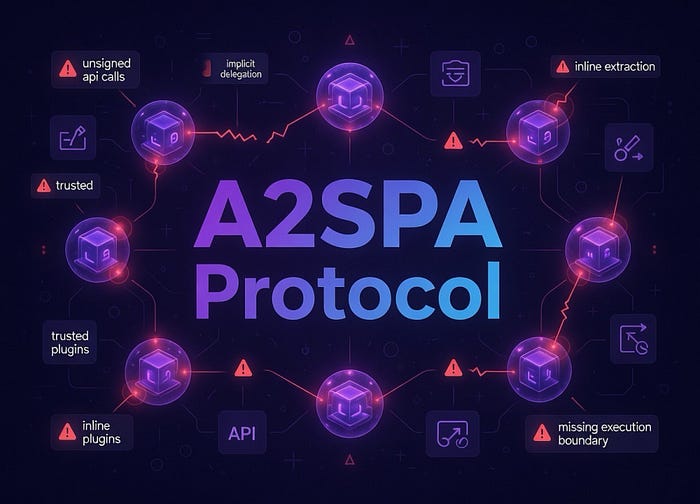
Why Traditional Security Models Break Down
TLS secures transport.
IAM secures identity.
But neither verifies intent at execution time.
That leaves a blind spot:
An authenticated agent can still perform unauthorized actions if execution itself is not cryptographically constrained.
OpenClaw exposes how fast agent ecosystems are moving.
A2SPA addresses what happens when those ecosystems start operating without human checkpoints.
The Real Design Question
Most teams ask:
“How do we build better agents?”
The better question is:
Where does execution authority live?
If governance does not operate at runtime, it becomes documentation instead of control.
OpenClaw shows the future of personal and enterprise agents.
Execution-time authorization defines whether that future scales safely.
OpenClaw makes one thing clear:
We are no longer building assistants.
We are building systems that act.
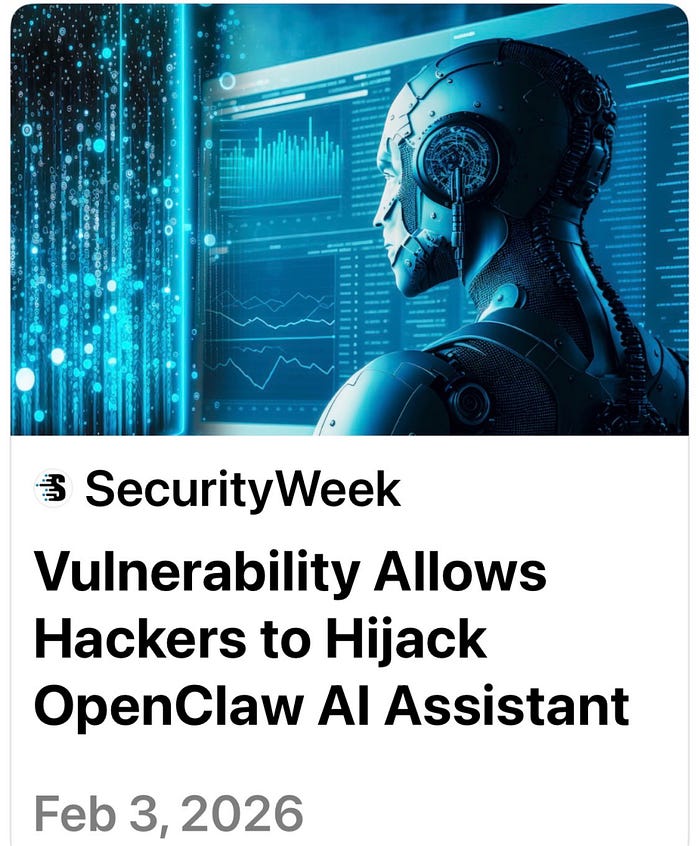
And the moment a system can execute without a human in the loop, the architecture changes.
Not philosophically.
Cryptographically.
Right now, most AI stacks assume trust at the exact moment they should require proof.
Agents plan faster.
Agents decide faster.
Agents execute faster.
But governance is still designed like a quarterly meeting.
That mismatch is where failures will happen.
Execution is not just another step in the pipeline.
It is the security boundary.
If the industry keeps scaling autonomy without redefining authorization, the next wave of “AI incidents” won’t be model failures.
They will be execution failures.
And by the time logs explain what happened, the action will already be irreversible.
We are entering a world where AI doesn’t just suggest actions.
It executes them.
And when execution happens at machine speed, trust cannot be assumed.
It has to be proven — every time, at runtime.
The future of AI will not be defined by smarter models.
It will be defined by who controls the moment an action becomes real.
Author’s Note
I am not building another AI feature layer.
I am building what I believe is the missing control plane for agent systems:
Execution-time authorization.
A2SPA (Agent-to-Secure Payload Authorization) defines a deterministic boundary where automation becomes delegated authority and every action requires cryptographic verification before it runs.
This work comes from watching agent ecosystems evolve faster than the security models designed to govern them.
OpenClaw, personal AI planners, multi-agent orchestration — all of it is accelerating toward a future where execution happens continuously and autonomously.
The real question is no longer what agents can do.
It is:
Who authorizes what they are allowed to execute at runtime?
More in artificial-intelligence


Venture
Write for entrepreneurs, founders, and builders.
Share startup lessons, growth tactics, and founder stories with readers on the same journey.
One free account across In Plain English, Stackademic, Venture, and Cubed.
How it works- Startups & entrepreneurship
- Marketing & growth
- Productivity & leadership
- Founder stories & lessons learned
Sign in
Google or GitHub
Complete profile
Takes a few minutes
Get approved & publish
Start sharing
Why write for Venture?
Entrepreneurship is rarely a straight path. The lessons worth sharing are learned while building.
Comments
Loading comments…