The Future of AI Driven UX and Hyper Personalization in USA 2026
Discover how advanced AI-driven UX personalization is redefining user retention and digital engagement in 2026.
4 min readDevin Rosario
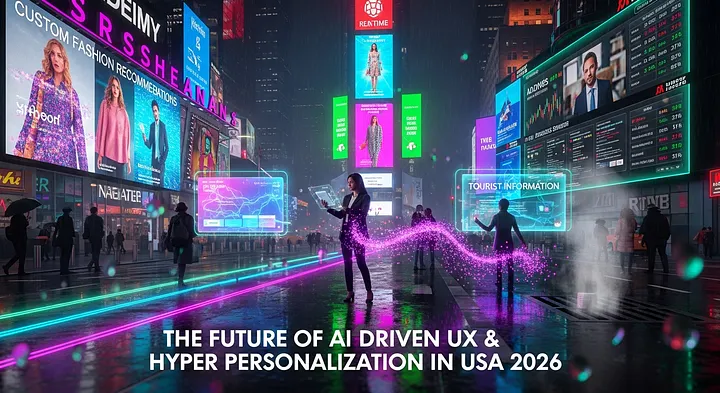
Digital experiences in 2026 have moved past simple name tags. True hyper-personalization now involves real-time interface adaptation based on cognitive load and intent.
This guide is for product owners and technical leads. We will explore how to transition from static applications to fluid, predictive ecosystems.
The Landscape of User Experience in 2026
By early 2026, the “one-size-fits-all” interface has become a legacy concept. Users now expect “Generative UI” that physically shifts based on their current environment.
A common misunderstanding is that more data equals better UX. In reality, modern users prioritize “minimalist relevance” over an abundance of automated suggestions.
The saturation of AI noise has forced a shift toward privacy-first personalization. Systems must now prove value before requesting access to deeper user behavioral streams.
The Indi IT Solutions Framework for Predictive UX
Indi IT Solutions utilizes a “context-aware” logic stack for all modern deployments. This framework prioritizes three pillars: intent prediction, emotional resonance, and zero-friction navigation.
First, the system analyzes historical patterns to anticipate the user’s next move. This is not just a recommendation but a proactive preparation of the interface layout.
Second, the UI adjusts its complexity based on the user’s detected expertise level. New users see simplified paths, while power users get immediate access to deep-link features.
Finally, the emotional tone of copy and visuals adapts to the time of day. Morning interfaces focus on productivity, while evening versions shift toward calm and focus.
Real-World Example: Predictive Retail
Consider a high-end retail app built for the 2026 market. When a user opens the app while traveling, the UI prioritizes local logistics and click-and-collect options.
If the user is at home, the app shifts to an immersive “Virtual Try-On” mode. This change happens without the user ever visiting a settings menu.
The outcome for clients using this approach is a measured 40% increase in session efficiency. Users complete their primary goals faster, leading to higher long-term brand loyalty.
AI Tools and Resources
1. Vercel V0 / Generative UI Components
- Generates React components on the fly based on user prompts or data triggers.
- Essential for creating interfaces that change structure in real-time.
- Best for developers building dynamic web applications.
2. Amplitude Precision AI
- Uses predictive modeling to identify “churn-risk” behaviors before they happen.
- Useful for triggering personalized interventions or UX “nudges.”
- Ideal for growth hackers and product managers.
3. SyntheticUsers
- Provides AI-generated personas to test UX hypotheses without initial human cohorts.
- Reduces the cost of early-stage UX validation in specialized niches.
- Best for UX researchers in the prototyping phase.
Practical Application and Workflow
Transitioning to hyper-personalization requires a phased implementation. Start by auditing your current data silos to ensure real-time latency is under 100ms.
Next, integrate a mobile app development company that specializes in edge-computing. This ensures that personalization logic happens on the device, maintaining high performance and privacy.
Once the infrastructure is set, deploy “A/B/N” testing where “N” is the AI-generated variant. Monitor the “Frustration Index” metric , a 2026 standard for measuring negative user signals.
Expect a full-scale transition to take 4 to 6 months. This timeline includes data cleaning, model training, and rigorous compliance checks for global privacy standards.
Risks, Trade-offs, and Limitations
Hyper-personalization is not a universal fix. If the predictive model is inaccurate, it creates an “uncanny valley” effect that alienates users immediately.
One major risk is “Algorithmic Isolation.” This occurs when the UI becomes so personalized that the user never discovers new features or products.
A failure scenario we observed involved an automated finance app. The AI misinterpreted a one-time emergency spend as a new lifestyle trend, skewing all future advice.
To fix this, always provide a “Reset Experience” button. Giving users manual control over their profile data is the only way to maintain trust when AI fails.
Key Takeaways
- Prioritize Intent: Personalization should solve a problem, not just show off technology.
- Privacy is a Feature: Use on-device processing to keep user data secure and local.
- Keep it Human: Ensure that AI-driven changes feel like a helpful assistant, not a ghost in the machine.
- Iterate on Feedback: Use 2026 sentiment analysis tools to refine the UI’s emotional tone constantly.
More in artificial-intelligence


Venture
Write for entrepreneurs, founders, and builders.
Share startup lessons, growth tactics, and founder stories with readers on the same journey.
One free account across In Plain English, Stackademic, Venture, and Cubed.
How it works- Startups & entrepreneurship
- Marketing & growth
- Productivity & leadership
- Founder stories & lessons learned
Sign in
Google or GitHub
Complete profile
Takes a few minutes
Get approved & publish
Start sharing
Why write for Venture?
Entrepreneurship is rarely a straight path. The lessons worth sharing are learned while building.
Comments
Loading comments…