This Is What LLMs Are Actually Used For
7 min readVlad Koval
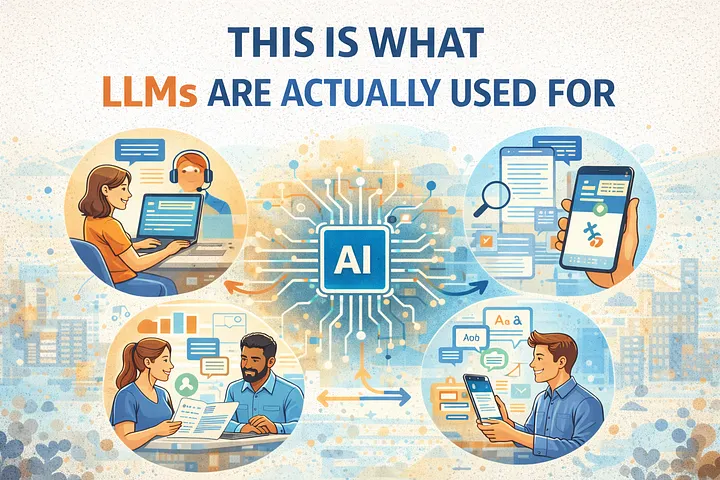
A few years ago, anytime someone said “LLM,” I’d picture the same thing: a chatbot that tries (and often fails) to answer questions. I was guilty of the common misconception that large language models were mostly futuristic toys, novel assistants, or — at best — expensive curiosities tech teams joked about. I couldn’t have been more wrong.
Working closely with engineering and product teams over time taught me a reality that the buzzwords didn’t prepare me for:
LLMs are already reshaping everyday work in ways that are practical, measurable, and not just hype.
And the more I looked into real deployments across businesses, the more I realized how diverse and grounded these use cases are. In fact, one article that really helped expand my understanding is Top LLM Use Cases: How Enterprises Are Applying Large Language Models Across Industries.
Large Language Models Use Cases | Enterprise LLM Solutions by Industry
That piece put specific examples into context — showing how LLMs go far beyond chatbots and start to solve actual business problems at scale. It was one of those reads that shifted my mental map from “AI as a novelty” to “AI as a reliable toolchain.”
So let me walk you through what LLMs are actually used for — not in theory, but in real, day-to-day business applications.
1. Intelligent Knowledge Search and Internal Support
The first time we deployed an LLM to assist with internal knowledge search, it felt like a lightbulb moment. Our support teams were drowning in outdated wikis, scattered Google Docs, and half-filled spreadsheets. People were spending more time finding answers than giving them.
LLMs changed that by bringing contextual search to life. Instead of keyword matching, they could understand meaning — reading through disparate documents and synthesizing answers on the fly.
Suddenly:
- Agents could get accurate answers instantly
- New hires ramped up faster
- Internal documentation became useful
This wasn’t about flashy AI — it was about saving hours of manual search every week. And that’s a use case any organization with knowledge silos can immediately relate to.
2. Customer Service That Scales Without Losing Accuracy
I remember hearing a product manager say, “We can handle more support tickets than ever before — but accuracy tanked.” This was before we introduced LLM-assisted support responses.
At first, teams used rigid automation that looked at keywords and spit back templated answers. It saved time, yes — but it annoyed customers because it felt like robots were guessing.
The shift came when we layered an LLM with real context: actual product docs, policy pages, and resolved ticket history. Now the model didn’t just echo keywords — it understood intent and provided grounded responses.
No more vague generic replies that felt like placeholders.
This is one of the most visible LLM use cases in the wild:
support automation that feels accurate, relevant, and human-like without human effort on every question.
3. Code Assistance and Developer Productivity
Developers are often the early adopters of LLMs — and for good reason. Ask most engineers about LLMs, and they’ll quickly tell you about contextual code suggestions that go beyond simple autocompletion.
LLMs are used to:
- Generate boilerplate code
- Explain complex logic in plain language
- Suggest fixes to bugs
- Turn comments into working code snippets
I’ve watched teams accelerate feature development simply by offloading routine tasks to LLM-powered tools. It doesn’t replace expertise — it augment it.
Junior developers get unstuck faster, senior developers avoid repetitive tasks, and the whole engineering flow gets smoother.
4. Automating Document Understanding and Structuring
Another powerful application is document ingestion and structuring.
You might have dozens of contracts, legal policies, research reports, product manuals, or compliance documents sitting in some shared drive. The challenge isn’t the volume — it’s making sense of them quickly.
LLMs change the game here:
- They read and summarize documents
- Extract key terms and clauses
- Tag and classify sections
- Answer questions against the document context
This turns static archives into live knowledge assets. Teams can ask complex questions and get precise answers grounded in the actual text — something simple keyword search could never handle.
5. Personalized Learning and Onboarding Assistants
Onboarding used to be a ritual of dense manuals, onboarding checklists, people-to-pester, and guesswork.
When we introduced an LLM-powered onboarding assistant internally, the impact was immediate. New team members could ask:
- “Where do we store design specs?”
- “What’s the review workflow here?”
- “Who approves marketing copy changes?”
And get precise, up-to-date answers instantly.
No long waits for someone to respond. No digging through outdated resources. Just moment-to-moment learning.
This is an LLM use case that doesn’t always hit headlines, but it dramatically improves how teams integrate knowledge and get productive faster.
6. Content Generation and Drafting
Content teams have been quietly adopting LLMs as creative co-pilots. Whether it’s drafting blog outlines, generating marketing copy, writing product descriptions, or even scripting video voiceovers, LLMs are being used to boost creative throughput.
But here’s the nuance: the best teams don’t treat LLMs as “ghostwriters.” They use them as idea accelerators:
- Generate first drafts
- Brainstorm topic angles
- Refine tone and structure
- Repurpose existing content into new formats
This lets content creators spend more time on strategic thinking and less on repetitive writing tasks.
7. Real-Time Language Translation and Global Collaboration
In global teams, language barriers can create friction. Traditional translation tools help, but they often miss context, idioms, or domain-specific phrasing.
LLMs excel in this space by delivering context-aware translation.
More than just word-for-word conversion, these models can preserve meaning and tone — which is critical when teams are collaborating across geographies.
This type of usage quietly accelerates international communication and breaks down silos that once required expensive human translators or clunky workflows.
8. Designing Decision Support Tools
One of the most fascinating and mature deployments I’ve seen isn’t about chatbots or assistants — it’s about decision support.
In data-heavy environments (finance, healthcare, logistics), teams build interfaces where humans interact with LLMs to explore what-if scenarios, interpret complex data relationships, or summarize analytical reports.
Rather than replacing analysts, LLMs amplify their ability to interpret information and make decisions faster.
That’s a profound shift from the “AI answers everything” narrative — it’s about AI enabling better, faster human judgment.
So, What Is LLM Used For, Really?
By now, you probably see a pattern:
LLMs shine when they connect knowledge with context and human intent.
They aren’t magic oracles. They don’t replace expertise. They’re amplifiers — tools that turn scattered information, repetitive tasks, or complex data into something meaningful and actionable.
Real use cases are not about hype. They’re about reducing cognitive friction, enabling faster decisions, automating repetitive work, and making knowledge accessible when it matters.
The early wave of excitement painted LLMs as futuristic bots. The second wave — the one we’re living in now — is about practical adoption that saves time, reduces errors, and scales knowledge work.
So if someone asks you, “What are LLMs actually used for?” don’t give them a vague description or buzzwords. Instead, tell them:
- They organize and search knowledge.
- They empower customer support and enable self-service.
- They accelerate developer workflows.
- They extract meaning from documents.
- They help onboard and train people.
- They drive more content, faster.
- They bridge language barriers.
- They support decision making in complex environments.
These are real applications. They’re live in production. And they’re reshaping how work gets done in organizations large and small.
LLMs are no longer a novelty. They’ve crossed into practical utility, powering workflows that matter every day. And as adoption matures, the focus — as we can see from real examples and practical breakdowns like those in Top LLM Use Cases: How Enterprises Are Applying Large Language Models Across Industries — will shift from what’s possible to what’s valuable.
That’s where true momentum lies.
And if you want inspiration or proof points for how LLMs are used in the real world, that piece is worth a look — not because it sells anything, but because it maps out how broad and grounded these applications already are.
More in artificial-intelligence


Venture
Write for entrepreneurs, founders, and builders.
Share startup lessons, growth tactics, and founder stories with readers on the same journey.
One free account across In Plain English, Stackademic, Venture, and Cubed.
How it works- Startups & entrepreneurship
- Marketing & growth
- Productivity & leadership
- Founder stories & lessons learned
Sign in
Google or GitHub
Complete profile
Takes a few minutes
Get approved & publish
Start sharing
Why write for Venture?
Entrepreneurship is rarely a straight path. The lessons worth sharing are learned while building.
Comments
Loading comments…