When a Team Looks Slow Because It’s Preventing Collapse
When a team enters survival mode, progress disappears.
2 min readJesus Anutrof
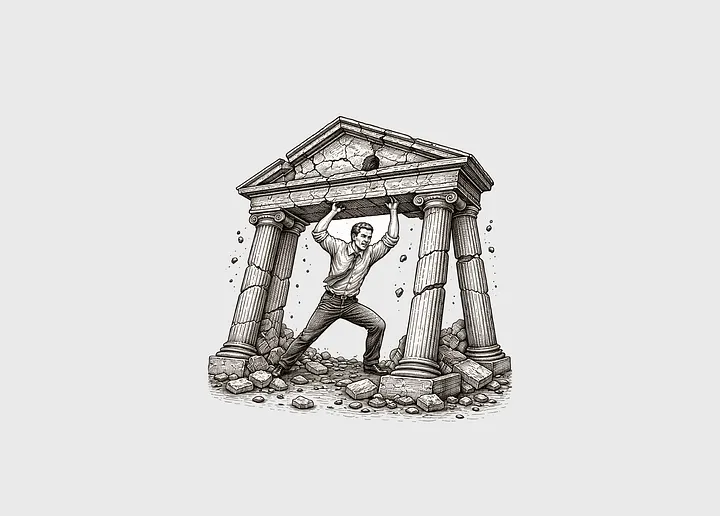
Static Movement
A team can go months without shipping anything new and still be the only reason the system is standing. From the outside, it looks like stagnation. From the inside, it’s containment.
When a team enters survival mode, progress disappears. Work that leaves no visible trace is mistaken for inactivity. The result is always working at a loss: burnout, constant pressure, and teams judged by what they don’t deliver, when in reality they are preventing collapse.
Internal Bleeding
The most dangerous wounds are the ones you can’t see.
A system can look stable while bleeding internally. It rewards what is visible and punishes what it doesn’t yet understand.
Houses are not built on mud. First, the ground is studied and the foundations are laid. Otherwise, problems don’t appear at the beginning. They appear later, when fixing them is already expensive.
Bad decisions trap teams in permanent reaction mode. They put out bugs born from past decisions because if they stop doing so, the project collapses. That work leaves no trace of progress. It doesn’t score points, but it prevents losses.
The Same Person Always Pays
No one values what you do until you stop doing it.
Prevention is invisible work. It is only recognized when it fails. The false dichotomy between moving forward and stabilizing comes from metrics that confuse novelty with value.
Metrics are a double-edged sword. With context, they align teams. Without understanding, they break them. The engineer who keeps the system afloat is the one expected to respond when something fails, while the system rewards whoever leaves visible traces, even if nothing actually moved.
The real cost of not investing in removing the root cause of the fire is not just economic. It is human. Burned-out talent, failed projects, and bad decisions made in silence, protected by a measurement system that never learned where to look.
Repeating an Error Is Not a New Error
Metrics are not neutral. Ignoring that is a choice. Rewarding visibility is a decision.
Nothing is more draining than knowing which problem needs to be solved and being forced to choose between solving it or surviving the incentive system. The work that holds the project together doesn’t need applause. It needs protection.
Watching signals is not leadership. It is reaction. What you reward gets repeated. What you punish disappears.
More in startup
Venture
Write for entrepreneurs, founders, and builders.
Share startup lessons, growth tactics, and founder stories with readers on the same journey.
One free account across In Plain English, Stackademic, Venture, and Cubed.
How it works- Startups & entrepreneurship
- Marketing & growth
- Productivity & leadership
- Founder stories & lessons learned
Sign in
Google or GitHub
Complete profile
Takes a few minutes
Get approved & publish
Start sharing
Why write for Venture?
Entrepreneurship is rarely a straight path. The lessons worth sharing are learned while building.
Frequently Asked Questions
Common questions about this topic
What does 'static movement' describe in a team context?
'Static movement' describes a situation where a team ships little or nothing publicly for months yet remains essential to keeping the system running by containing failures and preventing collapse.
Why can a team that appears inactive actually be doing critical work?
A team that appears inactive may be preventing system collapse by doing invisible containment and stabilization work that leaves no visible traces but is necessary for the system to continue operating.
What is meant by 'internal bleeding' in a system?
'Internal bleeding' refers to hidden, accumulating problems within a system that are not visible externally, are rewarded or ignored by existing incentives, and later become expensive and difficult to fix.
How do bad past decisions affect teams according to the content?
Bad past decisions trap teams in perpetual reaction mode, forcing them to spend effort fixing recurring issues born from those decisions, which prevents forward progress and leaves no visible progress to be rewarded.
What is the core problem with treating prevention as invisible work?
Treating prevention as invisible work causes it to be undervalued until it fails, concentrates reactive burdens on the same individuals, contributes to burnout, and allows measurement systems to miss the true sources of value and risk.
How do metrics influence team behavior in the described scenarios?
Metrics influence behavior by rewarding visible outputs and novelty while punishing unseen stabilization work; with context they align teams, but without understanding they break teams by incentivizing the wrong activities.
What consequence arises when organizations reward visibility over stability?
When organizations reward visibility over stability, people prioritize work that leaves visible traces, recurring root causes remain unaddressed, the same individuals repeatedly bear the burden of firefighting, and long-term costs—human and economic—accumulate.
What does the phrase 'the same person always pays' convey?
The phrase means that the individuals doing preventive and containment work repeatedly shoulder the cost—emotional, workload, and career recognition—because their contributions are overlooked until something breaks.
Why is repeating an error not considered a new error in this discussion?
Repeating an error is not a new error because metrics and incentives can cause the same preventable problems to recur; rewarding visible reactions rather than addressing root causes guarantees repetition rather than genuine resolution.
What distinguishes watching signals from leadership in the described situations?
Watching signals is characterized as reactive behavior that responds to visible metrics, whereas leadership would involve protecting and investing in the invisible work that prevents failures and addresses root causes.
Comments
Loading comments…