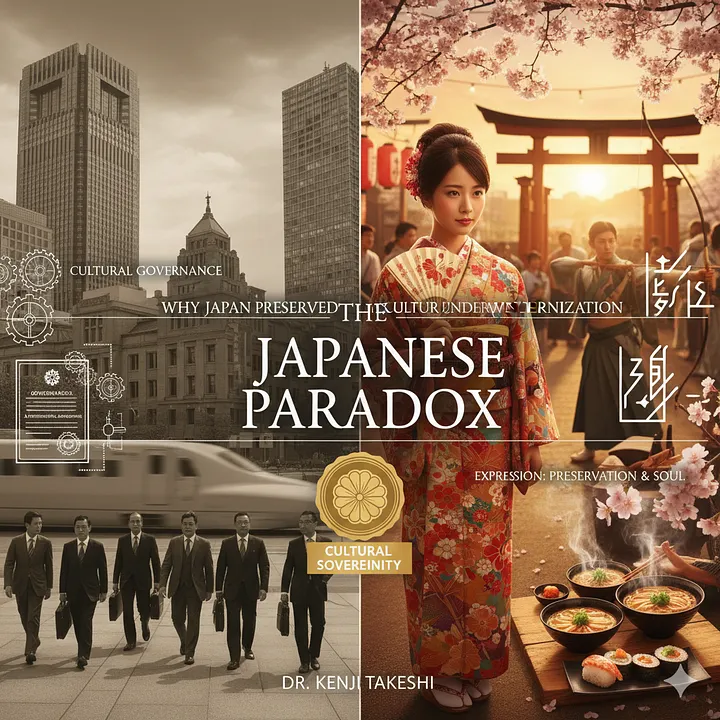
Japan was able to preserve its own culture despite deep institutional and material Westernization because it clearly separated, and deliberately loosened, the relationship between cultural expression and cultural governance.
Let me first clarify these two terms: cultural expression and cultural governance.
Cultural expression refers to how a culture manifests itself through art and traditional knowledge, such as language, music, musical instruments, clothing, cuisine, architecture, festivals, and traditional crafts.
The Japanese are exceptionally skilled at preserving and protecting this expressive layer of culture. Practices such as the tea ceremony, kyūdō (archery), kimono, summer festivals, and culinary traditions like sashimi and sushi all belong to this domain of cultural expression.
Cultural governance, by contrast, refers to how a culture organizes society at the level of power, institutions, and decision-making: how resources are allocated, rules are formulated, conflicts are resolved, and, most importantly, who has the authority to define legitimacy.
It includes, but is not limited to:
Political systems, legal frameworks, bureaucratic structures, military organization, education systems, modes of economic operation, and mechanisms for absorbing foreign knowledge and technology.
In other words, cultural governance is not about what we wear, what we eat, or how we celebrate festivals.
It is about who decides, by what rules, and how a society responds when external shocks arrive.
Opening Governance, Guarding Expression
The key reason Japan retained its cultural identity during intense Westernization lies here:
They opened the governance layer with extreme pragmatism, while guarding the expressive layer with equal conservatism.
Since the Meiji Restoration, Japan’s attitude toward Western institutions has never been romantic or blind, it has been highly instrumental. Japan adopted Western-style constitutions, modern bureaucratic systems, military structures, industrial frameworks, and education systems.
It allowed Western suits to replace samurai attire as the everyday clothing of officials. It made parliaments, courts, and modern corporations the core mechanisms of state operation.
But this never meant that Japan sought to become “Western in spirit.”
On the contrary, Westernization at the level of cultural governance was, in essence, a form of institutional armoring for survival.
What was firmly preserved was the expressive layer of culture, language, etiquette, rhythm, aesthetics, embodied skills, symbolic systems, and the deeply internalized “Japanese sense of order” embedded in daily life.
Crucially, Japan never allowed foreign institutions to acquire interpretive authority over its culture.
Even when institutions were imported from the West, they had to be retranslated, re-embedded, and domesticated before they could function within Japanese society.
Institutions could be foreign in origin, but their mode of operation had to be Japanese.
A Stable Paradox
This explains a phenomenon that appears contradictory yet remains remarkably stable:
At the level of cultural governance, Japan possesses Western-derived modern constitutionalism, capitalism, and a highly industrialized social structure.
Yet at the level of cultural expression, it retains a distinctly non-Western cultural temperament, where kimono, matcha, and tatami are not museum artifacts, but everyday presences integrated into life.
For Japan, institutions are tools; culture is not.
Japan learned from others at the level of governance in order to avoid being governed by others. It preserved cultural expression to ensure that the question “Who are we?” was never outsourced.
This clear distinction between what can change and what must not allowed Japan to maintain agency in its encounter with Western modernity.
Japan was not an object shaped by modernization; it was an operator of modernization.
Why Many Non-Western Societies Did the Opposite
This leads to a critical question: Why did so many non-Western societies make the exact opposite choice? The answer is not complicated: they mistakenly bound cultural dignity to the governance layer, rather than the expressive layer.
In many non-Western societies, culture is understood as an unquestionable source of ruling legitimacy. Once governance structures are questioned, revised, or replaced by foreign institutions, it is perceived as “cultural destruction,” “betrayal of ancestors,” or “loss of subjectivity.”
As a result, political systems, religious laws, and power structures become sacralized. Reform ceases to be a technical issue and becomes a moral betrayal.
This produces a structural consequence:
Reform and progress at the governance layer are frozen, while cultural expression becomes commodified.
In such societies, we often observe:
Traditional clothing reduced to stage performances or tourist symbols; Languages marginalized until only slogans remain; Festivals preserved merely as decorative legitimations of authority;
Cuisine, music, and crafts are packaged as “cultural exports,” yet detached from the actual order of daily life.
Culture still “exists,” but no longer possesses the power to organize life.
Meanwhile, the true centers of power, law, education, military, bureaucracy, and resource allocation, are declared “untouchable core values.”
This lies at the heart of the modernization dilemma faced by many non-Western societies:
They protect what should never have been sacralized (governing power), while sacrificing what most effectively carries cultural vitality (cultural expression).
Japan’s path worked precisely because it did the reverse:
Governance was treated as a tool that could be learned, adjusted, or replaced; Cultural expression was treated as an existential foundation that could not be easily surrendered.
Resistance to institutional reform in many non-Western societies does not stem from ignorance of modern systems, but from fear: once governance loosens, existing power structures lose their claim to “heavenly mandate.”
Thus, “anti-Westernization” becomes a language of rule, and “cultural defense” becomes a moral shield against reform.
This also explains why modernity often appears in distorted form in these societies:
Institutions look traditional but fail to function; Culture appears abundant but gradually hollows out.
They are not rejecting the West, they are rejecting the loss of monopoly over governance.
The result is stagnation:
Rigid governance unwilling to devolve power into genuine rule of law or democratic sovereignty; Bleeding cultural expression overwhelmed by Western material prosperity; A society trapped in an in-between state, unable to move forward, yet unable to retreat.
This is not a victory of cultural conservatism, but a manifestation of institutional fear.
Cultural Sovereignty Lies in Interpretation, Not Governance
This brings us to a broader conclusion, one that is clear, yet often overlooked:
True cultural sovereignty does not depend on clinging to a particular governing system. It depends on whether a society still holds the power to interpret itself.
Governance systems can be learned, borrowed, transplanted, or even forcibly replaced.
But whether a civilization is still alive depends on whether it can still answer these questions:
What is reasonable for us? What constitutes a legitimate way of life? Which changes are acts of absorption, and which are acts of self-dissolution?
The answers to these questions are not found in constitutional clauses or institutional designs, but in interpretive authority.
When a society loses interpretive power, familiar patterns emerge:
Foreign concepts are automatically labeled “progress”; Local practices must justify themselves using others’ languages; Culture can no longer explain itself, it can only be translated, evaluated, and ranked.
At that point, even if governance still bears the name of “tradition” or “local identity,” it is merely hollow sovereignty.
Japan did not retain itself because it rejected Western institutions, but because it never outsourced the question of how Japan should be understood.
Institutions could be Western, but the meaning had to be decided by the Japanese themselves.
By contrast, what many non-Western societies have truly lost is not institutional sovereignty, but interpretive sovereignty.
They sacralize governance while rejecting reform, yet unconsciously accept others’ definitions of their own culture.
The result is clear:
Institutions that cannot function, Cultures that cannot renew themselves, Societies oscillate endlessly between resistance and imitation.
Cultural sovereignty has never been a question of whether to modernize.
It is a question of who has the authority to define what modernization means for us.
As long as a culture can understand the world in its own language, absorb shocks, and choose transformation, it retains sovereignty.
Once it can only understand itself through others’ frameworks, Then, no matter how “local” its form appears, it has already been hollowed out.
The real crisis is never that institutions are rewritten, But that interpretive authority is taken away, And no one even realizes it.
#CulturalSovereignty #InterpretivePower #ModernizationAndCulture #NonWesternModernity #CivilizationalAnalysis
More in culture



Venture
Write for entrepreneurs, founders, and builders.
Share startup lessons, growth tactics, and founder stories with readers on the same journey.
One free account across In Plain English, Stackademic, Venture, and Cubed.
How it works- Startups & entrepreneurship
- Marketing & growth
- Productivity & leadership
- Founder stories & lessons learned
Sign in
Google or GitHub
Complete profile
Takes a few minutes
Get approved & publish
Start sharing
Why write for Venture?
Entrepreneurship is rarely a straight path. The lessons worth sharing are learned while building.
Frequently Asked Questions
Common questions about this topic
What is meant by cultural expression?
Cultural expression refers to how a culture manifests itself through art and traditional knowledge, including language, music, musical instruments, clothing, cuisine, architecture, festivals, traditional crafts, embodied skills, etiquette, rhythm, aesthetics, and symbolic systems.
What is meant by cultural governance?
Cultural governance refers to how a culture organizes society at the level of power, institutions, and decision-making, including who has authority to define legitimacy, how resources are allocated, how rules are formulated, how conflicts are resolved, and mechanisms for absorbing foreign knowledge and technology; it encompasses political systems, legal frameworks, bureaucratic structures, military organization, education systems, and modes of economic operation.
How did Japan manage Westernization differently at the levels of governance and expression?
Japan opened and adopted Western-style institutions pragmatically—reforming governance with constitutions, modern bureaucracy, military structures, industrial frameworks, and education—while deliberately preserving and guarding cultural expression such as tea ceremony, kyūdō, kimono, festivals, cuisine, language, etiquette, and everyday aesthetics.
Why did Japan allow foreign institutions but retain its cultural identity?
Japan permitted foreign institutions only after retranslation, re-embedding, and domestication so that institutions could be foreign in origin but operate in a Japanese mode; this ensured that interpretive authority over culture remained Japanese and preserved the question of 'Who are we?'
What does it mean that 'institutions are tools; culture is not' in the Japanese context?
It means that governance structures were treated as learnable and adjustable instruments for survival and modernization, whereas cultural expression was treated as an existential foundation that should not be surrendered or outsourced to foreign interpretive authority.
What mistake did many non-Western societies make regarding culture and governance?
Many non-Western societies mistakenly bound cultural dignity to the governance layer—sacralizing political systems, religious laws, and power structures—while allowing cultural expression to be commodified and detached from everyday life.
What are the observable consequences when cultural dignity is tied to governance rather than expression?
Consequences include frozen reform at the governance layer, traditional clothing becoming stage or tourist symbols, languages marginalized to slogans, festivals reduced to decorative legitimations of authority, cuisine and crafts turned into exports detached from daily life, institutions that look traditional but do not function, and culture that appears abundant but is hollowed out.
What is interpretive authority and why is it central to cultural sovereignty?
Interpretive authority is the power to define what is reasonable, what constitutes a legitimate way of life, which changes are absorption versus self-dissolution, and generally how a society understands and explains itself; cultural sovereignty depends on retaining that authority rather than clinging to a particular governing system.
How does losing interpretive authority manifest in a society?
Losing interpretive authority manifests as automatically labeling foreign concepts 'progress,' requiring local practices to justify themselves using others' languages, culture being translated, evaluated, and ranked instead of explaining itself, and governance becoming hollow sovereignty even if local forms remain.
What is the core reason Japan retained cultural sovereignty during modernization?
Japan retained cultural sovereignty because it never outsourced the question of how Japan should be understood; it learned and adopted institutions pragmatically while ensuring the meaning and mode of operation of those institutions remained Japanese through domestic interpretive authority.
What is the underlying problem described as 'institutional fear' in non-Western modernization?
Institutional fear is the phenomenon where existing power structures resist governance reform because loosening governance threatens their claim to legitimacy or a 'heavenly mandate,' leading to sacralization of governance, resistance to reform, and the hollowing out of cultural expression.
What defines whether modernization preserves or hollows out a culture?
Modernization preserves culture when a society retains the authority to interpret itself and decide what modernization means for it; modernization hollows out culture when interpretive authority is lost and culture can only be understood through others' frameworks.




Comments
Loading comments…