Accounts Receivable (AR) Automation Software: The 10 Best Platforms for Q4 2026
Stop chasing cash. Explore Q4 2026’s top 10 AR automation tools to decode customer replies, conquer AP portals, and master cash application.
20 min readNeville Naidoo
What AR automation software does after an invoice goes out, and the terms and checks a first-time buyer needs this quarter
B2B organizations often watch earned revenue linger in transit for extended periods following invoice issuance, primarily due to manual payment matching and repetitive PDF resubmissions. Accounts receivable (AR) automation software addresses this specific post-invoicing operational gap. Unlike foundational accounting platforms that merely log a sale and conclude their function, specialized AR software actively manages receivables through to final settlement.
Key takeaways
- Most AR work is still manual: PYMNTS Intelligence reported in April 2026 that 83% of firms have yet to fully automate their AR operations.
- Replies decide how fast cash arrives: Reminders get noticed, and the bigger gains come from software that reads the customer's answer and acts on it.
- Demo against your own exceptions: Bring a blank-memo wire and a rejected portal invoice, and judge each platform by what it does with them.
Understanding What Accounts Receivable (AR) Automation Software Is
Accounts Receivable (AR) automation software runs the receivables tasks that start once an invoice leaves your system and end when its payment posts. It delivers invoices, files them in customer AP portals, follows up on open balances, sorts out disputes and matches payments to open invoices.
Early tools swapped hand-written reminders for scheduled sequences. Newer platforms, many built after large language models arrived, read what the customer writes back and propose cash matches with their reasoning, since a stalled invoice more often waits on a question than on a reminder. Several AI-first platforms take this even further.
The software runs on top of your ERP and CRM. Contract-first platforms model each customer's billing terms before collections begin, while invoice-first platforms start from invoices already in your ERP and need less setup.
Where AR automation sits in invoice-to-cash
The invoice-to-cash workflow spans six distinct phases, each vulnerable to manual operational friction. According to research published by PYMNTS Intelligence in June 2025, fully 35% of mid-sized organizations relied exclusively on manual processes to navigate these stages.
| Stage | What goes wrong by hand | What the software does |
|---|---|---|
| Invoice delivery | Invoices miss required PO numbers or land with outdated contacts | Ensures correct reference data accompanies every billing transmission |
| AP portal submission | Portal rejections in systems like Ariba or Coupa go unnoticed for weeks | Automates portal filing and continuously tracks post-submission status |
| Collections follow-up | Manual outreach is delayed, leaving smaller accounts unaddressed | Executes rule-based follow-ups and leverages AI agents to handle incoming customer replies |
| Replies and disputes | Customer inquiries and short-pay disputes stall in unmonitored inboxes | Categorizes incoming correspondence and escalates unresolved disputes to team members |
| Cash application | Unidentified wire payments sit unapplied while staff manually determine remittance details | Reconciles incoming payments with open invoices and provides rationale for flagged edge cases |
| Reporting and forecasting | Aging records and DSO tracking remain confined to static monthly spreadsheets | Delivers continuous DSO updates and generates cash flow forecasts based on historical payment patterns |
AR terms worth knowing
Days sales outstanding (DSO): The average timeframe, measured in days, between issuing an invoice and collecting the corresponding funds.
Cash application: The process of reconciling incoming payments against outstanding billing records and recording entries into the general ledger.
Remittance: Documentation supplied by a buyer that specifies which invoices are covered by a transaction.
AP portal: A buyer-side procurement platform, such as SAP Ariba or Coupa, requiring vendor submission of invoices prior to payment processing.
Dunning: Automated or scheduled communications dispatched to remind buyers of upcoming or overdue balances.
Promise to pay: A formal acknowledgment from a customer specifying an agreed payment amount and targeted transfer date.
Short pay: A payment received for less than the total invoice value, often resulting from transaction fees, early payment discounts, or line-item disagreements.
Dispute: An official objection raised by a buyer regarding billing terms or fulfilled orders, suspending payment until resolved.
What to look for in AR automation software
Because the Federal Reserve held the federal funds target at 3-3/4 to 4 percent on Oct. 28, 2026—with two committee members favoring a 25-basis-point increase—carrying uncollected receivables will maintain its financial cost heading into 2027.
Cash application that shows its reasoning
Evaluate what percentage of transactions the platform reconciles without human intervention and how performance evolves past initial setup. Effective solutions present transparent reasoning for every match and maintain audit-compliant tracking. Request a live demonstration of matching an unannotated wire payment from every vendor under evaluation.
Collections that read and answer replies
Outstanding balances frequently stall when customers request tax forms or line-item clarifications. Determine whether the platform autonomously processes these replies or merely logs incoming messages, and clarify which automated actions require internal authorization.
AP portal submission and monitoring
Verify whether the platform automates invoice placement inside customer procurement portals and inquire about its verification frequency following upload. Identifying a submission rejection within a day minimizes payment delays far more effectively than discovering it weeks later.
Controls on every AI action
Automated agents communicating with clients require strict operational controls: programmatic rules must audit every outward action before customer dispatch or ledger posting, backed by comprehensive logging for financial controllers.
ERP and CRM fit, and time to go live
Confirm which ERP systems the solution reads from and syncs data back to, assessing CRM compatibility as a distinct requirement. Ensure the vendor provides a binding timeline for full deployment.
Reporting and forecasts tied to payment behavior
Aging schedules and DSO metrics must update dynamically without requiring manual data exports. Furthermore, cash forecasting should draw from actual historical buyer payment trends rather than relying solely on stated due dates.
The 10 best AR automation platforms
We reviewed each platform's product, integration and security pages, its pricing page where one exists, and its G2 reviews as of November 2026; capabilities are as each vendor describes them unless marked otherwise.
1) Monk
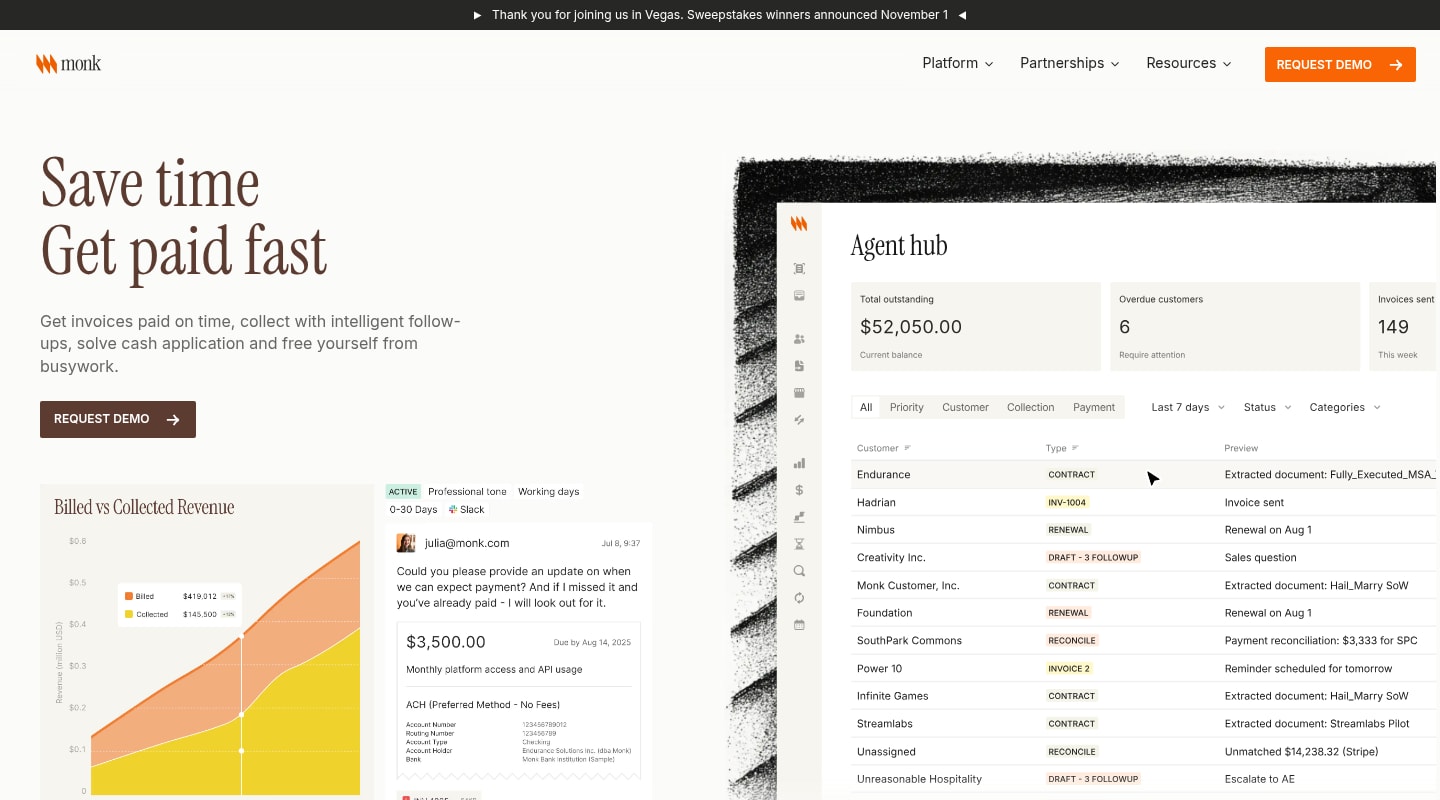
Serving B2B organizations ranging from Series A startups to Fortune 500 enterprises, Monk is an AI-native accounts receivable platform that consolidates AP portal submission, collections outreach, and cash application into a single solution. Its Intelligent Cash Application module processes exact matches with 100% confidence without using LLMs, while applying custom rules (many recommended by the system). For unannotated wire transfers or complex multi-invoice payments, an LLM layer analyzes details and proposes matches alongside confidence scores and supporting rationale. Monk achieves an 80% fully automated match rate, increasing to 95% with suggested rules, and maintains complete audit trails for all operations.
Rather than relying on static contact schedules, Intelligent Collections actively interprets and responds to customer replies. Julia, Monk's AI email agent, can attach requested W-9 forms within existing email chains or identify alternative contacts when messages bounce. Meanwhile, Ryan, Monk's AI voice agent, manages phone outreach. Both agents route complex cases to staff via Playbooks that govern communication tone and timing rules. Monk resolves 87% of collections with zero human intervention, delivering response rates 24% higher than traditional dunning. The platform also integrates with over 600 AP portals, conducting daily status checks and flagging invoice rejections for attention; across its user base, Monk uploads 87% of portal invoices autonomously, with its team handling the exceptions for the 92% of enterprise invoices requiring portal submission.
Every AI-driven operation passes through rule-based code validation before reaching customers or updating ledgers, with full activity logging. Financial dashboards update DSO, cash balances, and aging metrics in real time while tailoring forecasts to individual buyer payment habits. Monk integrates natively with SAP S/4HANA, Oracle Fusion Cloud and E-Business Suite, Workday, Microsoft Dynamics 365, NetSuite, Sage Intacct, Infor, Epicor, JD Edwards, Acumatica and more. Teams go live on Monk in under a month.
Security standards include active SOC 2 Type II and ISO 27001 certifications, backed by a strict policy that customer data is never used for AI model training. Each customer gets a dedicated team: Account Strategist, Collections Lead, Implementation Engineer and AI Systems Lead, backed by a U.S.-based team you can call on a weekend. Users experience an average 37% increase in cash on hand in month one; for instance, Profound achieved a +122% cash on hand in month one while automating 11 bespoke AP portals. Pricing scales with business volume and isn't a percentage of collections.
2) HighRadius
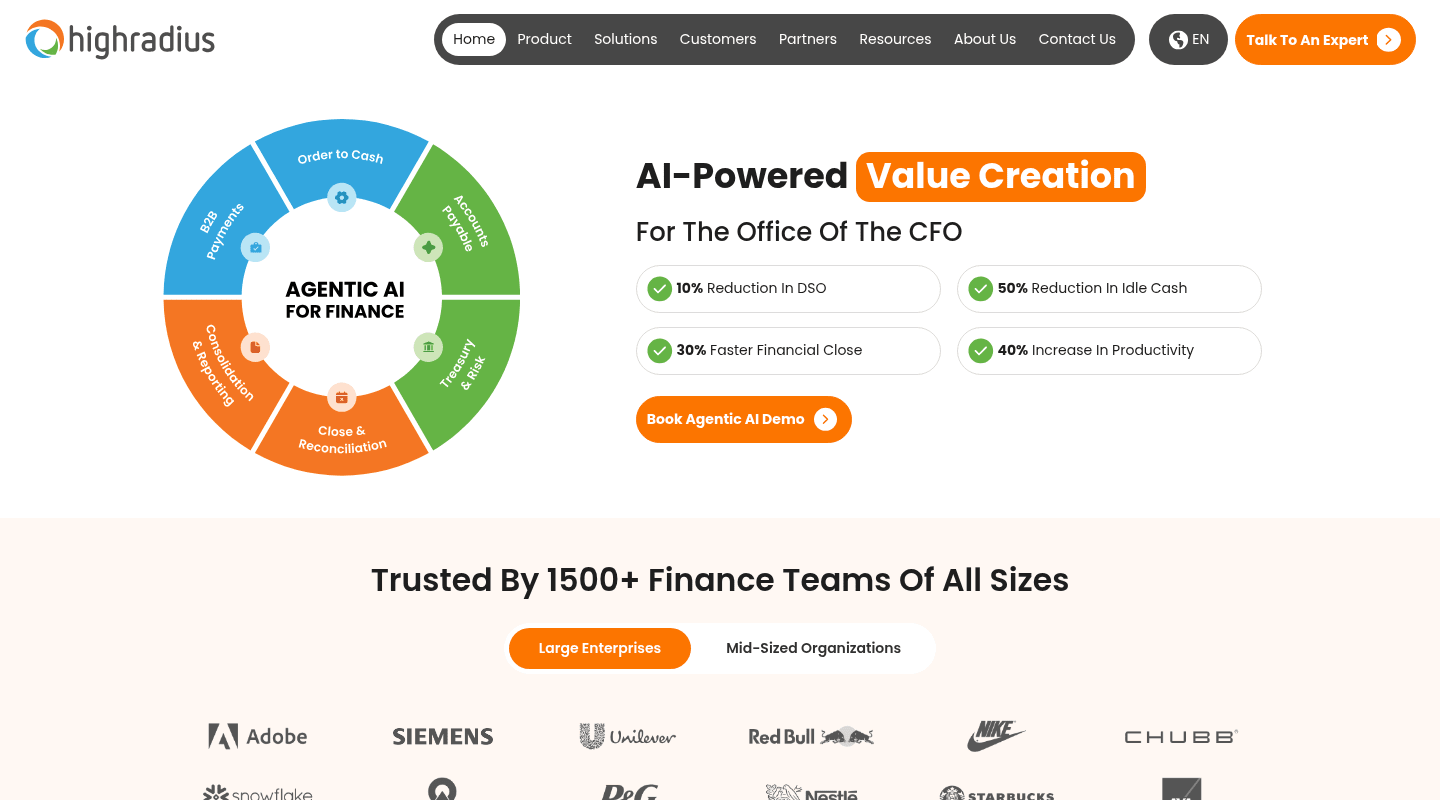
HighRadius provides an autonomous finance ecosystem designed for CFO teams, offering accounts receivable automation as one component alongside dedicated modules for treasury, payables, and financial close operations. The vendor deploys over 190 AI agents across its order-to-cash applications and holds recognition in Gartner's Voice of the Customer for invoice-to-cash solutions. Its key differentiators include extensive experience supporting enterprise operations across complex multi-ERP environments and a broad global partner network. HighRadius offers 50+ pre-built ERP integrations, with its RadiusOne AR solution holding official Built for NetSuite verification for mid-market clients.
The platform uses an outcome-aligned pricing model featuring $0 upfront implementation fees coupled with a gain-share fee structure activated upon deployment. Security credentials encompass ISO/IEC 27001:2022, SOC 1, SOC 2 Type 2, SOC 3, and PCI DSS compliance. Across 238 reviews on G2, HighRadius maintains a 4.3 out of 5 rating, with users highlighting its cash application matching capabilities as a core strength.
Potential limitations center on deployment timelines and collections automation depth. Collections features outlined on its site emphasize prioritized task worklists and built-in agent dialers, without detailing an agent capable of managing end-to-end customer email dialogues. While an AP Portal Automation agent is listed in its product suite, HighRadius does not publish supported portal totals or checking frequencies. The company targets measurable results within six months of deployment; however, G2 feedback indicates an average implementation period of eight months, with "Poor Customer Support" listed as the most frequent critical tag. Additionally, reviewers note that data synchronization relies on batch processing rather than immediate real-time updates.
3) Billtrust
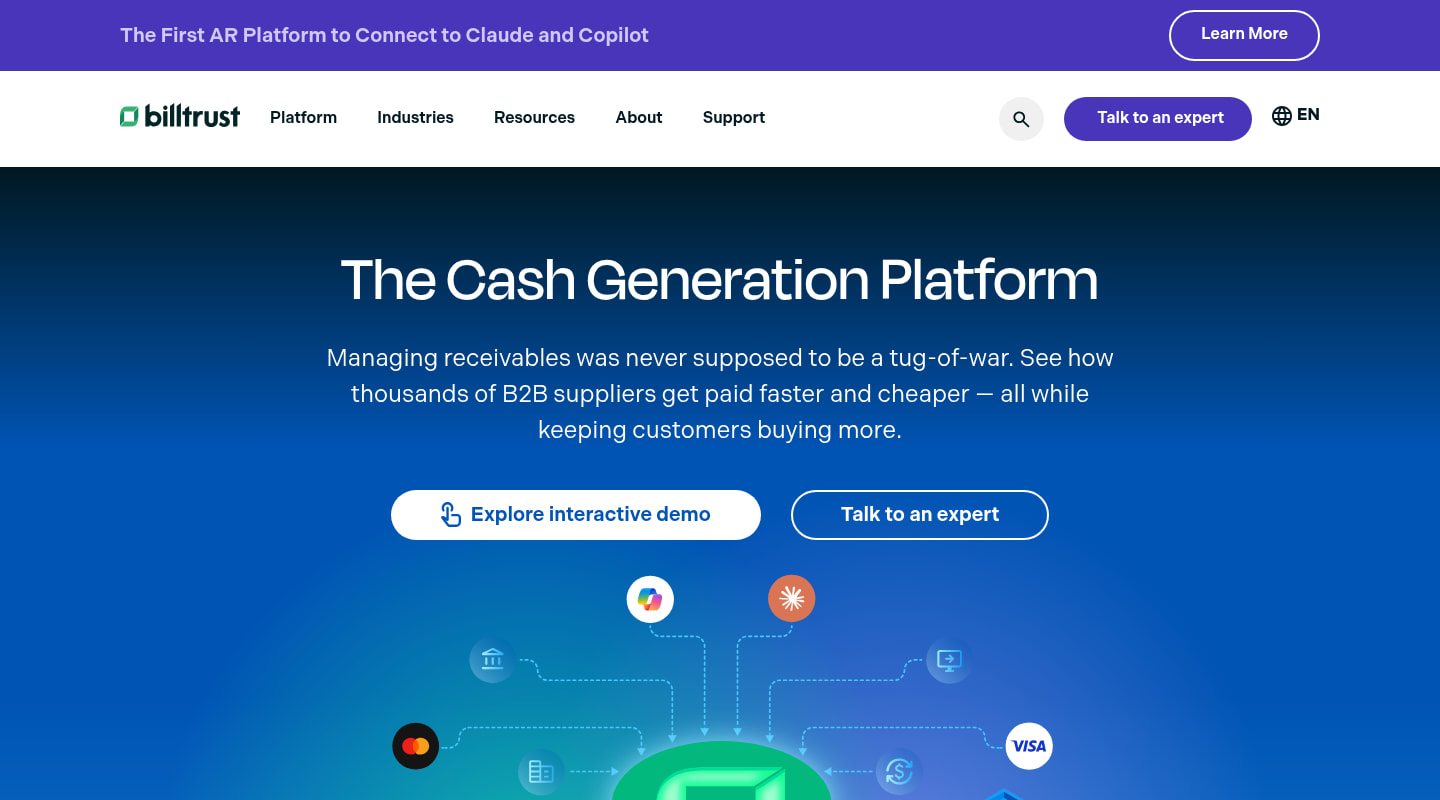
Billtrust describes itself as a B2B cash generation platform, with invoicing, payments, credit, collections and cash application in one suite and a buyer network it puts at 13M+ buyers. It holds as much ground in B2B payments and customer portals as anyone in the category, backed by ERP and channel partnerships that go back years. It lists 200+ connectors to ERPs and banks, NetSuite and SAP among them, and a Services arm handles implementation and custom integrations.
On the receivables side, Billtrust publishes 260+ AP portal integrations and cash application match rates of 95%+. Its Agentic Email feature lets you choose which requests the Collections Email Responder answers on its own, and messages that need a person arrive as drafts for a collector. Agentic VoIP summarizes and documents the calls human collectors make. Billtrust says each AI recommendation carries its reasoning and a confidence score. G2 shows 4.4 out of 5 from 515 reviews, with ease of use as the most-tagged pro by a wide margin.
Timing and follow-through are the gaps to probe. Billtrust doesn't publish a go-live time; its medical industry page features Össur with a six-month implementation, and G2 reviewers average five months. A cadence for checking portal invoices after submission isn't published either, and its trust page cites SOC 1 and SOC 2 reports without naming the type. Reviewers also mention slow loading and reporting that needs an Excel export for custom views.
4) Versapay
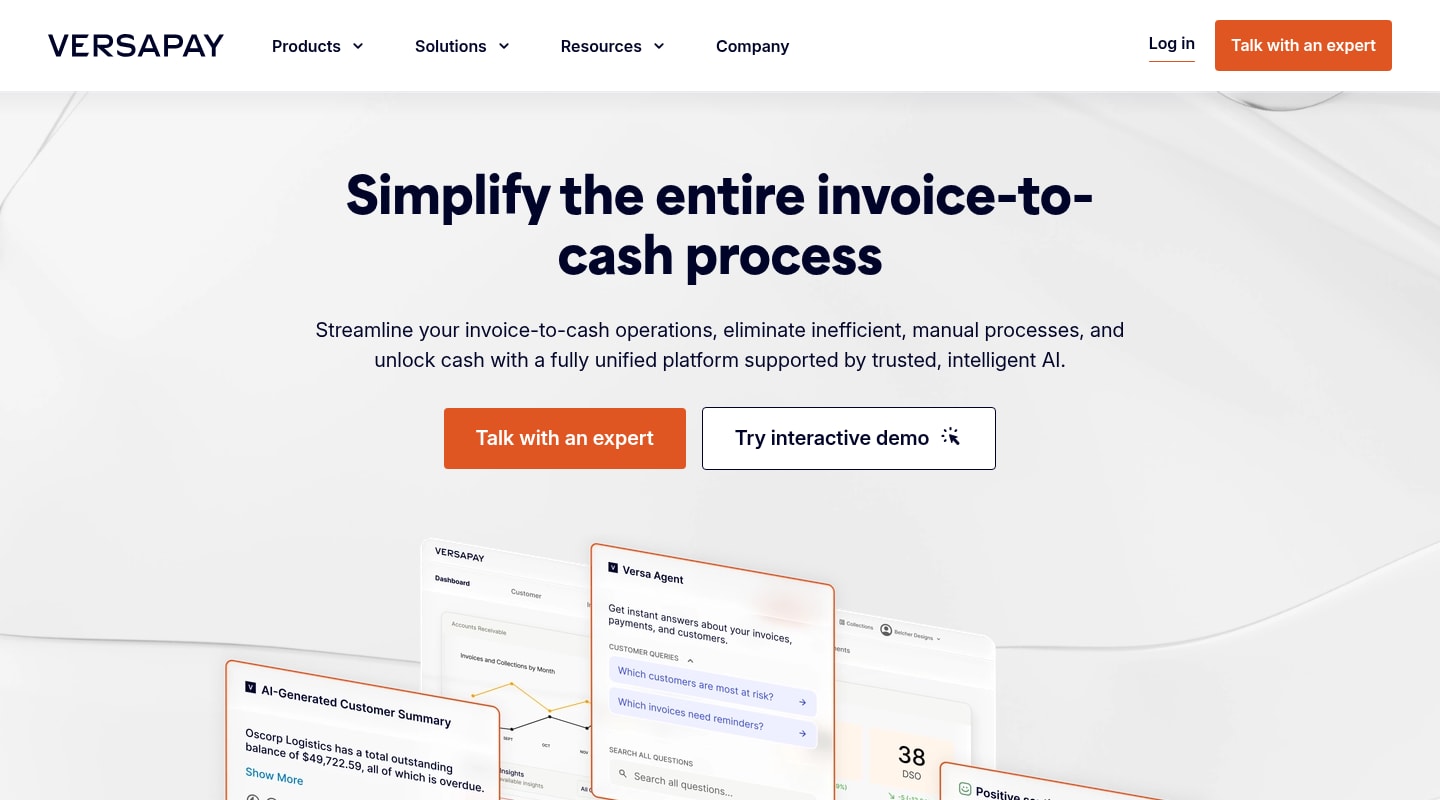
Versapay pairs AR automation with its own payment processing. Buyers use a collaborative portal to pay invoices and raise disputes, and Versapay says it processes $257B in payments a year for 10,000+ customers. Its supplier portal lets your AR team comment on invoices alongside customers. Its payments footprint and ERP partnerships run deep: it holds Built for NetSuite certification and offers built-for connectors for Dynamics 365 and Sage Intacct. Each rollout gets a dedicated implementation specialist and a customer success manager.
Versapay Intelligence lays out four stages of AI autonomy, and at the top stage agents coordinate within permissions the customer grants. The live pieces today include Versapay Assistant and real-time sentiment scoring, next to machine-learning cash application. Collections outreach runs on 100+ configurable dunning notifications, and reviewers say customers stop asking for invoice copies once they use the portal. Its security documents cover SOC 1 Type 2, SOC 2 Type 2, SOC 3 and PCI DSS, and G2 reviewers single out its NetSuite integration.
Portal coverage is the open question. AP portal invoice submission isn't described on Versapay's site, and it doesn't publish a cash application match rate. Its own guide says a migration from another AR tool "can take as little as 90 days," while G2 reviewers average four months. Versapay rates 4.1 out of 5 from 101 G2 reviews. Payment issues are the top complaint tag, and several reviewers describe trouble reaching the right support team.
5) Esker
Esker markets an agentic AI suite to CFO teams covering both order-to-cash and source-to-pay, and buyers can license its AR modules one at a time. The company has operated for about four decades from Lyon in France, and Gartner placed it among the Leaders for invoice-to-cash applications in 2024. Its strengths are ERP scale and long experience: it lists 70+ ERP integrations and trains its own model, Esker Synergy AI.
Esker's invoice delivery page puts its supported AP portals at 300+, Coupa and Ariba among them, with real-time status tracking on each submission. For deductions, RPA bots pull supporting documents and dispute specific deductions in retailer and carrier portals, while Synergy AI matches deductions to promotions and payments. Its security datasheet names ISO 27001 and SSAE 18 / ISAE 3402 Type 2.
The collections design keeps people at the center. Esker describes AI predictions and risk analysis that help collectors prioritize, plus promise-to-pay tracking, and an agent that handles customer replies end to end isn't described on its pages. Go-live time isn't published, and G2 reviewers average six months. One verified reviewer wrote that configuration "can be complex and may require specialist knowledge." Esker holds 4.4 out of 5 on G2 across 60 reviews, many of them about AP rather than AR.
6) Quadient AR
Quadient AR, which grew out of YayPay, is the receivables module in Quadient's wider suite, combining cash application, credit decisions, collections, dispute tracking and customer payments. Its communications heritage shows in delivery, since invoices and reminders go out in print or digital channels by customer preference. Quadient says more than 2,100 finance teams use it and reports a 34% average DSO reduction. Prebuilt connectors cover NetSuite, SAP, Microsoft, Sage and Acumatica, among others.
Its newest agentic AI feature reads incoming AR emails and prepares the next action for review. Collections workflows run on triggers that send reminders and escalate on the rules you configure. Quadient claims forecasting accuracy of up to 94% and ships 10 releases a year. It states an average implementation of 72 days, and G2 reviewers average three months. Its trust matrix for AR lists ISO 27001:2022 and related ISO standards, plus SOC 2 and PCI DSS.
Review-first AI is the trade-off here. The agent prepares each action, so a person still approves the next step before it goes out. AP portal submission isn't described on its site. On G2, where it scores 4.4 from 156 reviews, users credit the communication trail that keeps each customer's invoices and remittances in one place. One G2 reviewer noted that you don't pay per user. A director of global credit and collections said it "can feel clunky," and other reviewers report customer replies landing on the wrong account.
7) Upflow
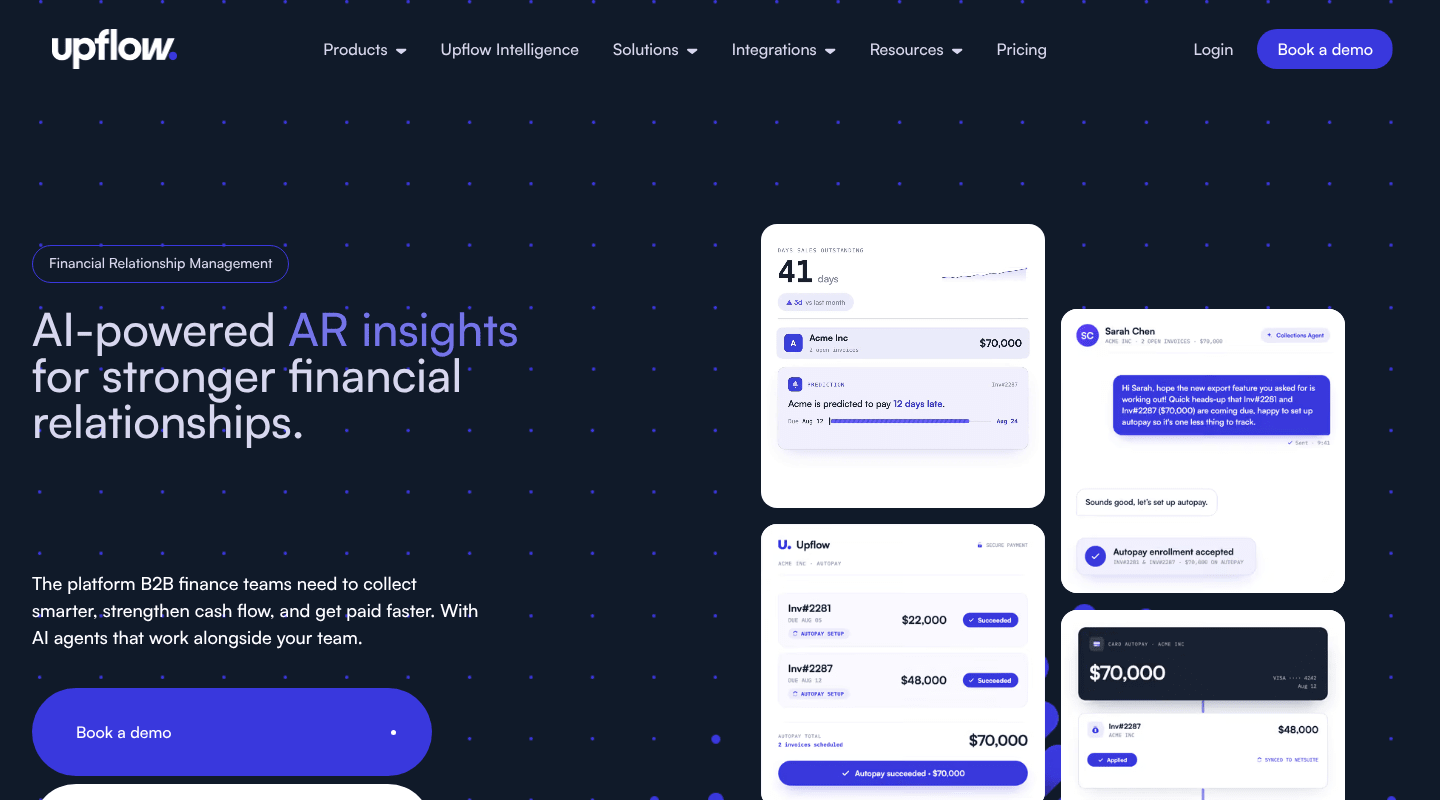
Positioning its solution as a financial relationship management platform, Upflow delivers four core modules: Insights, Collections, Payments, and Cash App, each incorporating AI agents designed to assist finance staff. Upflow holds official NetSuite SuiteApp status with real-time two-way synchronization and ledger write-back, while also connecting directly with QuickBooks Online, Xero, Sage Intacct, and Business Central. On G2, the platform earns a 4.8 out of 5 rating across 236 user reviews, with feedback highlighting its automated dunning workflows and rapid initial setup.
Subscription pricing is calculated based on annual invoiced volume, offering unlimited user seats and customized tier quotes. Advanced AI features are introduced across specific plan levels: the AP Portal Agent and Collections Agent become available at the Scale tier (for companies managing up to $50M in invoiced volume), while the Cash Application Agent—which Upflow states achieves a 98% auto-match rate—is included at the Accelerate tier (up to $100M). Autonomy settings for the Collections Agent can be adjusted from basic suggestions to full operational independence. Furthermore, the Insights Agent supports AR analytics within ChatGPT and Claude through an integrated MCP server. Upflow maintains SOC 2 Type 2 compliance and provides dedicated onboarding support starting at the Grow tier.
Buyers should evaluate feature availability across subscription tiers prior to scheduling demonstrations, as specialized agents require higher-level plans. Upflow does not specify the total number of supported portals for its AP Portal Agent, and phone communications are billed on a usage basis without native voice AI functionality. Deployment timelines are not explicitly stated, though the vendor notes teams can initiate collection activities while initial data syncing occurs. User reviews occasionally cite reporting constraints, with feedback characterizing standard reports as somewhat rigid.
8) Invoiced
Marketed as AI-native invoice-to-cash software, Invoiced by Flywire leverages Flywire's global payment infrastructure, which processes $37.5B annually across 1,200+ payment methods and 140+ currencies. Following its acquisition by Flywire in 2024, the platform assigns specific operational tasks to specialized AI agents: Assist drafts customer communications, Automate manages payment reconciliation, Advise evaluates account risks, and Configure optimizes dunning schedules. Its Smart Chasing functionality dynamically adapts follow-up cadences according to individual customer payment habits.
To handle missing remittances or single payments covering multiple invoices, the CashMatch engine evaluates potential reconciliations, assigns confidence scores, and routes exception cases for manual review before writing entries to the ERP. The Ask Invoiced conversational assistant parses natural language queries and returns analytical insights with supporting data attachments. NetSuite integration is maintained via the SuiteTalk API, executing bi-directional data checks every five minutes. Invoiced holds SOC 2 Type 2 compliance and PCI Level 1 status, maintaining a 4.5 out of 5 G2 rating across 418 reviews, where users report an average implementation duration of one month.
Portal submission capabilities are not detailed on its site, and the solution does not feature an AI voice agent. Invoiced does not publish overall cash application match rates or guaranteed deployment timelines. On G2, payment processing queries represent the primary negative tag, and legacy customers on legacy plans have noted subscription rate increases in review responses.
9) Centime
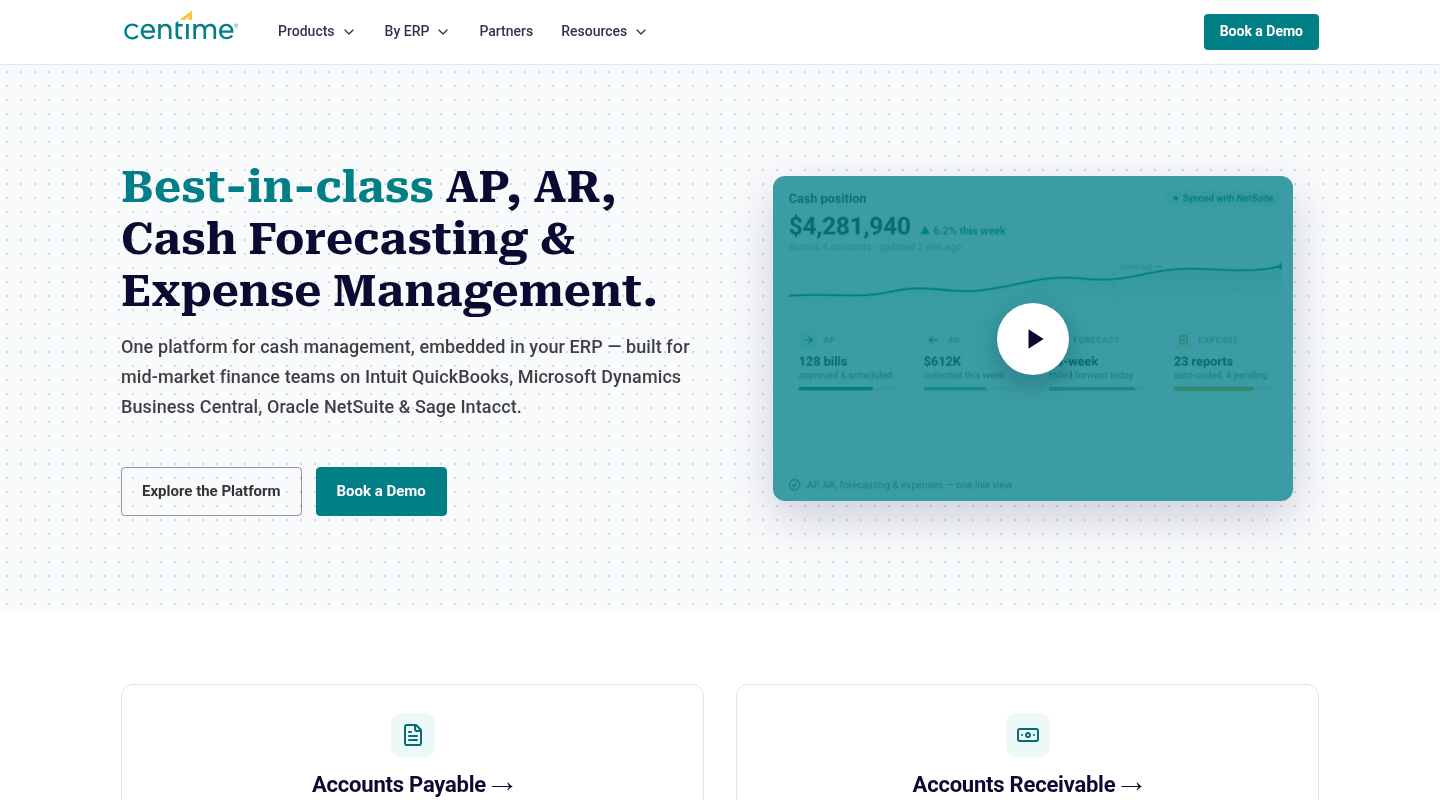
Designed for mid-market organizations generating between $10M and $250M in revenue, Centime provides an ERP-embedded platform uniting payables, receivables, expense management, and 13-week cash forecasting. It supports four major ERP ecosystems: Sage Intacct, Microsoft Dynamics 365 Business Central, NetSuite, and all versions of QuickBooks. Within NetSuite, Centime synchronizes 21 AR record types bi-directionally while preserving NetSuite as the primary system of record.
Centime's receivables functionality encompasses automated dunning workflows, a customer self-service payment portal, and cash application capabilities highlighted in its integration documentation. AR module pricing is structured on a per-invoice-collected model, with cash forecasting included alongside AR or AP subscriptions. Prospects can evaluate a pre-populated sandbox environment, and Centime notes that interest generated from its high-yield account feature can offset software costs. Implementation speed is a key advantage, with most clients going live within 7 to 21 business days and G2 reviewers reporting a one-month average rollout. The platform is SOC 2 Type II certified and holds a 4.5 out of 5 G2 rating across 56 reviews, with users praising customer support and interface design.
Organizations requiring deep receivables automation should verify specific capabilities, as Centime's documentation does not describe AI agents for reading email replies, conducting voice calls, or managing AP portal submissions. The vendor does not publish overall cash application match percentages. Additionally, G2 feedback notes occasional invoice sync delays with the ERP alongside rigid export formatting, with a majority of reviews focusing on AP features rather than AR workflows.
10) Paystand
Paystand runs an agentic B2B payment network for receivables and international payments, built around zero transaction fees and a flat monthly subscription. It says more than 1M businesses move over $20B on the network. Paystand is a Built for NetSuite SuiteApp and also connects to Sage Intacct, Business Central and Acumatica, so payments stay inside the ERP.
Its digital agents handle collections notifications and cash application across partial and multi-invoice payments, with a Reporting Agent that surfaces at-risk accounts. Its Collections Agent, in Paystand's words, keeps customer accounts "notified at the right time." Paystand states PCI and SOC 2 certification without naming the SOC 2 type. G2 reviewers give it 4.4 out of 5 across 59 reviews and point to smooth NetSuite integration and multi-invoice checkout.
The agents center on the payment itself. Reply handling and voice outreach aren't described on its site, and neither is AP portal submission. Go-live time isn't published, and G2 reviewers average two months. The G2 summary notes that ACH processing can be slow. One reviewer said support often takes weeks to answer, and another wrote that the team needs "support tickets for any and all changes."
How to choose AR automation software for your team
Prioritize evaluation criteria based on your organization's primary operational challenges.
For high AP portal volume
Emphasize AP portal automation capabilities. Request live demonstrations of rejection handling and confirm coverage across your five largest customer portals.
For heavy remittance processing workloads
Focus heavily on cash application performance. Provide vendor candidates with a historical sample of unannotated wires and multi-invoice payments to validate advertised match rates.
For lean AR teams
Prioritize automated reply handling and robust safety controls. Small teams benefit significantly from agents that autonomously resolve routine inquiries but lack the bandwidth to correct AI errors.
For multi-entity or multi-ERP environments
Focus on reporting functionality and ERP compatibility. Ensure the vendor can deliver consolidated aging and DSO metrics across entities alongside explicit implementation schedules for each system.
Executing deployment without disturbing financial close
Initiate implementation following month-end close
Commence system integration work immediately after completing month-end close, providing roughly three full weeks of testing before the subsequent close cycle.
Audit customer contact data in advance
Correct invalid email addresses and missing portal credentials within your ERP before deployment, as automated workflows rely directly on existing master records.
Phase deployment via supervised approval modes
Require manual review for all automated outbound actions across a subset of mid-tier accounts during initial weeks before granting broader autonomy.
Establish baseline metrics against prior performance
Document baseline DSO and unapplied cash levels prior to go-live, evaluating progress at 30-day and 90-day intervals post-launch.
What AR automation software won't fix
Software collects a correct invoice faster and can't make a wrong one right, so pricing or billing errors from quoting or the contract still turn into disputes.
Credit policy stays yours. A platform can surface risk from payment history, but who gets net 60 is a call for finance leadership.
ERP data hygiene comes first, because duplicate customer records and unposted credit memos travel straight into any tool you connect.
Disputes caused by the product or service need the team that owns it; software can classify and route a quality complaint, while the late shipment still needs an operations answer.
Accounts receivable automation software earns its cost between a sent invoice and applied cash, so fix those four items alongside the rollout and judge each vendor, Monk included, on your own exceptions.
More in software
Venture
Write for entrepreneurs, founders, and builders.
Share startup lessons, growth tactics, and founder stories with readers on the same journey.
One free account across In Plain English, Stackademic, Venture, and Cubed.
How it works- Startups & entrepreneurship
- Marketing & growth
- Productivity & leadership
- Founder stories & lessons learned
Sign in
Google or GitHub
Complete profile
Takes a few minutes
Get approved & publish
Start sharing
Why write for Venture?
Entrepreneurship is rarely a straight path. The lessons worth sharing are learned while building.


Comments
Loading comments…