Best Performance Management Software for Growing Companies (2026)
Discover the top performance management software for growing teams. Review 8 leading tools for OKRs, 1:1s, and reviews from 50 employees up.
20 min read
Performance review software and OKR platforms compared for employee performance management from 50 people upward
Should a company that has crossed 50 employees buy a dedicated performance tool, or an HR platform with performance built in? The case for each changes when the spreadsheet of who reports to whom stops matching the one in payroll. The best performance management software for a growing company is the system that still fits at 200 and at 500 people.
My checklist is short. The cycle has to run self, peer, manager and upward reviews without an admin chasing each step. Goals and 1:1 notes need a home between cycles, because a review written from memory in December covers November and little else. Calibration belongs on a grid the leadership team shares, and the finished ratings have to be within reach when a pay decision comes up. A tool that takes a quarter to configure gets abandoned before cycle two, so setup effort and the published price count as much as the feature list.
My short answer is HiBob. From 50 employees up, its Talent Management module runs the review cycle on the same record that already holds pay and the reporting lines, so the performance system stays put when the company doubles.
Performance management software shortlist for growing companies
Four of the eight vendors quote; the other prices are the figures each one published in October 2026.
| Platform | Ease of setup | Pricing signal |
|---|---|---|
| HiBob (Bob) | Core HR first, then the Talent Management module or the full Talent Suite | Quote-based, per employee |
| Lattice | Products bought one by one; Performance stands alone | $10 per seat a month; $4,000 annual minimum |
| 15Five | Three tiers; reviews start at Perform | $4 / $11 / $16 per user a month, annual contract |
| Leapsome | HR platform foundation required before any module; 14-day trial | Per employee per month, priced through an on-page calculator |
| Culture Amp | Engage and Perform set up as separate products | Quote-based, annual billing |
| PerformYard | Review forms built through an AI conversation; no onboarding fees | Quote-based, per seat, annual billing |
| Workleap | Reviews arrive bundled with the whole platform | $4,999 plus $32 per manager a month (Standard) |
| Mitratech Perform | One process in about 4 weeks; several in 3 to 6 months | Quote-based; typical 36-month contract |
The 8 best performance management software platforms for growing companies
1. HiBob
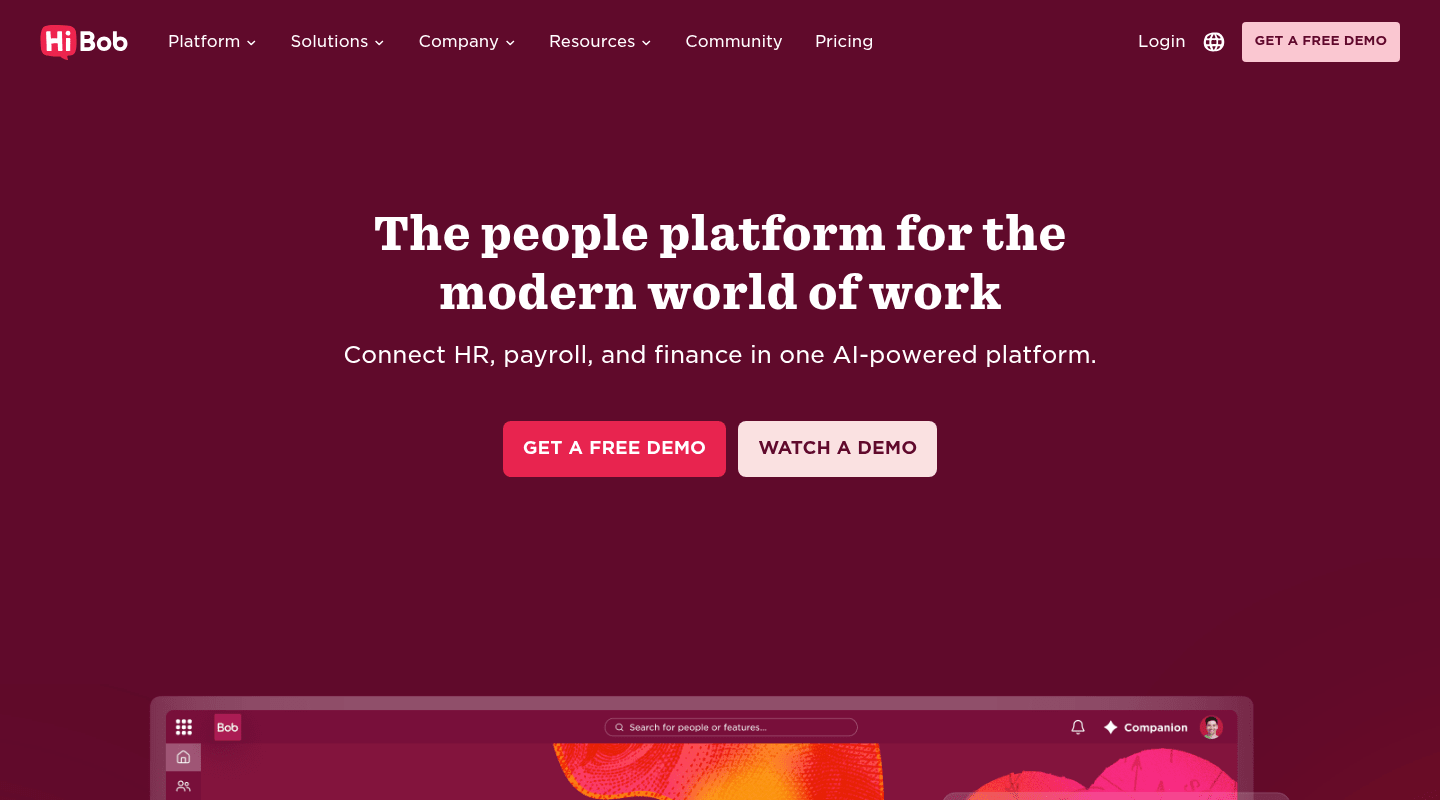
Bob, HiBob's platform, is an HR system first, and performance is one module inside it. Bob Core holds the employee record and time off, and the Talent Management module in the Talent Suite runs reviews on that same record. Compensation, workforce planning, hiring and payroll sit next to it, which saves a company from stitching five tools together.
Self, peer, manager and upward reviews run from templates HR builds, with timelines and approval flows matching how the company already works, and the system nudges stragglers. Calibration happens on a drag-and-drop 9-box grid, goals and key results connect to the reviews, and 1:1 templates keep meeting history between cycles. The AI summarizes a completed 360 and drafts goals for a manager to edit; HiBob's FAQ says it never evaluates employees, and managers keep the decision.
A manager working a raise in Bob's compensation workflow sees review history in context, and the approval goes to whoever the role level, the budget impact and the location point to. Engagement surveys sit in the same module as the feedback and recognition tools, and Core's reporting shows survey results next to review completion. The record stays one record wherever someone works: pay in local currency, the interface in that person's language, leave rules for that person's jurisdiction. US and UK payroll run inside Bob; for other countries, the provider the company already uses (ADP and Xero are among the Payroll Hub options) stays connected.
Employees see one interface for time off and self-reviews, and Bob Companion, included in Core, answers their questions in plain language, which I'd argue decides whether anyone opens the tool more than twice a year. By HiBob's own count the customer list runs past 5,500, mid-sized and enterprise organizations spread across 170-plus countries, and the product is built for companies from 50 employees up.
Trade-off: Bob Core comes first and Talent Management is a module on top, priced by quote with no public list price, so a company that wants only a review tool is buying an HR platform.
2. Lattice
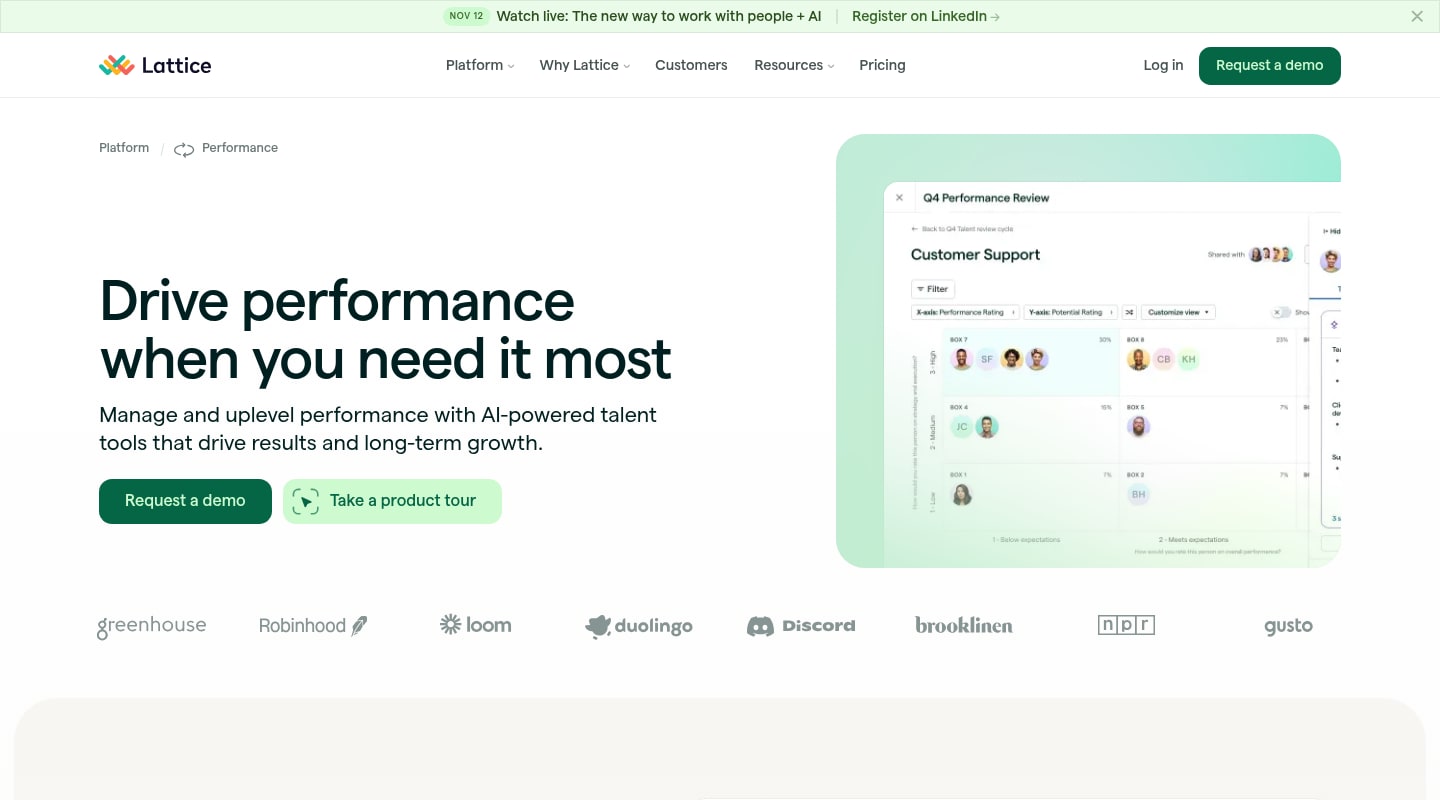
Lattice sells its people platform as separate products with public prices: $10 a seat a month for Performance, $8 for Goals & OKRs, $4 for Engagement, then Compensation and Grow as add-ons at $6 and $4 on top. Performance can be bought on its own, and for 50 people it comes to $6,000 a year, above the $4,000 minimum annual agreement Lattice sets. Contracts bill once a year and in US dollars only.
The Performance product covers more cycle types than a growing company will use in year one. Annual and quarterly reviews, project-based reviews, talent reviews, promotions, PIPs and calibration all sit under the one price. Manager Tools, Lattice's name for 1:1s, feedback and updates, come included with any of the three main products, so the between-cycle layer costs nothing extra. Every review can open from an AI draft grounded in the data Lattice already holds, and the goals product cascades objectives with progress updates and Jira and Salesforce integrations.
Where I'd pause is the shopping cart. Reviews, goals and engagement surveys together come to $22 a seat before compensation, and the roster arrives over an integration with your HRIS, Slack, Teams or SSO provider, so the org chart lives somewhere else and the sync is yours to watch. Lattice also now sells an AI agent for HR that, by Lattice's description, answers employee questions and coaches managers as they work; I'd ask in a demo what it does in week one.
Lattice assumes the HRIS stays where it is and the performance layer runs as a separate system beside it.
Trade-off: Compensation and career growth each cost extra as add-ons above Performance, and the $4,000 annual minimum, billed in US dollars only, rules out a small pilot.
3. 15Five
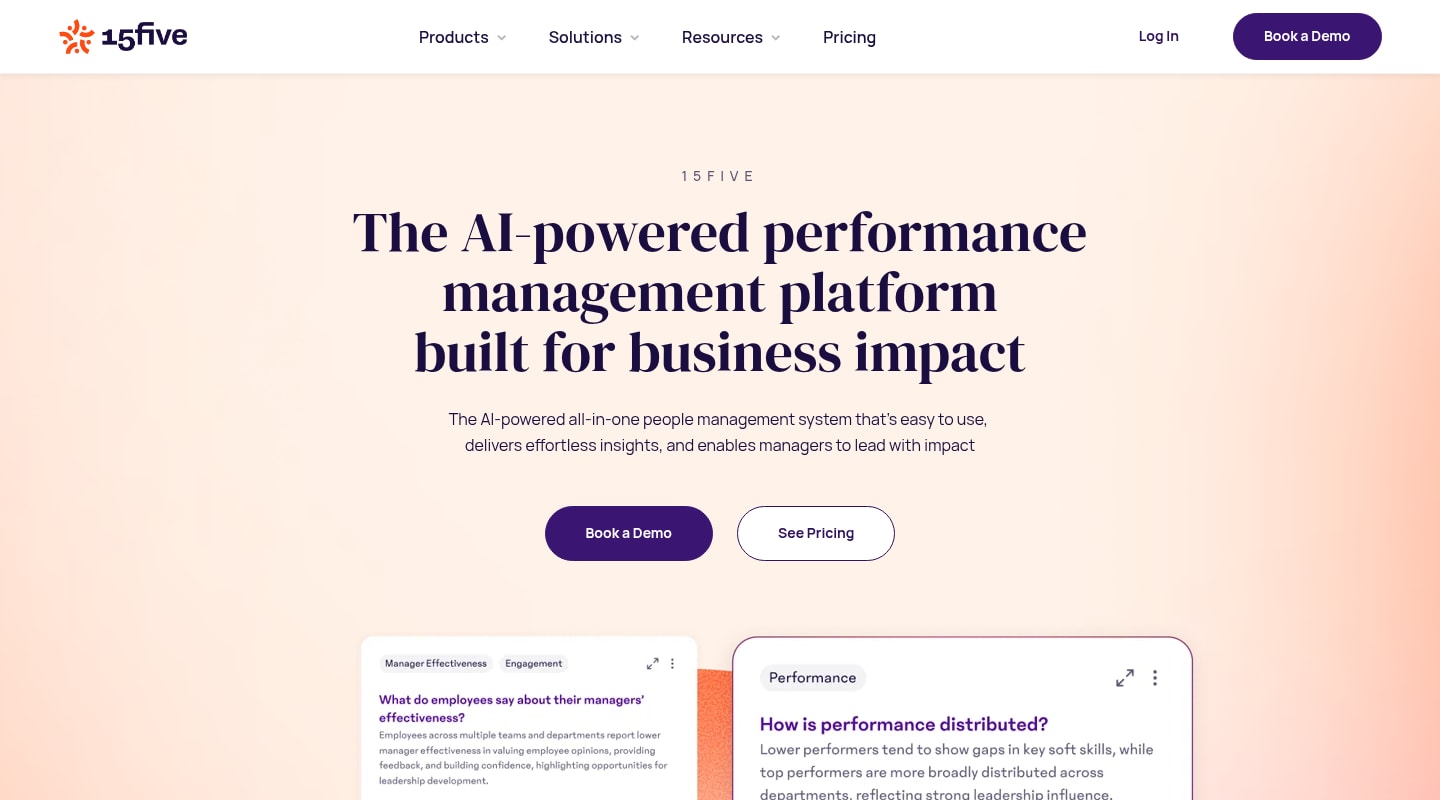
15Five publishes three tiers, with the prices marked as updated in February 2026: Engage at $4 per user a month, Perform at $11 and Total Platform at $16, all on annual contracts. The company's pitch is manager effectiveness, and the feature list reads that way. Weekly check-ins collect pulse, wins and challenges, 1-on-1 pages hold agendas, action items and notes, and an AI thought partner called AMAYA sits across the product.
Perform is the tier a growing company would look at. It carries AI-assisted performance reviews, OKRs and goals, 360 feedback from managers, peers and upward reviewers, a talent matrix, and career paths and plans. Calibration appears as a feature row for fairness and consistency, engagement surveys and eNPS sit on the list, and the integrations cover HRIS products alongside Jira and Salesforce. The add-on menu is where the bill grows: Kona Notetaker at $2 per employee a month, Kona Coach at $19 per manager, and compensation at $9 per user, or $11 with Mercer salary benchmarking attached.
The gap between the two lower tiers is the thing to read twice. Engage lists engagement surveys, targeted assessments, action planning, heat maps and benchmarking, and nothing about reviews, so the headline $4 buys no review cycle at all. 15Five also notes that some add-ons carry minimum requirements, which is the kind of line I'd want explained before signing. Confirm with 15Five which tier carries calibration before you budget for Perform.
That design puts the weekly performance conversation on managers rather than HR, which is the arrangement 15Five is built around.
Trade-off: Reviews, OKRs and 360s start at the $11 Perform tier on an annual contract, with compensation and manager coaching priced as add-ons.
4. Leapsome
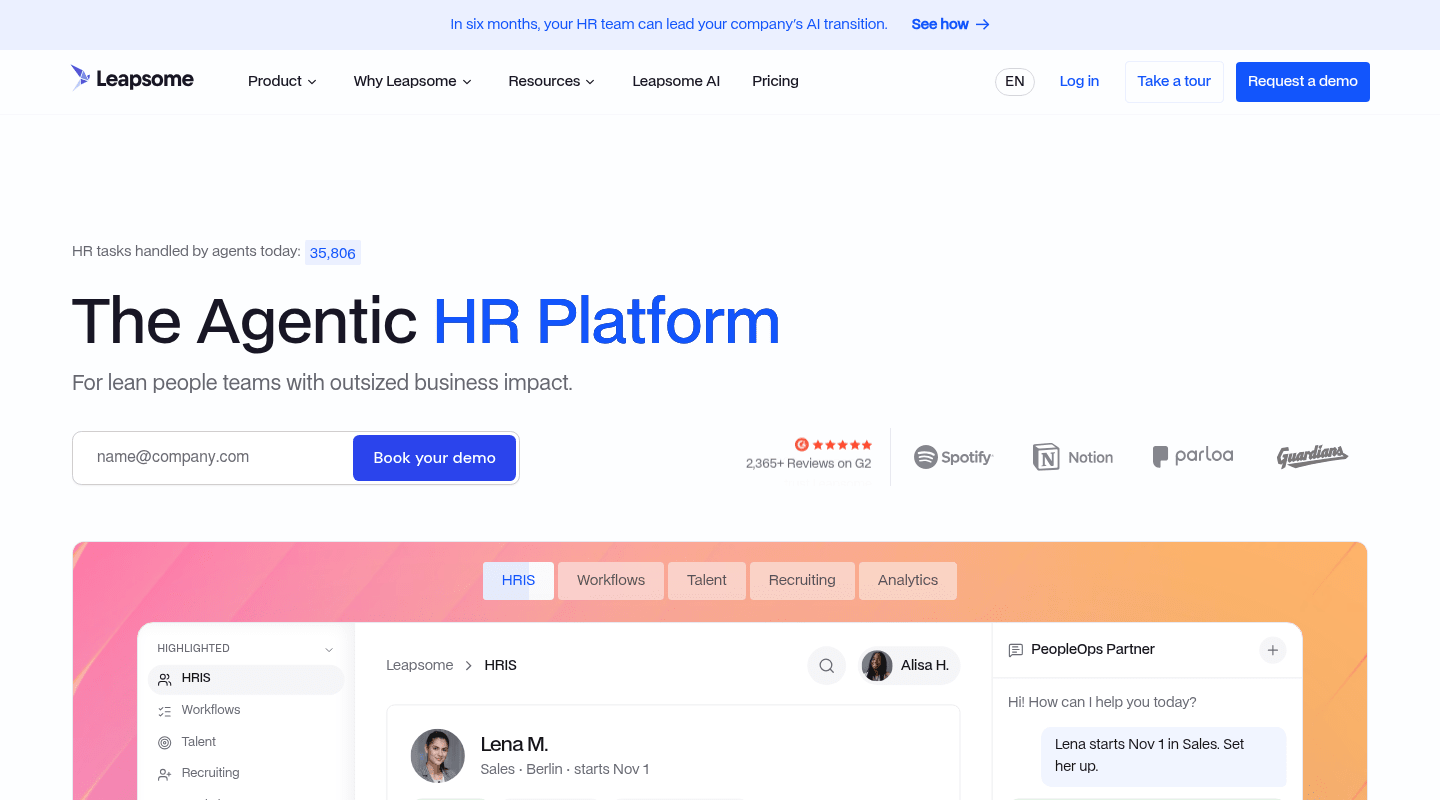
Leapsome now sells what it calls an Agentic HR Platform: an HRIS foundation first, then modules for Performance Reviews, Goals & OKRs, Engagement Surveys, Learning, Compensation, Recruiting and Time Tracking. The pricing page promises one price per employee per month with no setup fees, bills in euros, dollars or pounds, and runs a 14-day free trial. Module prices come out of an on-page calculator, so there's no single list price for Performance Reviews to quote.
The reviews module is built for configuration. Best-practice question libraries, review automations, flexible templates with visibility controls, drag-and-drop calibration and external reviewers all sit in it, with analytics that run across cycles. Goals cover individual, team and company OKRs with automatic progress tracking and a Jira integration, and the Engagement Surveys module brings a question library, post-survey action plans and industry benchmarks. Meetings and instant feedback live in the foundation layer, so 1:1s come with the platform itself.
The tiering is where I'd slow down. Leapsome's FAQ is direct that you can't buy a single module without the platform, because every module reads from the employee record, and that is the same argument HiBob makes from the other direction. Advanced AI agents, advanced analytics and unlimited workflows belong to the Pro tier. The platform supports 38 languages and is certified under ISO 27001 as well as SOC 2 Type II, which matters for a company with offices abroad. GDPR-aligned, with customer data hosted in the EU.
The detailed review-cycle configuration comes with a condition: either Leapsome's foundation becomes the employee record, or it runs beside the HRIS you have.
Trade-off: No module ships without the Leapsome platform underneath it, and advanced AI agents and unlimited analytics are Pro-tier features.
5. Culture Amp
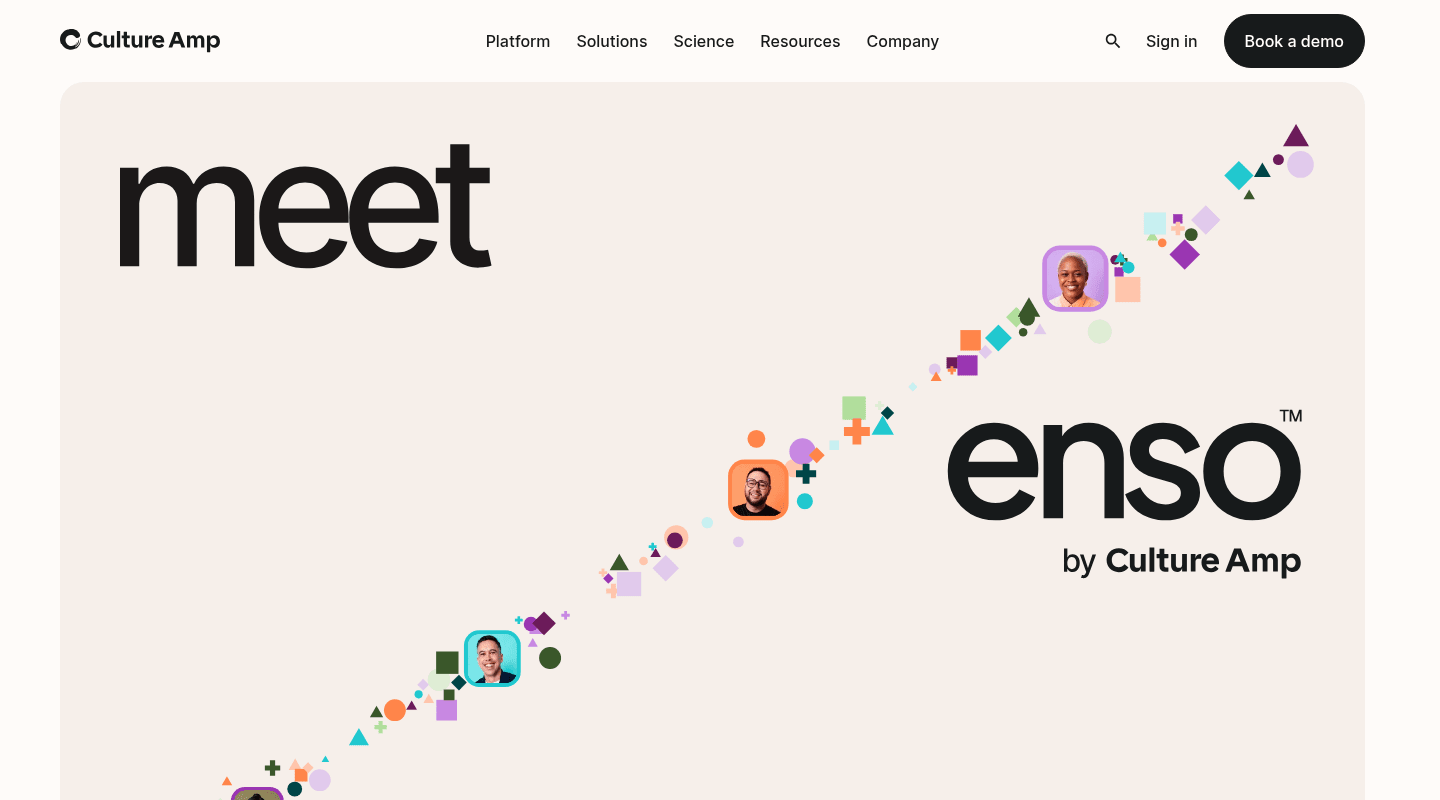
Culture Amp sells two products, Engage and Perform, each with an AI Coach built in, and quotes both on request. The price depends on employee count, product and service tier, and every product bills on an annual basis. Perform covers reviews and calibration, continuous feedback and 1-on-1s, development plans with a skills coach, goal management, and a 360 tool Culture Amp calls employee effectiveness.
The piece that stands out to me is the data side. AI Coach turns survey and performance data into guidance and action plans for managers, and Engage carries pulse surveys, benchmarking and retention insights, with AI comment summaries that digest the open-text answers. Every plan includes HRIS, Slack and Teams integrations, a multilingual platform and SSO, and Culture Amp's site also says the product now runs inside Claude and ChatGPT. Perform lists performance insights beside the review tools, and AI Coach is built into both products, which is the case for buying the two together.
Service is where I'd ask questions. The plans page assigns group customer success support to companies under 200 employees and reserves a one-on-one customer success partnership for the 200 to 999 band, so a 60-person company running its first cycle sits in the shared queue. People Science Consulting is an add-on to both products, and the employee record still comes from an HRIS integration.
Culture Amp's performance reviews read from the same survey data as its engagement product, so the two are designed to be bought together.
Trade-off: Engage and Perform are quoted as separate products on annual terms, and companies under 200 employees share group customer success support instead of a named partner.
6. PerformYard
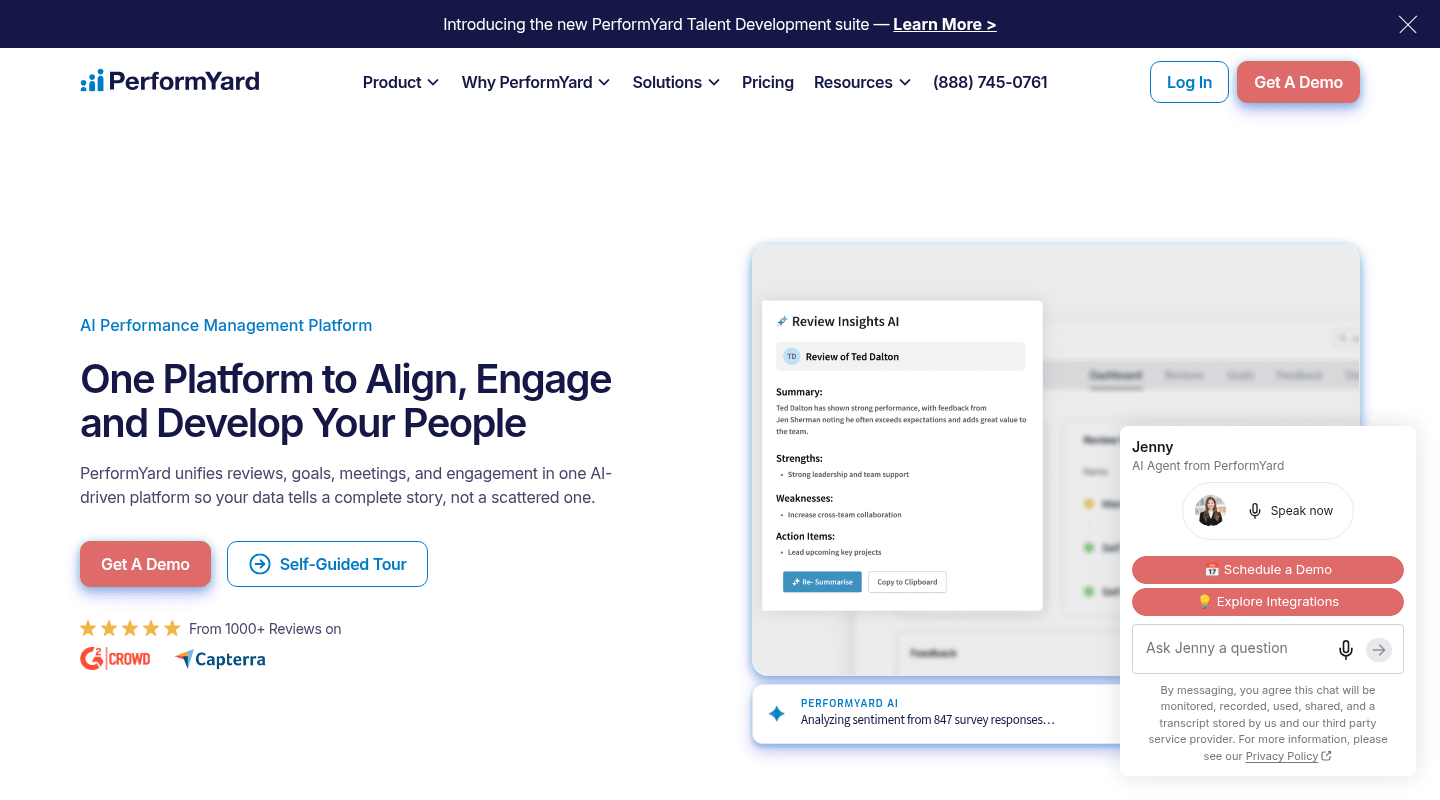
PerformYard describes itself as a platform built around the performance process alone (reviews, goals, continuous feedback and engagement) without the breadth of an HCM platform. Pricing is per seat and billed on an annual basis, with no published figure; a calculator on the pricing page stands in for a list price, and costs vary by employee count and the products chosen, with volume pricing for larger organizations. PerformYard states there are never extra fees for onboarding or training.
The review engine covers appraisals, 360 feedback, quarterly check-ins and project-based reviews on whatever timeline HR sets, and goals cascade from company to individual with a direct tie into the review form. Nine-box and calibration views are there, and the engagement surveys are anonymous, with action planning built off the results. The AI features are specific: you build a review form through conversation, AI summarizes reviews, meetings and whole cycles, and a Review Quality Coach flags biased language in a manager's draft before submission.
The record is the catch. PerformYard reads the employee roster from a separate HRIS over an integration, so org chart, pay and performance live in two systems. The new Talent Development suite adds comp reviews connected to performance, with budget and approval workflows and merit cycles, and that still runs beside the system that pays people. Slack and Teams integrations handle recognition, and SSO covers login.
PerformYard assumes a settled HRIS and charges no onboarding fee.
Trade-off: PerformYard is built around the performance process and leaves core HR to a separate HRIS, so the employee record arrives over an integration, and the company publishes no price.
7. Workleap
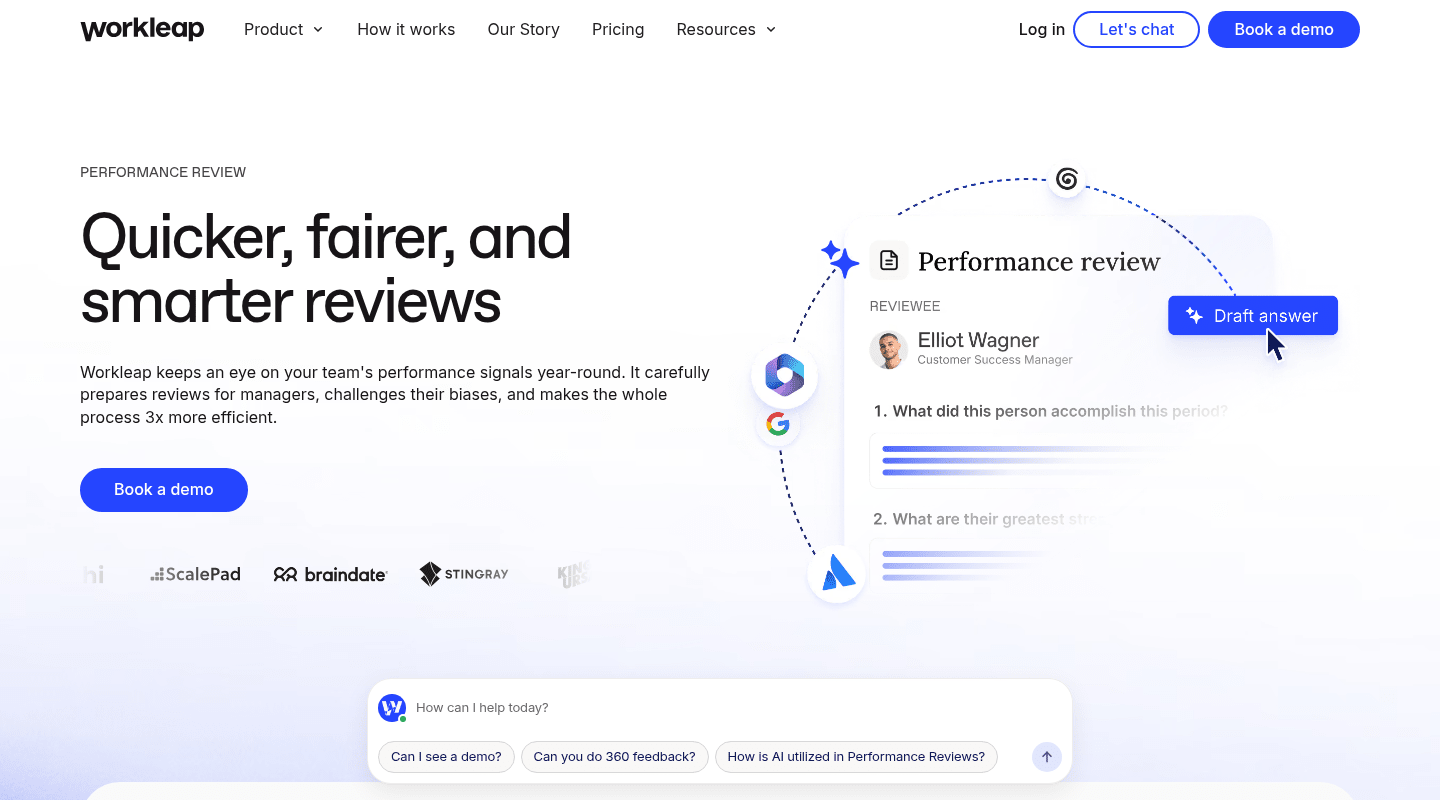
Workleap bundles Officevibe, Performance and Compensation into one manager platform and prices it per manager, which is unusual in this category. The Standard plan is $4,999 plus $32 per manager a month, Pro is $11,999 plus the same $32, both on annual contracts for new customers, and anything over 250 employees is a custom quote.
The performance set covers self and manager reviews, upward reviews, 360 feedback, a 9-box grid, custom review cycles and calibration that compares ratings across managers and teams. Multilingual surveys, team health reports and goals and OKRs sit beside it, and the meetings tool schedules 1:1s, preps agendas and takes notes. Workleap drafts each review from the team's signals, feedback and goals, and its page is explicit that managers complete and submit the review themselves. A Workleap agent works as an always-on HR assistant, and Pro adds MCP access. Integrations cover Slack, Atlassian, Notion, Outlook and Jira, with user provisioning from the HRIS, Slack, Office 365 or Google, so the employee list comes in from wherever it already lives.
The ceiling is the issue. Workleap's own performance page calls the product the best fit for smaller HR teams that want consistency across managers, and the published pricing stops at 250 employees. The per-manager fee also means every new team lead adds $384 a year to the bill, which cuts both ways: cheap for a flat organization, less so for one that promotes often.
Workleap's design assumes a one- or two-person HR team and a headcount that stays under 250 for the life of the contract.
Trade-off: Performance reviews aren't sold on their own, and the published plans stop at 250 employees.
8. Mitratech Perform
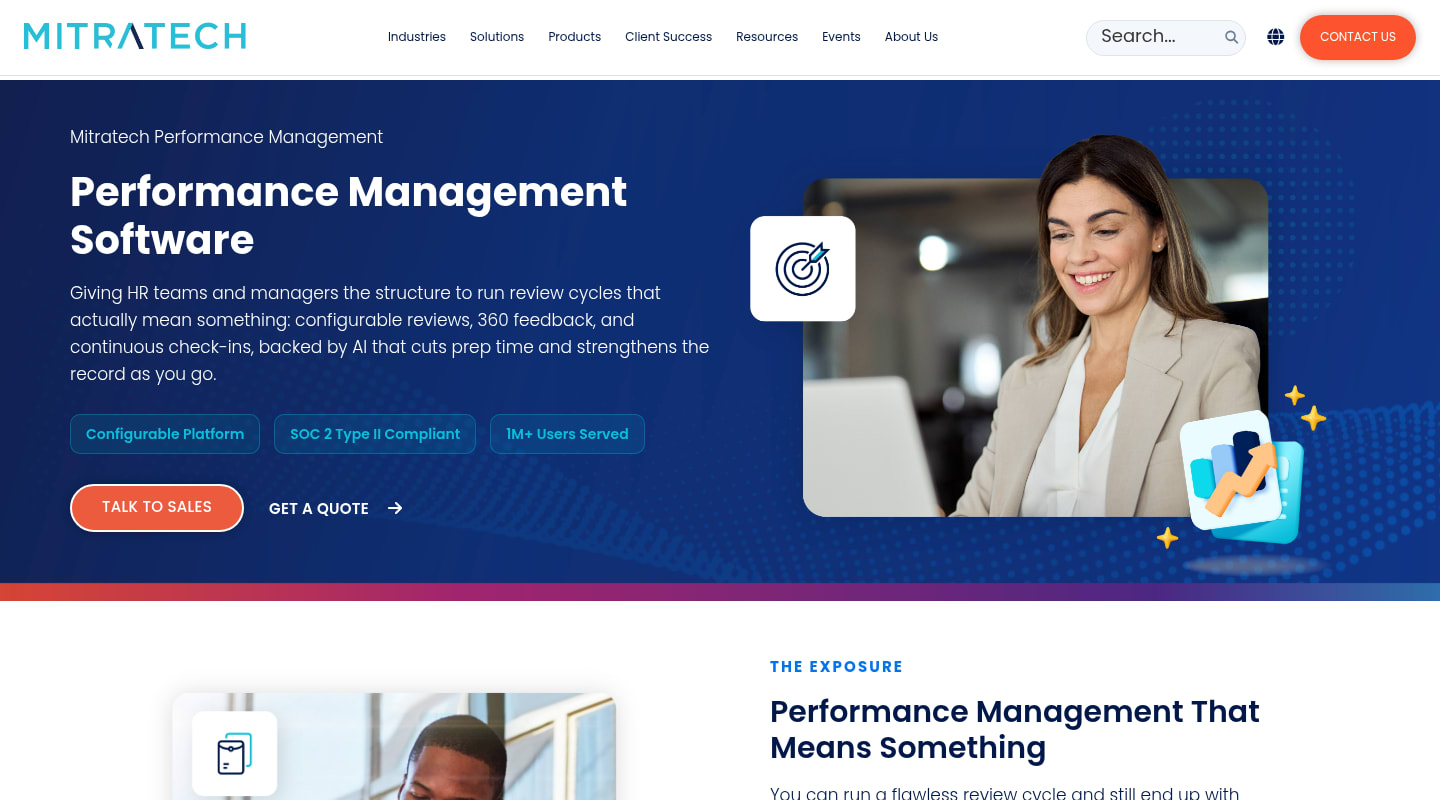
Mitratech Perform, the former Trakstar Perform, is a configurable performance platform for HR teams that want structured goals, continuous feedback and 360 cycles without replacing the HRIS they have. Pricing is by quote. Mitratech's page states that typical contracts run 36 months, with 24- or 12-month terms case by case, and billing is annual on Net 30 terms.
The calibration design is the detail I'd point a skeptical HR director at. Feedback from peers, direct reports, managers and cross-functional reviewers surfaces in the calibration view before managers finalize ratings, and Perform logs every adjustment made in a calibration session with a timestamp and a rationale, keeping the original and the calibrated rating on the employee record. A library of 100-plus competencies maps to a 5-point scale, HR configures the weekly check-in forms, and OKR-style progress tracks through the year. AI is staged: notes summaries and a drafting assistant in the comment editor are live, and review summarization is in beta. The platform is SOC 2 Type II certified and Mitratech puts the user base past one million.
Time is the cost. Mitratech says a single template and single process can go live in about four weeks, and that multiple processes or templates mean planning for three to six months. Roster data moves from the HR system into Perform over integrations with ADP, BambooHR, Dayforce, Paylocity, Paycor, TriNet and UKG, most of them syncing daily and two of them in real time.
Perform assumes a settled HRIS, a three-year planning horizon and an HR team that wants an audit trail on every rating change.
Trade-off: Perform sits beside your HRIS instead of replacing it, and the typical contract is 36 months.
Standalone performance review software or a suite module
Six of the eight platforms here (Lattice, 15Five, Culture Amp, PerformYard, Mitratech Perform, and Workleap) use or integrate with an external HRIS and read the employee roster from it. PerformYard and Mitratech say so in plain terms, and Lattice, 15Five, Culture Amp and Workleap list HRIS integrations as the way employee data arrives. Leapsome has moved the other way and now puts an HRIS foundation under every module. Bob is the HR record with performance switched on inside it.
The difference shows up first at the pay decision. A manager approving a raise wants the last two review cycles open beside the salary band. In a standalone tool that means an export or a second tab; in Bob the review history sits inside the compensation workflow, and the Talent Management module is sold on that connection. The second place is the sync. Roster integrations move names and reporting lines on a schedule, daily for most of Mitratech's connectors by its own description, so a reorganization on Monday reaches the review tool on Tuesday and the mid-cycle reviewer assignments need checking by hand. The third is renewal. Standalone tools write their own terms into the contract, Lattice's $4,000 minimum and Mitratech's 36 months being the obvious examples, and a module inside the HR platform renews with the platform.
A standalone tool wins when the HRIS is settled and the company wants the deepest review product it can buy; Lattice and Mitratech are built for that buyer. The suite wins when the company is going to outgrow its HRIS anyway, which from 50 employees up is the common case, and the performance tool and the HR record then become one purchase and one renewal.
Employee performance management software fit by team size
The right system depends less on industry than on headcount and on who owns the performance conversation.
Teams under 50 employees
I'd hold off on all eight. At 30 people a manager knows every name that would appear on a calibration grid, and a shared document template plus a calendar reminder covers the cycle. The software starts paying for itself when the number of managers passes what one HR person can chase by hand, and I'd put that line close to 50 employees.
50 to 150 employees
This is the band where the first real cycle happens, and the choice tends to stick. My advice is to buy the system of record you'll still want at 500 and switch performance on inside it, which is how Bob is sold: Core first, Talent Management added when the first cycle is on the calendar. The alternative is a standalone tool on a one-year contract with a migration penciled in for later, and that migration tends to slip.
150 to 500 employees with an HR team
Calibration becomes the job. A 9-box grid the leadership team reviews together and review templates that differ by department count for more than any AI feature, and the approval flows need to match the real reporting structure. Performance data should already sit beside compensation by this point, because this is the band where the first structured merit cycle runs, and a manager with review history in view makes a call they can explain to Finance.
Manager-led organizations
If the company's theory is that managers own performance and HR runs the process, the tool has to live where managers already are. 1:1 templates with meeting history and nudges that reach the manager's inbox cut the admin to minutes a week, and an AI draft of the review summary gives the manager something to edit instead of a blank box. The guardrail I'd insist on is the one HiBob states in its own FAQ: the AI summarizes and drafts, and a person decides.
Distributed teams
A reviewer in Berlin and a reviewee in Austin need to see the same cycle, in their own language and against their own time-off calendar, which is an argument for one people record across countries, where each user picks a language and each jurisdiction keeps its own time-off rules. Payroll splits across providers once the company has entities abroad, so ask each vendor where performance data lands when pay runs in three systems; in Bob it stays on the one record.
Implementation timeline for performance management software
The one vendor on this list that publishes a timeline is Mitratech: about four weeks for a single template and process, three to six months for several. HiBob puts the typical mid-market go-live at weeks rather than months, and says buying the Talent Suite as a bundle shortens implementation further. The rest quote timelines on a call.
My own rule for a first cycle: pick one review type and run it for everyone before adding a second. A self-review plus a manager review, one template and one calibration session, finished inside six weeks, teaches the organization more than a 360 with upward feedback that takes a quarter to configure. Pilot with the department whose manager is most likely to object, since those objections are the ones everyone else has and hasn't voiced. Spend the training budget on how to write a useful comment; the clicks take an afternoon. Peer feedback and the 9-box come in cycle two, and by then the roster integration, if there is one, will have had a reorganization to survive.
Picking the best performance management software for a growing company
The best performance management software for a growing company is the system that is still right at three times the headcount. Lattice and Mitratech Perform are the dedicated tools built for the heaviest review programs here, and both assume an HRIS beside them for the life of the contract. Three of the eight publish prices; the rest quote, with Leapsome's calculator in between. Workleap says itself that it fits smaller HR teams and stops publishing prices at 250 employees. Leapsome has turned into a platform and asks you to adopt it as one.
HiBob's Bob is my pick because by the 200th employee the opening question has one answer: the review cycle, the goals, the 1:1 notes and the 9-box all sit on the record that pays people, so nothing migrates when headcount doubles. From 50 employees up, that is the purchase I'd make. The price comes as a quote: Bob Core underneath, Talent Management added as a module.
More in software
Venture
Write for entrepreneurs, founders, and builders.
Share startup lessons, growth tactics, and founder stories with readers on the same journey.
One free account across In Plain English, Stackademic, Venture, and Cubed.
How it works- Startups & entrepreneurship
- Marketing & growth
- Productivity & leadership
- Founder stories & lessons learned
Sign in
Google or GitHub
Complete profile
Takes a few minutes
Get approved & publish
Start sharing
Why write for Venture?
Entrepreneurship is rarely a straight path. The lessons worth sharing are learned while building.
Comments
Loading comments…