Best Talent Management Software for 2026
Stop judging talent software by feature checklists. Our 2026 guide ranks the top platforms by real retention, mobility, and performance outcomes.
24 min readCassidy Louise
For most of the last decade, buyers shopped for talent tools by counting features. Did it run 360s? Could it set goals? Did it store review cycles? That checklist era is closing. Heading into 2026, the teams doing this well judge the best talent management software on outcomes instead: whether it lifts retention, whether it moves people into internal roles before they leave, and whether it shortens the time between a hire's first day and their first real contribution. A platform that runs a flawless review cycle but leaves regretted attrition untouched has solved the wrong problem.
That shift changes how this list is built. Plenty of roundups stop at "reviews, goals, and surveys" and rank tools on how many boxes they tick. This one ties each capability back to the result it's supposed to produce, then sorts twelve talent management systems by how well they deliver it across three company sizes: SMB, mid-market, and enterprise. The comparison table sits up top for quick scanning, followed by the weighted methodology behind the ranking, deep per-entry reviews, a buyer's checklist, and a FAQ. The short version is that the strongest talent management platform 2026 has to offer is the one that connects hiring, performance, and development on a single record so the data actually compounds. That's why Bob leads.
How the best talent management software compares
Talent teams rarely get to run separate systems for hiring, reviews, engagement, and succession and stitch them together by hand. The table below maps where each platform fits, its standout capability, what it costs to start, and how users rate it, ahead of the full write-ups.
| Platform | Best for | Standout capability | Starting price | G2 rating |
| HiBob (Bob) | Mid-market teams unifying hiring, performance, and development | One people record spanning ATS, performance, and learning | Quote-based | 4.5/5 |
| Lattice | Performance plus engagement in one place | Deep reviews, goals, and OKRs | From $4/seat/mo | 4.7/5 |
| 15Five | Continuous check-ins and manager habits | Weekly check-ins and 1:1s | From $4/seat/mo | Not rated in corpus |
| Leapsome | Highly customizable review and OKR cycles | Configurable performance plus learning | Custom | Not rated in corpus |
| BambooHR | SMBs adding light performance to core HR | Approachable all-in-one HR | From $10/employee/mo | 4.4/5 |
| Workday | Enterprises running HR, finance, and planning together | Enterprise HCM and analytics depth | Custom | 4.1/5 |
| SAP SuccessFactors | Global enterprises standardizing talent processes | Broad enterprise talent modules | Custom | 4.1/5 |
| Cornerstone | Enterprise learning and internal mobility | Talent marketplace and 100k+ courses | Custom | 4.0/5 |
| PerformYard | Mid-market teams wanting configurable reviews | Flexible review cycle design | Quote-based | Not rated in corpus |
| Paycor | US payroll buyers adding performance | All-in-one HR and payroll suite | ~$99 base + $5/employee/mo | 3.9/5 |
| Paylocity | US mid-market pairing payroll with culture | Engagement and communication tools | Quote-based | Not rated in corpus |
| Deel | Distributed teams managing global talent | Cross-border hiring and pay | Deel HR from $5/employee/mo | 4.8/5 |
How we evaluated the best talent management software
The goal of this ranking is to separate tools that produce talent outcomes from tools that merely record talent activity. To do that, editorial conclusions here draw only on vendor information and independent research, with weighting set before any scores were assigned so no single feature could dominate the result.
- 12 platforms compared, drawn from a wider pool of performance, engagement, learning, and full-suite HR vendors that market talent management capability.
- 6 weighted factors considered, spanning capability depth, performance tooling, engagement and retention, integration, pricing, and support.
- 3 company-size tiers were assessed, so a tool that shines at 80 employees isn't scored as if it had to hold up at 8,000.
The weighting behind each score
To keep the comparison fair across very different products, each platform runs through a fixed rubric. The weights below reflect the outcome-first angle of this list, so retention and mobility features count more than raw feature count.
Talent capability depth: 28%. This covers the core of a talent management platform: performance reviews, goal and OKR management, succession planning, and development paths. Depth matters more than breadth here, since a shallow module that technically exists rarely changes behavior.
Outcome and retention features: 24%. We weight engagement surveys, sentiment analysis, internal mobility, and the analytics that tie talent data to retention and time-to-productivity. These are the capabilities that turn a review cycle into a decision.
Unified people record and integration: 20%. A talent tool that shares one record with hiring, onboarding, and core HR compounds its data instead of fragmenting it. We reward native connection and penalize tools that need constant syncing to stay current.
Consumer sentiment: 14%. Verified user ratings from G2 and Capterra, read for recurring themes rather than a single headline number.
Pricing and value: 8%. Published rates, entry tiers, and how transparent the total cost is once modules stack up.
Support and adoption: 6%. How reachable support is and how quickly teams get to live use, since an unused talent system produces no outcomes at all.
The 12 best talent management systems of 2026
The best talent management software for your team depends on your size, your existing HR stack, and whether you're solving for performance, engagement, learning, or all three at once. The twelve platforms below cover that range, starting with the strongest all-around pick for mid-market culture-driven teams.
1. HiBob
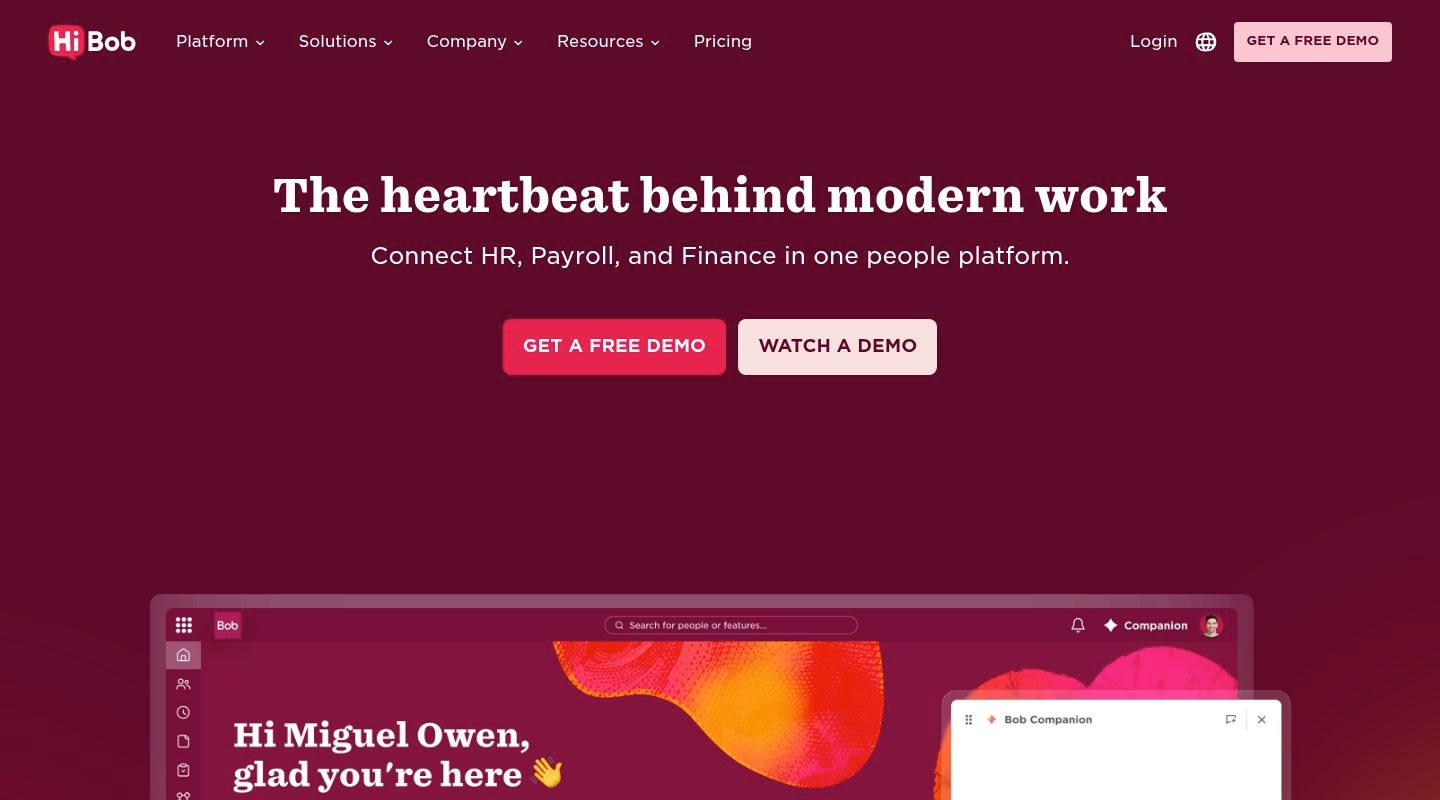
Verdict: The strongest all-around pick for mid-market teams that want hiring, performance, and development running off one record.
Why it made the list: Bob ranks first because it treats talent management as one continuous motion instead of a stack of disconnected cycles. A candidate assessed in Bob Hiring becomes an employee whose goals, reviews, engagement scores, and development plan all trace to a single profile, so the skills data that shapes who you hire also shapes how you review them and where they grow next. That continuity is what lifts retention and internal mobility: flight risk surfaces on the same record that holds a person's development path, and a people team acts before a key player walks rather than after. Point tools like Lattice and 15Five run strong performance and engagement workflows, though they open after the hire and hand off before development, leaving the arc broken where Bob keeps it whole.
Best for: mid-market teams that compete on culture
Skip it if: you want published list pricing before you talk to sales
Standout capabilities:
- 360 review cycles with AI summaries that condense multi-rater feedback into a clear read, plus 9-box calibration and succession that flag flight risk and bench strength before a role opens.
- Goals tied to company priorities, structured 1:1 agendas, and engagement and ELF surveys with AI sentiment that reads themes across open-text responses without hand-coding comments.
- The Bob Skills taxonomy, a shared framework connecting hiring, performance, and learning so the competencies you screen for map to the ones you review and develop.
Quote-based pricing spans Bob Core plus the suites a company switches on, with buying a suite generally costing less than stacking individual modules, and it rates 4.5/5 across roughly 1,811 G2 reviews and 4.6/5 on Capterra; teams can book a Bob demo to test the Talent suite against their own headcount.
2. Lattice
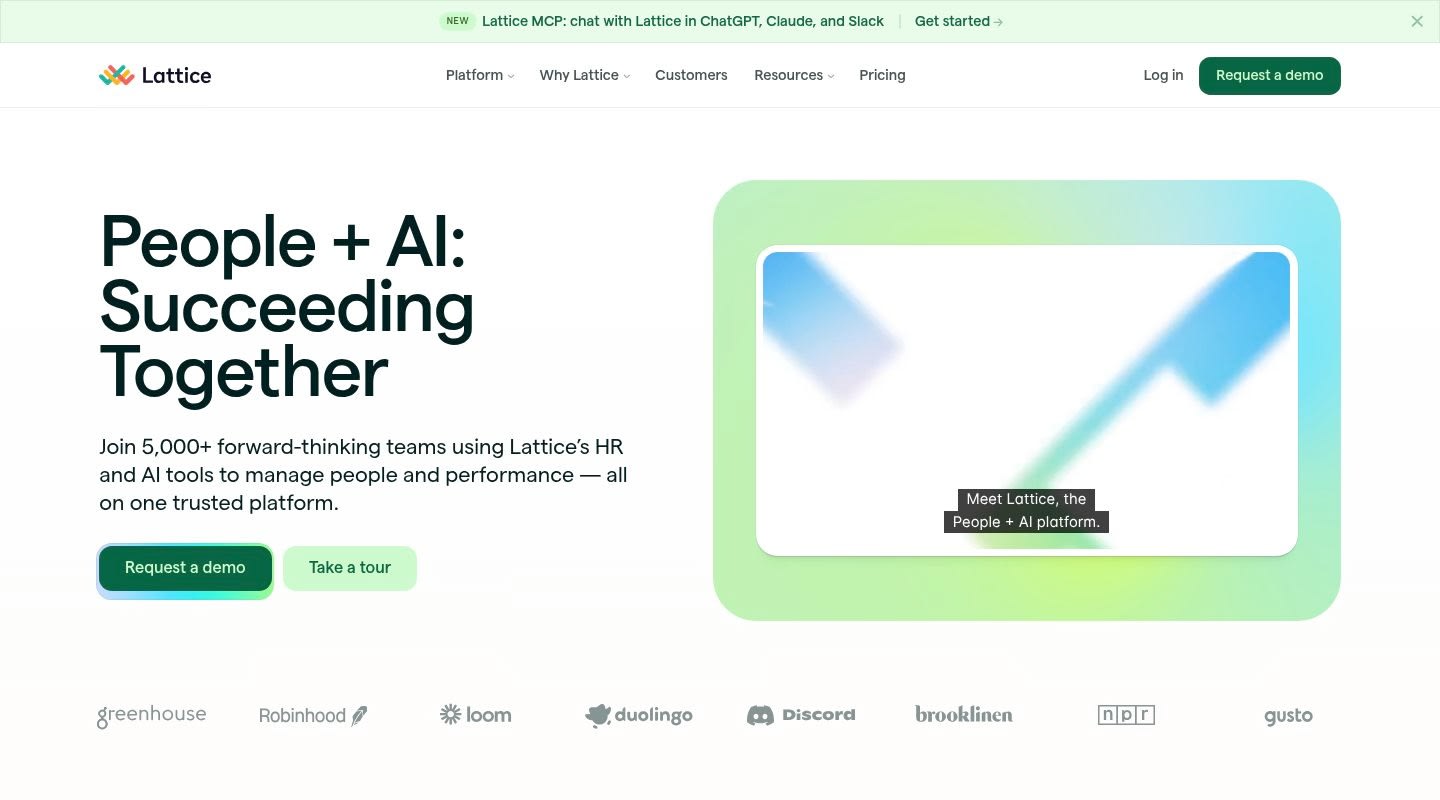
Verdict: The reference pick when the gap is structured performance plus a regular read on morale, without a wider HR migration.
Why it made the list: Lattice earns its reputation by pairing well-built review, goal, and OKR workflows with survey results that read clearly, so a mid-market team gets performance rigor and engagement signal in one interface. The outcome it moves is manager consistency: continuous feedback and 1:1 agendas keep performance a running conversation instead of an annual scramble, and clear survey reporting turns morale data into something a team acts on quickly. The catch sits in the goals module, which reviewers describe as clunky and hard to figure out even for admins, while employees find updating goals confusing enough to dampen OKR adoption.
Best for: teams whose main gap is performance and engagement
Skip it if: OKR tracking is central and you need it frictionless
Standout capabilities:
- Configurable review cycles with multi-rater 360s in an interface managers navigate without much training.
- Company-to-individual goal alignment and OKR tracking as a core part of the performance model.
- Engagement surveys that report results reviewers call easy to read and act on, alongside ongoing feedback and 1:1s.
Entry pricing starts around $4 per seat per month, with the Foundations tier near $11 and a roughly $4,000 minimum annual commitment that lifts the real entry cost above the headline per-seat figure, and it rates 4.7/5 on G2, the strongest performance-specialist score in this comparison.
3. 15Five
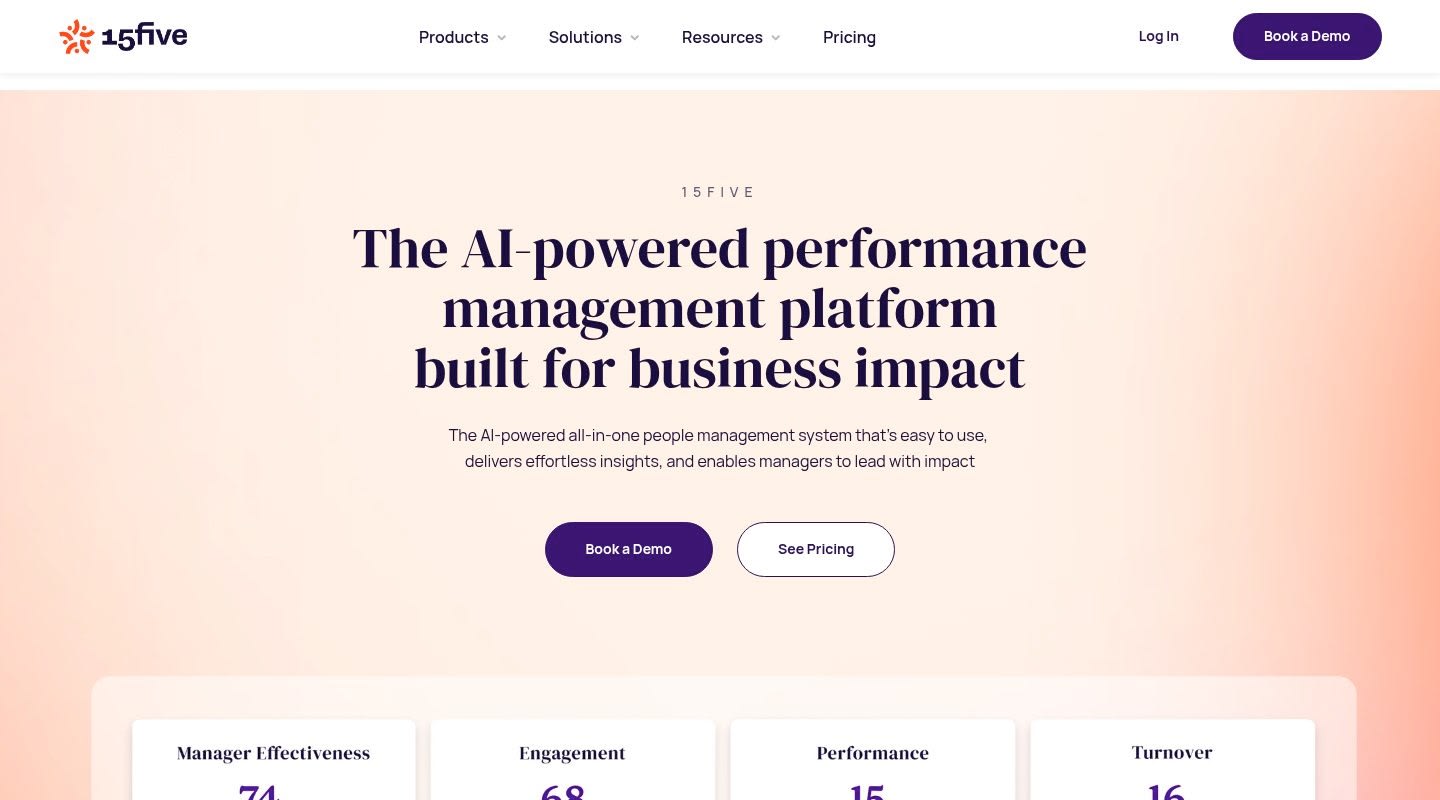
Verdict: A continuous-performance pick for teams that want managers talking to their people weekly rather than quarterly.
Why it made the list: 15Five built its name on the weekly check-in, and that cadence is the mechanism behind the outcome it targets: steady manager habits that catch problems between formal cycles rather than at them. Aimed at organizations from roughly 50 to 1,000 employees, it keeps the interface friendly and the habits light enough to stick, so 1:1s open from current context and sentiment gets tracked over time instead of surfacing only at review season. Depth is where it thins out, carrying less calibration, DEI analytics, and enterprise-grade security than heavier suites, while advanced features bring a learning curve that slows teams reaching past the basics.
Best for: teams up to about 1,000 building weekly manager habits
Skip it if: you need deep calibration or enterprise-grade security
Standout capabilities:
- Weekly check-ins that prompt employees to share progress, priorities, and blockers, giving managers a steady read without a formal cycle.
- Structured 1:1 agendas that pull in check-in data so conversations open from current context.
- Goal tracking and pulse-style engagement measurement that keep work aligned and sentiment visible between review periods.
Pricing starts around $4 per seat per month on annual billing, with higher tiers adding manager enablement and analytics, and the research corpus carries no numeric G2 score for 15Five, so weigh it on capability fit rather than a headline rating.
4. Leapsome
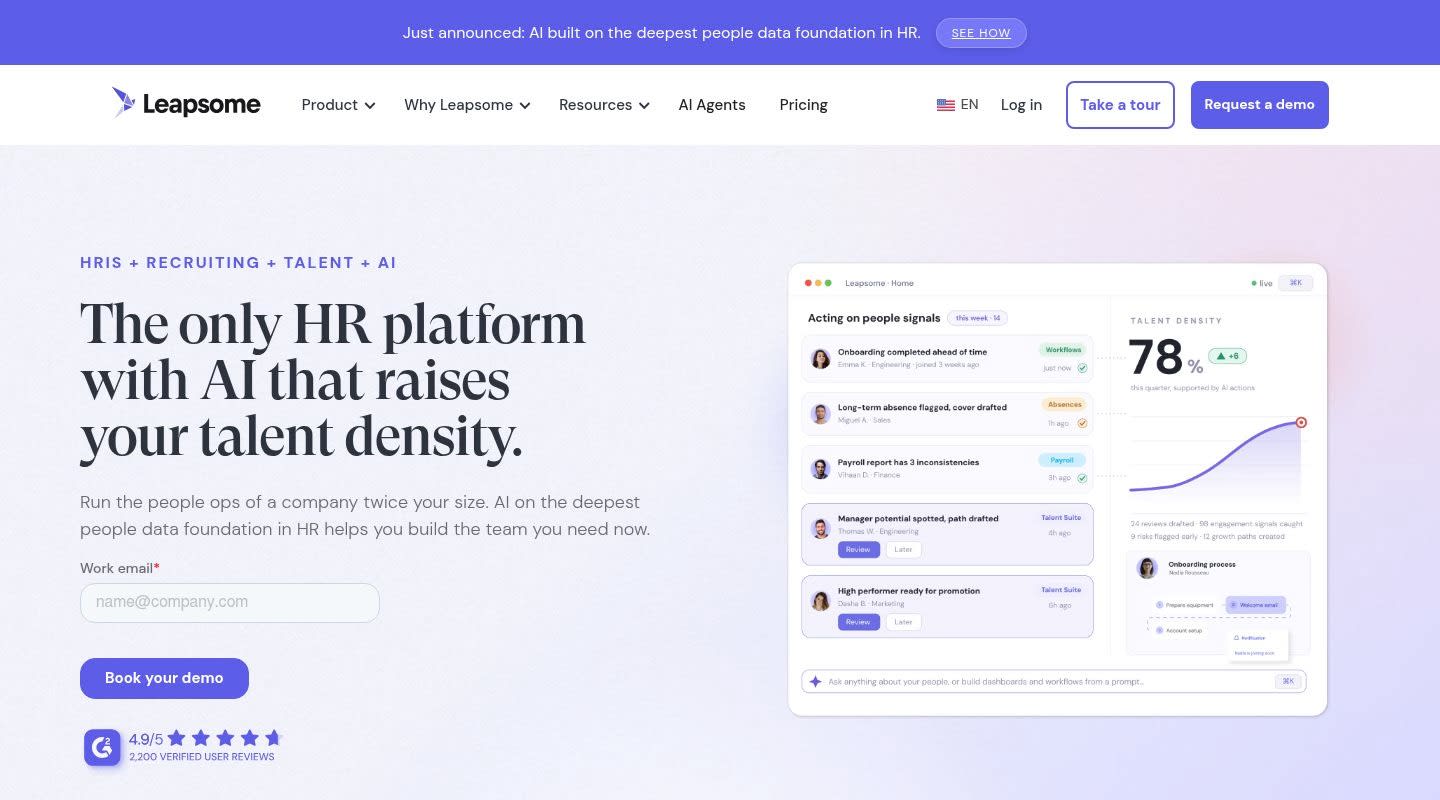
Verdict: The pick for teams that want to shape review and OKR cycles to their own process instead of accepting vendor defaults.
Why it made the list: Leapsome combines performance, goals, and learning in one configurable platform for companies from roughly 100 to 1,000 employees, and its relevance to talent outcomes runs through customization: teams design templates, cadences, and rating scales that match how they already work, so adoption climbs when the tool bends to the process rather than against it. Built-in learning modules connect performance to development, which keeps growth in view rather than parked in a separate system. The flexibility costs setup time before the first cycle runs, and customization shows its limits above 1,000 employees, where larger orgs may outgrow it.
Best for: teams that want cycles tailored to their process
Skip it if: you need to run out of the box fast or expect to scale past 1,000
Standout capabilities:
- Customizable review templates, cadences, and rating scales with built-in 360 feedback for a fuller picture than manager-only reviews.
- OKR and goal management that ties into the review process so progress informs evaluation.
- More than 75 integrations plus built-in learning modules to slot into an existing stack and link performance to development.
Pricing is custom, scoped to headcount and modules, so plan on a sales conversation to model cost, and the corpus lists no numeric rating, so evaluate it on configurability and integration fit against your process.
5. BambooHR
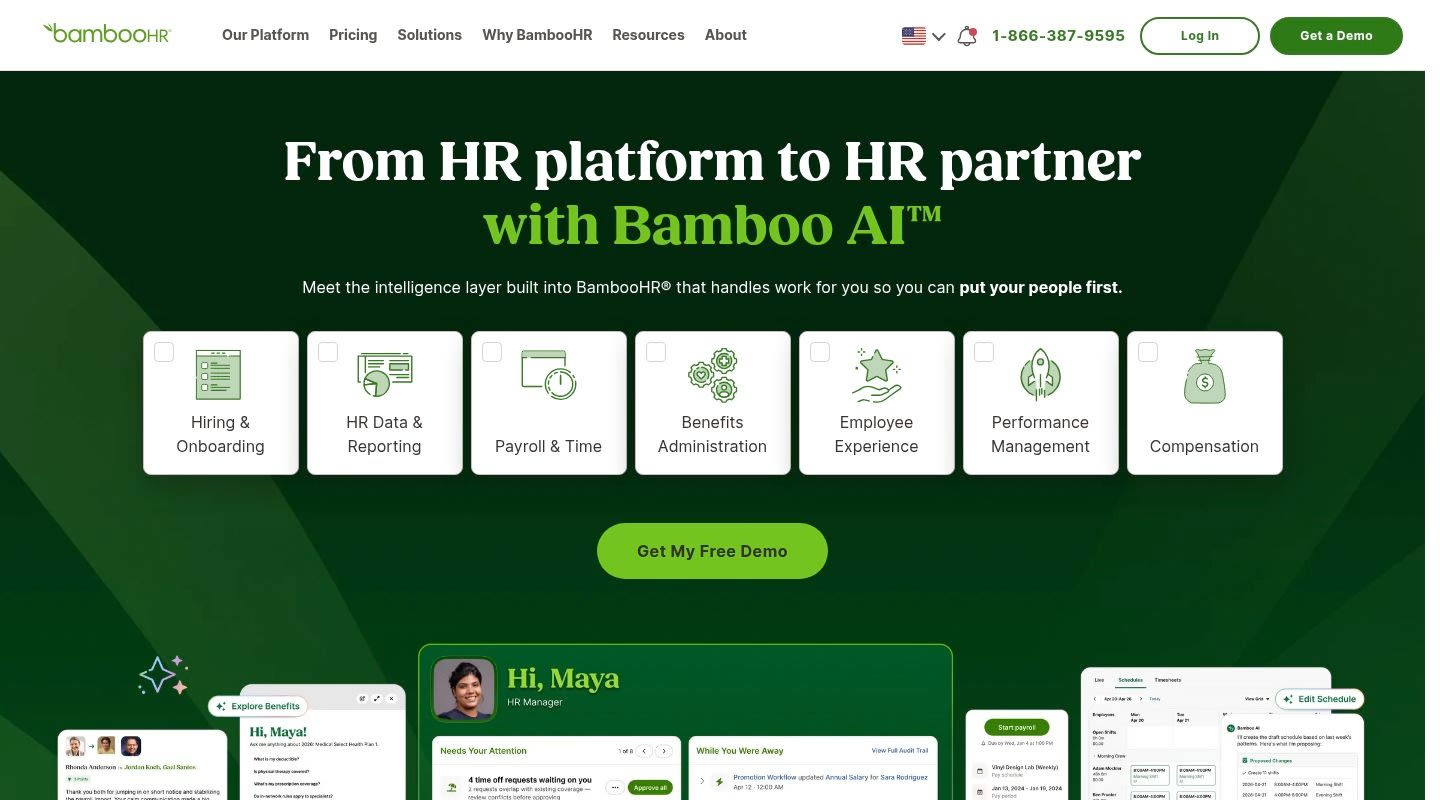
Verdict: A sensible SMB starting point where talent is a light add-on to core HR rather than a dedicated suite.
Why it made the list: BambooHR is a core HR system first, and its talent features exist to round out an approachable all-in-one for smaller companies. The outcome it serves is adoption: staff pick it up with minimal training, so light reviews and goals get used when they sit in the same friendly tool that already holds employee records and time off. Depth is the trade-off, with reviewers calling the performance and goal-setting features limited next to dedicated tools, weak analytics that often force you to extract data yourself, and a platform that can feel constraining as headcount climbs.
Best for: SMBs adding light performance to core HR
Skip it if: you need serious analytics or performance depth
Standout capabilities:
- Employee records, time-off tracking, and a company directory in a tidy hub reviewers consistently call easy to use.
- A performance add-on layering review cycles and goal tracking onto core HR, plus a well-liked self-service app that lifts load off lean teams.
- An open API and broad integrations connecting payroll, benefits, and other systems.
Pricing starts around $10 per employee per month, with Pro near $17 and Elite near $25, plus a roughly $250 monthly floor for teams under 25 and add-ons for payroll and performance that lift the total, and it rates 4.4/5 across more than 5,600 G2 reviews and 4.6/5 on Capterra.
6. Workday
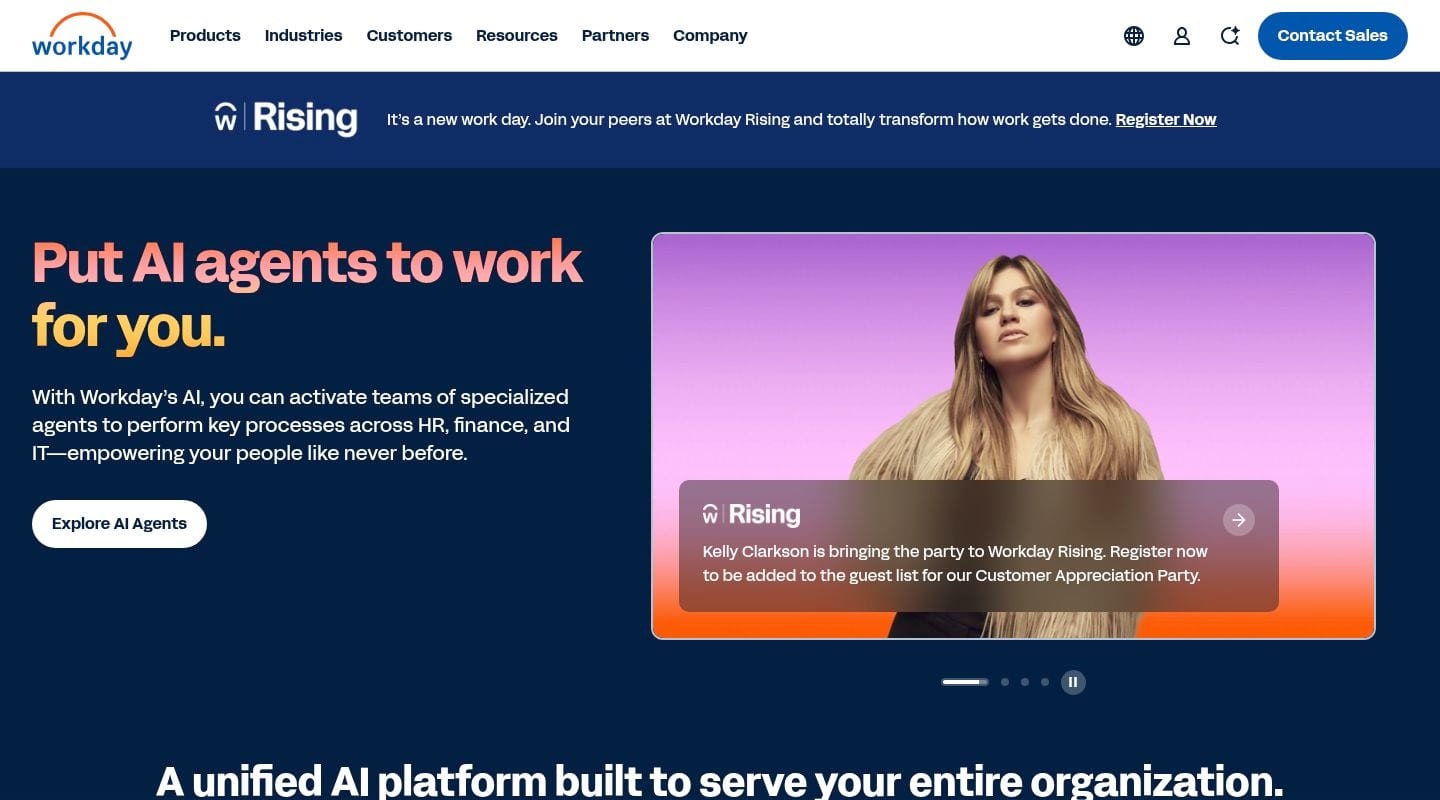
Verdict: The system a company reaches for when enterprise scale is here and HR, finance, and planning need to run together.
Why it made the list: Workday sits talent modules inside a deep HCM whose analytics and workforce planning hold up at scale, tying talent data to financial planning in a way mid-market tools can't. The outcome it supports is enterprise-grade decision-making: reporting and planning run deep enough to connect headcount, succession, and cost across a global workforce, which is why a large organization tolerates the commitment it asks for. That commitment is steep, with implementations running 9 to 18 months under heavy IT involvement, and reviewers flag a long, difficult candidate application and goals editing that's hard to navigate.
Best for: enterprises unifying HR, finance, and planning
Skip it if: you can't absorb a year-plus rollout
Standout capabilities:
- Enterprise HCM with reporting and workforce planning that run deeper than most mid-market tools.
- Review cycles, goals, and succession feeding the core HCM record across a global workforce.
- Configurable workflows for the complex approval chains and governance large organizations require, over multi-country HR and connected payroll at scale.
Pricing is custom enterprise and unpublished, targeting large organizations, and it rates around 4.1 to 4.2/5 on G2 and 4.5/5 on Capterra.
7. SAP SuccessFactors
Verdict: A global-enterprise suite for standardizing performance, learning, and succession across many countries and business units.
Why it made the list: SuccessFactors is built to enforce consistent talent processes across regions and entities, which is the outcome a distributed, highly governed workforce needs: the same review, calibration, and succession logic applies whether an employee sits in one country or twelve. For an organization already invested in SAP, broad talent modules and enterprise-grade compensation planning tie into performance data across the whole enterprise. The weight shows in cost and rigidity, with reviewers calling it costly, noting that even small updates can require a costly vendor, and pointing to high maintenance, complex integration, and rigid standard reporting that leans on IT.
Best for: large organizations already standardized on SAP
Skip it if: you want to change processes without vendor involvement
Standout capabilities:
- Performance, goals, succession, and learning spanning a wide enterprise suite.
- Global process standardization that enforces consistent talent processes across regions and entities.
- Enterprise-grade calibration and compensation planning tied into performance data, with tight fit to the wider SAP stack.
Pricing is custom and scoped to the enterprise, and it rates 4.1/5 across roughly 1,649 G2 reviews and 4.0/5 on Capterra.
8. Cornerstone
Verdict: The enterprise pick when the priority is developing and redeploying existing talent at scale.
Why it made the list: Cornerstone anchors on learning and internal mobility, and that focus maps directly to a retention outcome: a talent marketplace matches people to open roles, gigs, and projects so employees grow in place instead of leaving to advance. A course library past 100,000 titles and a mature LMS give a large organization the content depth to back that mobility with real development. The trade-offs are cost opacity and complexity, with no public pricing to gauge against and a platform built for scale that reads as overkill for teams with simpler talent needs.
Best for: enterprises prioritizing learning and internal mobility
Skip it if: your talent needs are simple or budget clarity matters early
Standout capabilities:
- A talent marketplace matching employees to open roles, gigs, and projects across the organization.
- A catalog of more than 100,000 courses supporting broad, self-directed learning.
- A mature LMS handling compliance training, certifications, and development tracking, with skills data connecting learning to career pathing.
Pricing is custom and quote-based, and it rates 4.0/5 on G2, the lowest among the enterprise suites here, so read recent reviews closely against your specific use case.
9. PerformYard
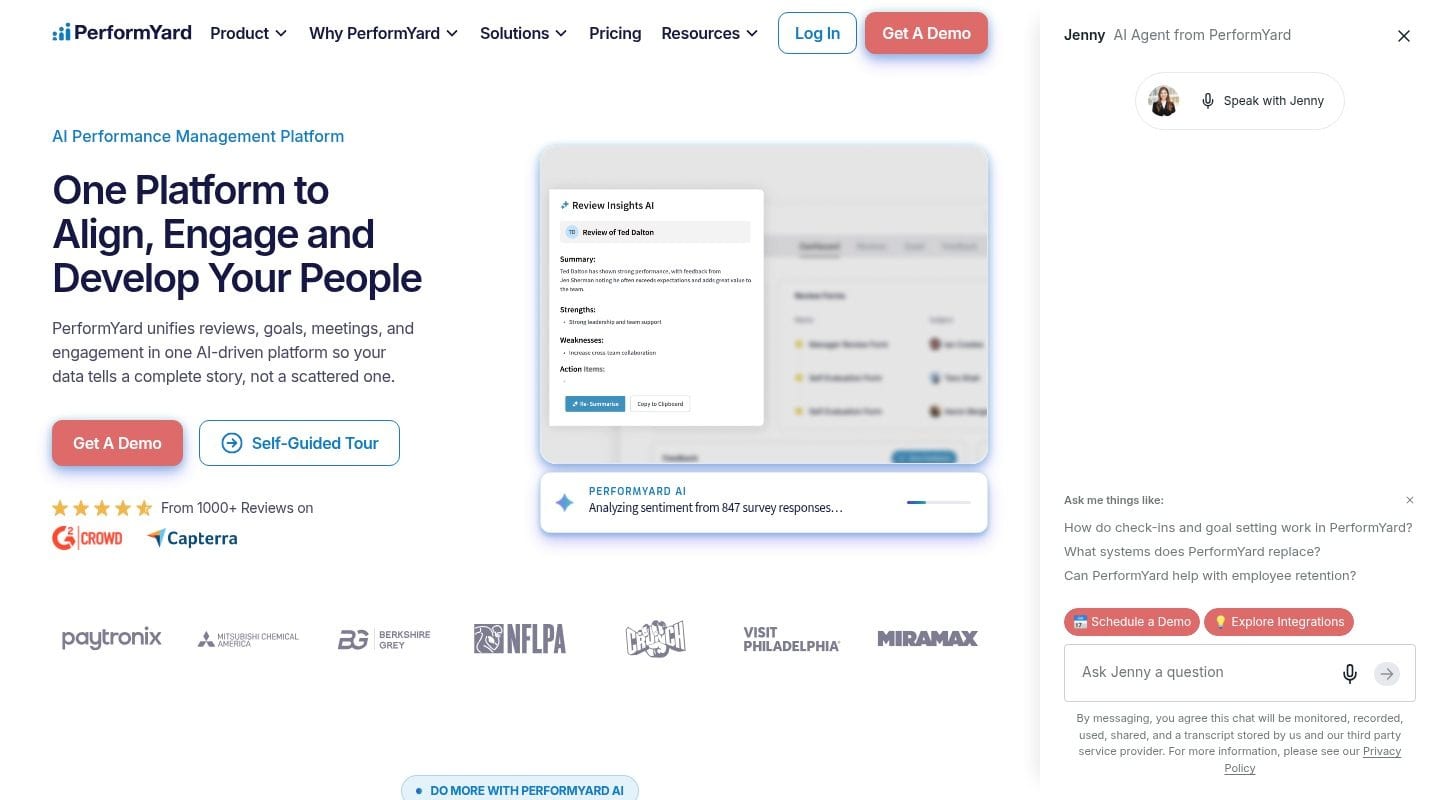
Verdict: A configurable-review pick for mid-market teams that run a defined process and want software that bends to it.
Why it made the list: PerformYard focuses on shaping the review cycle without the overhead of a full suite, and reviewers single out its flexibility and hands-on support. The outcome it serves is a review process that actually fits: teams design structures, cadences, and workflows around how they already run performance, while a clean interface plus attentive support ease rollout for lean HR teams so the cycle gets adopted rather than worked around. The limits show for data-heavy teams, with no advanced calibration, AI, or DEI analytics, and no recruiting, so hiring runs on a separate ATS that PerformYard won't unify.
Best for: mid-market teams with a defined review process
Skip it if: you want calibration, AI analytics, or unified hiring
Standout capabilities:
- Configurable review structures, cadences, and workflows matched to an existing process.
- Goal tracking that ties into reviews, plus ongoing feedback and check-ins supplementing formal cycles.
- A straightforward interface and hands-on support that ease rollout for lean HR teams.
Pricing is quote-based, so expect a sales conversation to scope cost, and the corpus carries no numeric rating, so weigh it on configurability and support fit rather than a headline score.
10. Paycor
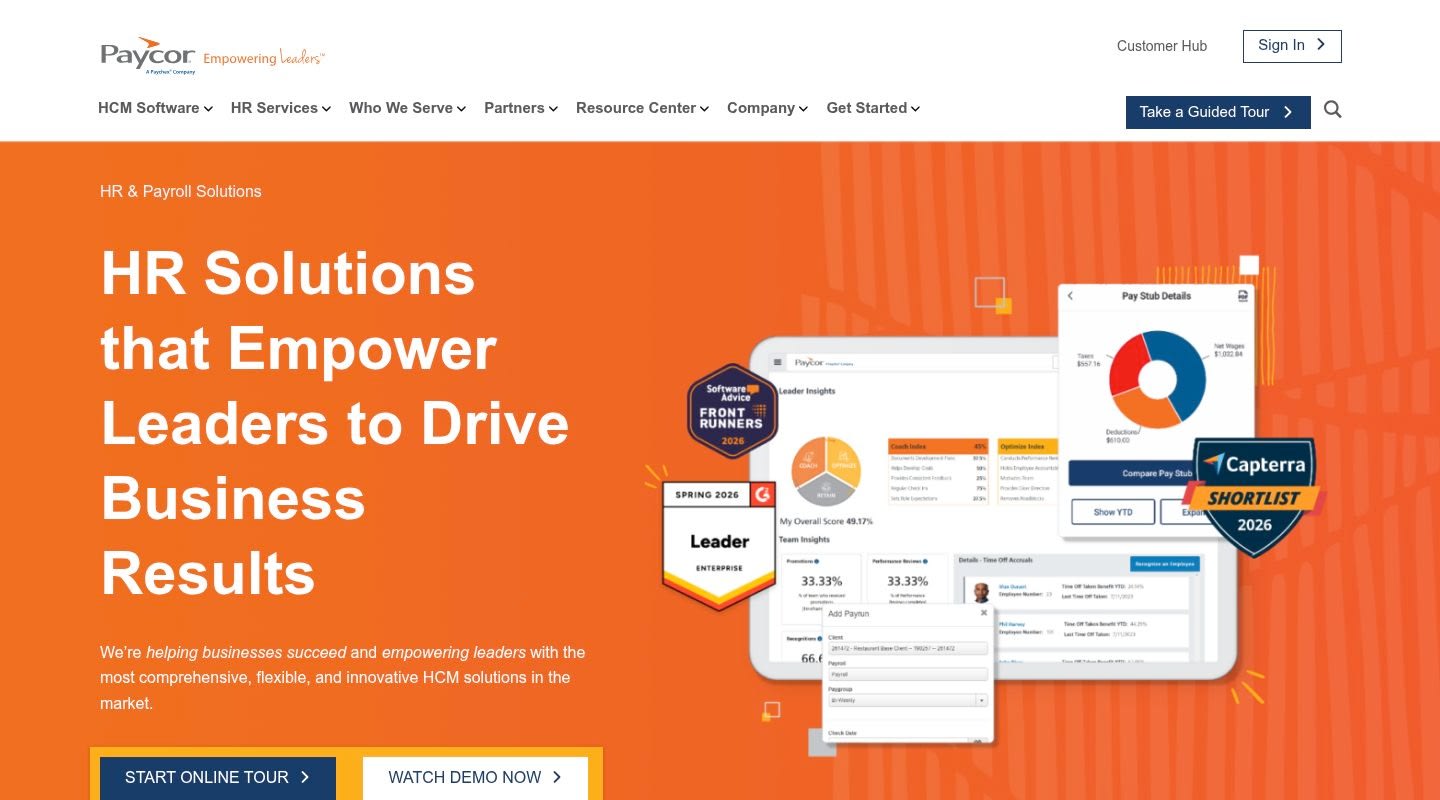
Verdict: A US suite pick for companies that want performance tooling under the same roof as pay.
Why it made the list: Paycor packages payroll, HR, and talent into one US-focused suite, and the outcome it targets is a trimmer vendor count: review and 1:1 tools sit inside a broader HRIS rather than a standalone system, so a mid-market team consolidates pay, hiring, and performance with one provider. Recruiting and onboarding feed new hires into the core record, keeping the employee lifecycle in a single place. Execution is the concern, with reviewers citing ongoing issues around paycheck delivery, PTO accruals, and recruiting not working as expected, plus a dated, clunky interface that's hard to learn.
Best for: US teams consolidating payroll, HR, and performance · Skip it if: you need polished, reliable core payroll and hiring
Standout capabilities:
- Performance reviews and structured 1:1 tracking alongside core HR.
- An all-in-one HRIS covering payroll, time and attendance, and core HR for most US mid-market needs.
- Built-in recruiting and onboarding feeding new hires into the core system, with standard HR and workforce reporting for admins.
Pricing runs about $99 base plus $5 per employee per month, varying by company size and modules, and it rates 3.9/5 across roughly 1,300 G2 reviews and 4.3/5 on Capterra.
11. Paylocity
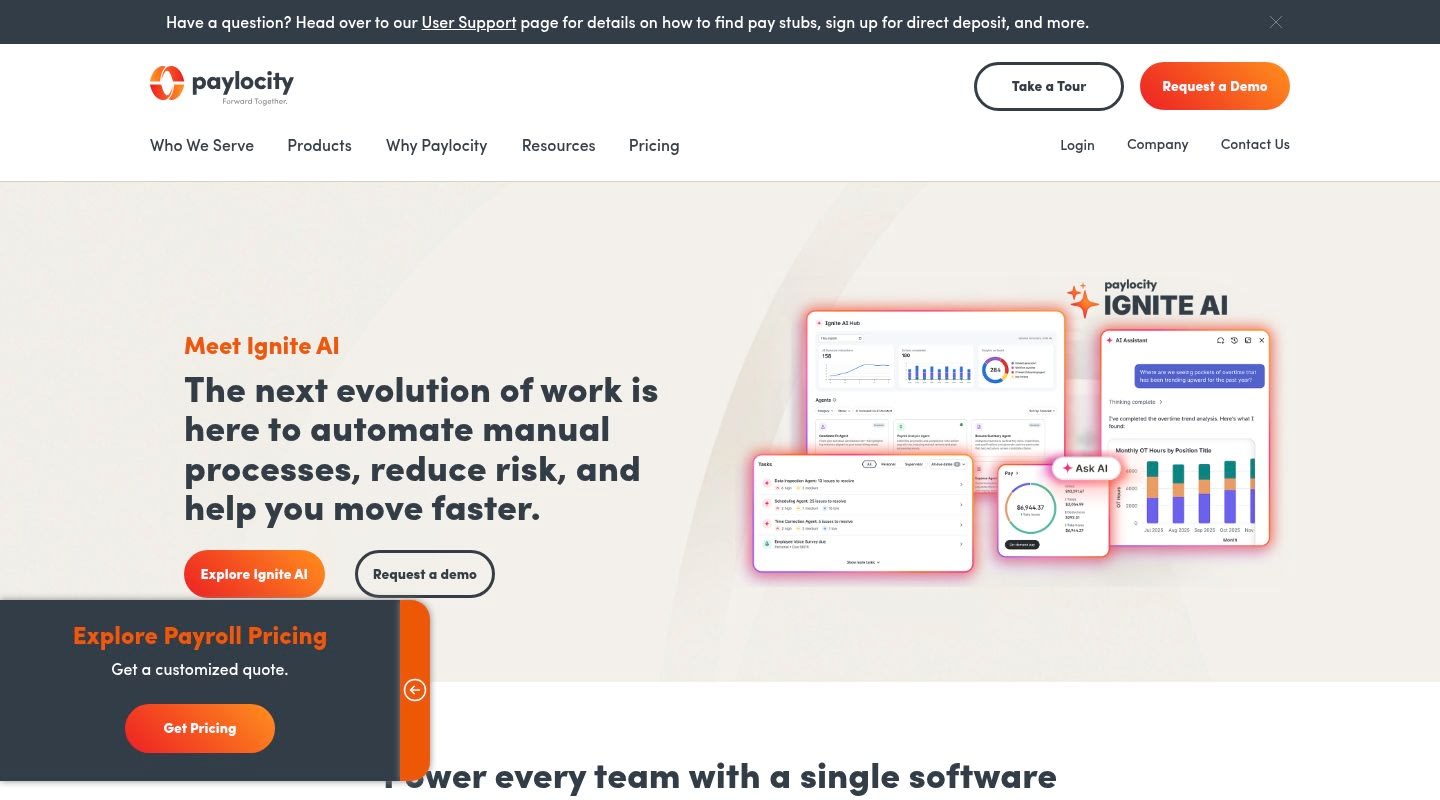
Verdict: A payroll-first US pick that stands out for pairing pay with genuine engagement and communication depth.
Why it made the list: Paylocity's differentiator among payroll-first suites is culture tooling, and that maps to an engagement outcome: recognition, surveys, and a community feed give the employee experience depth most payroll platforms skip, sitting next to pay and performance rather than in a separate tool. A flexible report builder lets admins create the non-standard reports power users value. The boundaries are geographic and operational, with a US-based system that can't manage a global workforce, inconsistent support quality, and a learning curve until the platform's terminology clicks.
Best for: US mid-market teams wanting culture tools beside payroll
Skip it if: you manage a global workforce or need consistent support
Standout capabilities:
- Recognition, surveys, and a community feed that add depth to the employee experience.
- Review and goal features connecting to the broader HR and payroll platform.
- A flexible report builder for non-standard reports, over US payroll, time, and PTO.
Pricing is quote-based, tied to headcount and modules, and the corpus lists no numeric G2 score, so evaluate it on engagement fit and US-market suitability rather than a rating.
12. Deel
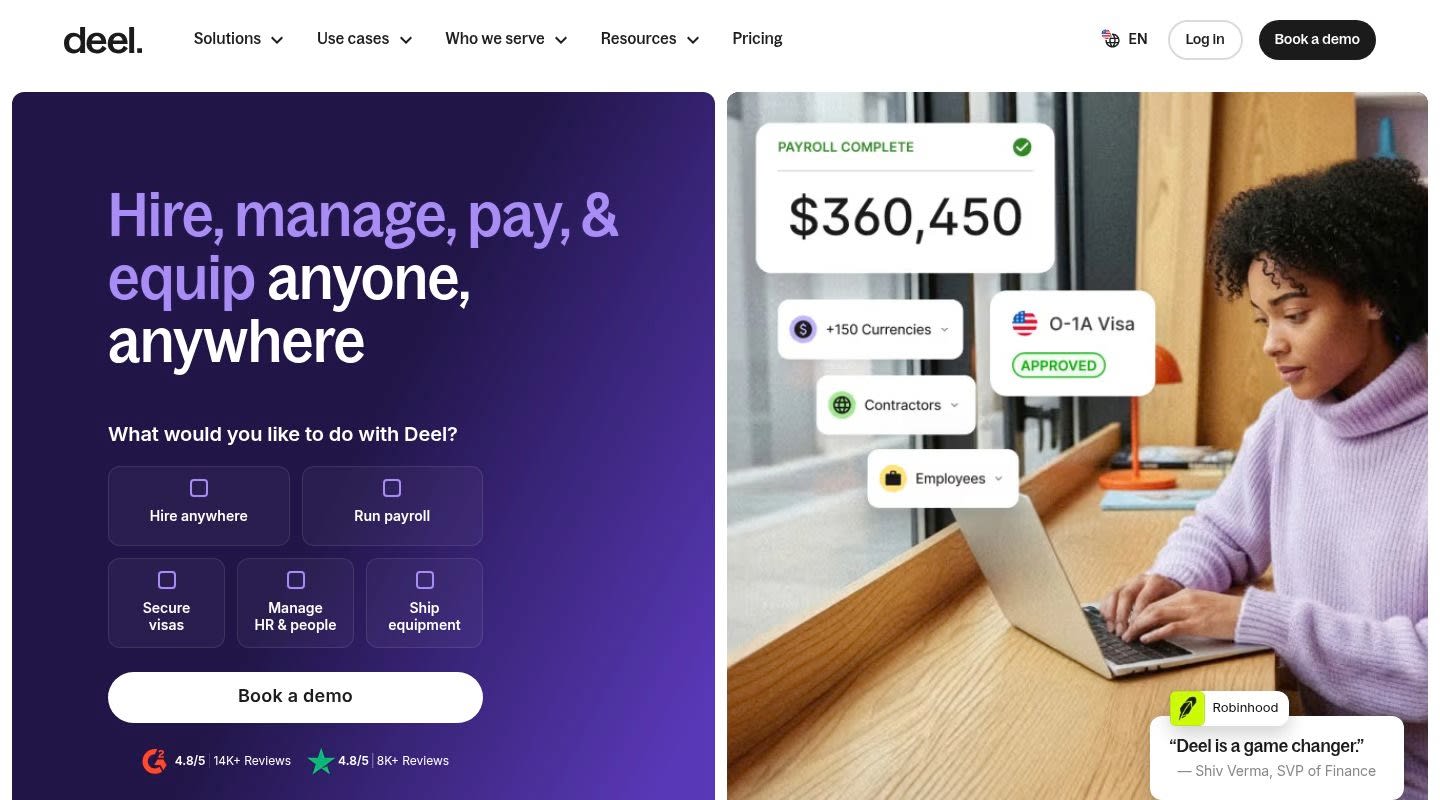
Verdict: The pick for distributed teams adding headcount abroad where the buyer holds no local entity.
Why it made the list: Deel made its name on cross-border employment, and its talent relevance is reach: hiring, paying, and managing people in more than 150 countries, with Deel HR adding a core people record to the global pay engine for a single view of a distributed workforce. The outcome it enables is growth without entities, letting a globally spread organization onboard talent in new markets while the platform handles local tax and compliance. Talent depth is where it runs thinner than platforms designed talent-first, with reviewers calling the employee offboarding experience terrible, a dashboard short on deep analytics for large teams, and steep withdrawal fees.
Best for: distributed teams hiring across borders
Skip it if: you need deep talent analytics or a talent-first design
Standout capabilities:
- Onboarding and pay for workers across 150-plus countries, managing local compliance through an EOR model.
- Deel HR core records sitting alongside global pay for a single view of a distributed workforce.
- Contractor and employee onboarding flows that collect documents, set up payments, and manage local tax and compliance across markets.
Deel HR starts around $5 per employee per month, with EOR priced separately at roughly $29 to $125 per employee, and it rates 4.8/5 on G2 and 4.9/5 on Capterra, though those scores center on its global-pay strength rather than talent depth.
How to choose the best talent management platform for your team
A tool that fits at 100 employees can strain at 1,000, so the real question isn't only what a talent management system does today but whether it lifts the outcomes you care about as you grow. Run each candidate through these checks:
- Start from the outcome, not the feature. Decide whether your priority is retention, internal mobility, or time-to-productivity, then judge each tool on how directly it moves that number rather than how many modules it lists.
- Confirm one people record. The strongest talent data compounds because hiring, performance, engagement, and learning share a single profile. Tools that sync between separate systems lose fidelity every time the data moves.
- Look for depth where you'll actually use it. A 9-box grid or calibration workflow only helps if your team runs talent reviews; a weekly check-in only helps if managers adopt it. Match capability depth to your real cadence.
- Weigh AI on signal, not novelty. AI review summaries and survey sentiment earn their keep when they cut reading time and surface themes a person would miss, not when they simply exist.
- Map the full cost. Quote-based pricing and per-module add-ons mean the headline rate rarely reflects the bill. List the capabilities you need on day one versus later, then ask each vendor to quote that exact mix.
- Check the size fit both ways. Enterprise suites like Workday, SAP SuccessFactors, and Cornerstone carry weight a mid-market team doesn't need, while point tools like PerformYard and 15Five can thin out as you scale. Buy for where you'll be in two years.
- Read reviews for adoption, not features alone. Support responsiveness and ease of use decide whether a talent system gets used at all, and an unused platform produces no outcomes.
Which talent management software is best for 2026
The right talent management software comes down to where your friction lives and how big you are. Enterprises standardizing global processes will look at Workday, SAP SuccessFactors, and Cornerstone despite the cost and rollout weight. Teams that just need performance and engagement can do well with Lattice or 15Five, while PerformYard suits a defined review process and Leapsome rewards heavy customization. US payroll-first buyers adding talent will weigh Paycor and Paylocity, and globally distributed teams lean on Deel. BambooHR remains a sensible SMB starting point where talent is a light add-on to core HR.
Bob earns the top spot for the problem this list is really about: producing talent outcomes on one connected system. Its Talent suite runs 360s with AI summaries, 9-box calibration, goals, structured 1:1s, engagement and ELF surveys with AI sentiment, succession, and development paths, all on the same people record that powers Bob Hiring and Bob Learning, with the Bob Skills taxonomy tying hiring, performance, and learning together.
That continuity is what point tools in the mid-market and culture lane can't match and what enterprise suites deliver only at far greater cost and complexity. For a mid-sized team that competes on culture and wants a clear read on retention and internal mobility, that unified thread is what makes Bob the best talent management platform 2026 buyers can commit to. As talent decisions get judged on outcomes rather than feature lists through 2026, the systems that connect the full arc from hire to development will be the ones worth building on.
Frequently asked questions
What is talent management software?
Talent management software is a platform that handles the employee-development side of HR: performance reviews, goal setting, engagement measurement, succession planning, and often learning and internal mobility. Where a payroll or core HR system records who someone is and how they're paid, a talent management system focuses on how they perform, grow, and stay. The strongest platforms connect these functions so the data from a review informs development, and engagement scores inform retention, rather than sitting in separate silos.
How is talent management software different from an HRIS?
An HRIS is the system of record for core people data: employee profiles, time off, and often payroll and benefits. Talent management software sits on top of that foundation and focuses on developing people once they're hired, through performance, engagement, succession, and learning. The line blurs in unified platforms. Bob, for example, runs its Talent suite on the same people record as its core HR and hiring, so the two work as one system instead of a talent tool bolted onto an HRIS through an integration.
Which talent management software is best for mid-sized companies?
Mid-market teams usually want more performance and engagement depth than an SMB tool offers, without the cost and rollout of an enterprise suite. Lattice and 15Five are strong performance-and-engagement picks, while Leapsome suits teams that want heavy customization. For a mid-sized company that wants hiring, performance, engagement, and development on one connected record rather than three tools stitched together, Bob is built for exactly that lane.
Can talent management software improve employee retention?
It can, when the features connect to action rather than just recording activity. Engagement surveys with sentiment analysis surface morale problems early, 9-box calibration and succession planning flag flight risk before a key person leaves, and internal mobility and development paths give people a reason to grow in place instead of leaving. The tools that move retention are the ones that turn signals into decisions rather than filing them away in a dashboard.
What features matter most in a talent management platform?
Prioritize the capabilities that map to your outcome. For performance, that means configurable reviews, 360 feedback, and goal alignment; for retention and mobility, engagement surveys, sentiment analysis, succession planning, and development paths; and underneath all of it, a shared people record and a skills taxonomy so the data compounds. AI that summarizes reviews or reads survey sentiment adds value when it cuts work, not when it's a bullet point. Feature depth only counts where your team will actually use it.
How much does talent management software cost?
Pricing ranges widely. Performance-focused tools like Lattice and 15Five start around $4 per seat per month, though minimums and higher tiers lift the real entry cost, while BambooHR starts near $10 per employee per month. Full suites and enterprise platforms, including Workday, SAP SuccessFactors, Cornerstone, and Bob, use quote-based pricing scoped to headcount and the modules you turn on. The practical move is to list the capabilities you need on day one versus later, then ask each vendor to quote that exact mix, since add-ons are where budgets slip.
More in business
Venture
Write for entrepreneurs, founders, and builders.
Share startup lessons, growth tactics, and founder stories with readers on the same journey.
One free account across In Plain English, Stackademic, Venture, and Cubed.
How it works- Startups & entrepreneurship
- Marketing & growth
- Productivity & leadership
- Founder stories & lessons learned
Sign in
Google or GitHub
Complete profile
Takes a few minutes
Get approved & publish
Start sharing
Why write for Venture?
Entrepreneurship is rarely a straight path. The lessons worth sharing are learned while building.
Comments
Loading comments…