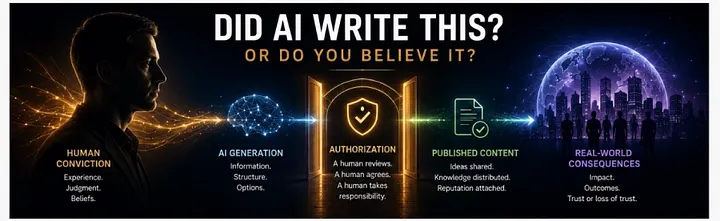
Did AI Write This?
Or Do You Believe It?
5 min readJonathan Capriola
Author’s Note
I’ve spent the last several years thinking about trust, authorization, autonomous systems, and what happens when AI moves from generating information to executing real-world actions. This article reflects my personal view on where the industry is headed.
In 2026, we are asking the wrong question.
Not:
“Did AI write this?”
But:
“Do you believe it?”
Those are not the same question.
For decades, society judged ideas partly by the effort required to produce them.
Writing a book took years.
Researching a paper took months.
Building software required teams.
The assumption was simple:
If something was difficult to create, it was valuable.
Artificial intelligence breaks that relationship.
Today, a founder can spend ten years studying an industry, building products, talking to customers, making mistakes, and developing convictions about how the world actually works.
Then AI can help organize those convictions into an article in minutes.
Who is the author?
The person who typed the words?
Or the person who formed the belief?
That question matters because production is no longer scarce.
Judgment is.
The real question has never been whether a machine assisted in creating something.
The real question is whether a human stands behind it.
Did they review it?
Do they understand it?
Can they defend it?
Are they willing to attach their reputation to it?
If the answer is yes, authorship still exists.
If the answer is no, something fundamentally different is happening.
A person who publishes AI-generated content they have never reviewed, do not understand, and cannot defend is not functioning as an author.
They are functioning as a distribution channel.
That distinction may become one of the defining trust questions of the AI era.
Because this debate is not actually about writing.
It is about accountability.
And accountability is ultimately about authorization.
Who approved this?
Who accepted responsibility for it?
Who stood behind it?
The reason this matters extends far beyond content.
The same question society is beginning to ask about AI-generated articles will soon be asked about AI-generated actions.
When an AI system approves a loan, executes a financial transfer, deploys infrastructure, modifies a database, purchases inventory, or controls critical operations, nobody will care how the decision was generated.
Nobody will care whether the recommendation came from GPT, Claude, Gemini, an open-source model, or a future system that does not yet exist.
The question will be much simpler:
Who authorized it?
Who is accountable for the consequence?
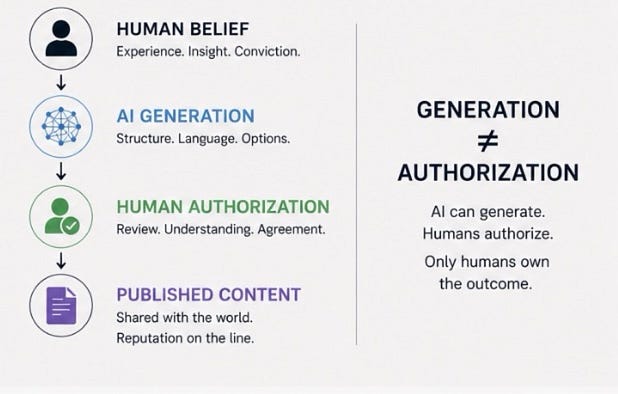
Generation and authorization are not the same thing.
An AI can generate content.
- A human author authorizes publication.
An AI can generate a recommendation.
- A human executive authorizes adoption.
An AI can generate an action.
- Someone must authorize execution.
This may become the defining mistake of the first generation of autonomous systems.
We spent years teaching machines how to generate.
The age of AI is not creating a content problem.
It is revealing an authorization problem.
And authorization has always been the real trust boundary.
The important question isn’t who typed the words.
It’s who stands behind them. We spent very little time deciding who authorizes the consequences.
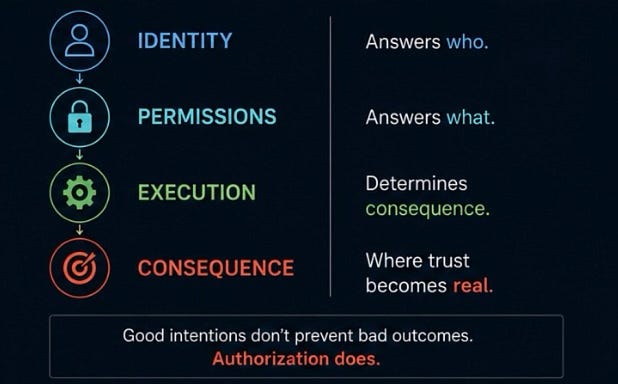
For decades, cybersecurity focused primarily on identity.
Who is the user?
Who has the credentials?
Who has permission?
Those questions still matter.
But autonomous systems introduce a new problem.
A system can possess valid credentials and still execute the wrong action.
An agent can be fully authenticated and still cause harm.
A workflow can be approved upstream and still produce unacceptable consequences downstream.
Identity answers who.
Permissions answer what.
Execution determines consequence.
And consequence is where trust becomes real.
This is why the trust boundary is moving.
Historically, trust was established before execution.
In autonomous systems, trust must increasingly be verified at execution.
Because probabilistic systems are now interacting directly with deterministic outcomes.
Money moves.
Infrastructure changes.
Systems execute.
Consequences become irreversible.
Once autonomous systems begin acting at machine speed, governance that happens after execution becomes little more than documentation.
The future belongs to systems that can establish trust before consequence occurs.
Not after.
Which brings us back to the original question.
Did AI write this?
Maybe.
Maybe AI helped structure it.
Maybe AI improved its clarity.
Maybe AI refined its wording.
That is not the interesting question.
The interesting question is whether I understand every sentence, agree with every sentence, and am willing to put my name behind every sentence.
Because trust has never been about who typed the words.
Trust has always been about who stands behind them.
And as autonomous systems become more capable, that same principle will extend beyond words and into actions.
The age of AI is not creating a content problem.
It is revealing an authorization problem.
And authorization has always been the real trust boundary.
The age of AI is not creating a content problem.
It is revealing an authorization problem.
And authorization has always been the real trust boundary.
The important question isn’t who typed the words.
It’s who stands behind them.
More in artificial-intelligence


Venture
Write for entrepreneurs, founders, and builders.
Share startup lessons, growth tactics, and founder stories with readers on the same journey.
One free account across In Plain English, Stackademic, Venture, and Cubed.
How it works- Startups & entrepreneurship
- Marketing & growth
- Productivity & leadership
- Founder stories & lessons learned
Sign in
Google or GitHub
Complete profile
Takes a few minutes
Get approved & publish
Start sharing
Why write for Venture?
Entrepreneurship is rarely a straight path. The lessons worth sharing are learned while building.
Comments
Loading comments…