How Acoustic Measurement Tools Are Helping Companies Build Better Workspaces
Renovating without measuring is expensive guesswork. Learn how acoustic measurement data helps companies solve the right problems, protect budgets, and build high-performance workspaces.
7 min read
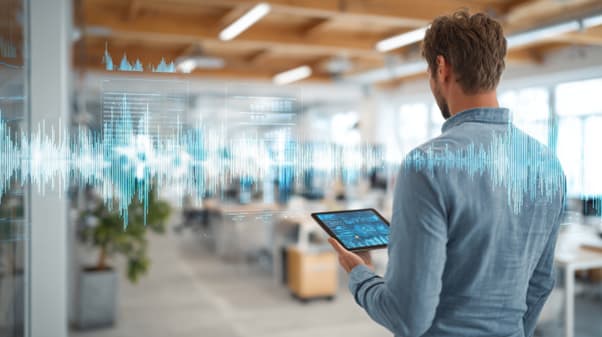 Companies will spend six figures on ergonomic furniture, circadian lighting systems, and biophilic design. They'll hire interior architects, run employee surveys, and iterate on floor plans for months. Then they'll install a few acoustic panels based on gut feeling and call the sound environment handled. It's the one part of the workplace that almost nobody actually measures.
That's starting to change. Acoustic measurement has become an essential step for companies that are serious about building workspaces that actually perform. Not guessing at the problem. Not decorating their way toward a solution. Measuring, understanding, and then acting on real data about what's happening in their specific space.
What Most Companies Get Wrong About Office Acoustics
The typical approach goes something like this: the office feels loud, someone complains, a few panels get ordered online and mounted on the most visible walls. The room looks more treated. Whether it actually is treated — and whether the right problem got solved — is a question most companies never ask.
This matters because acoustic problems are not all the same. A space with too much reverberation needs absorption. A space where speech from one zone bleeds into another needs better sound isolation or masking. A space with mechanical noise coming through the ceiling needs a completely different intervention than one where the problem is conversation carrying across an open floor. Treating the wrong problem doesn't just fail to help. It can make things worse.
The financial consequences of getting this wrong are real. Companies have renovated entire floors, installed expensive ceiling systems, and rearranged teams — only to find the core problem unchanged because they never identified what it actually was. Measurement isn't a technical formality. It's the step that protects the investment.
What Acoustic Measurement Actually Tells You
The four parameters that matter most in a workplace acoustic assessment are reverberation time, speech intelligibility, ambient noise floor, and sound transmission between spaces.
Reverberation time measures how long sound persists in a room after the source stops. Long reverberation makes spaces feel loud and fatiguing even at moderate sound levels. It's the reason some conference rooms feel exhausting after an hour, regardless of how many people are in them. Short reverberation, taken too far, creates a dead, uncomfortable quality that most people find equally unpleasant. The target depends on the function of the space.
Speech intelligibility measures how clearly spoken words can be understood at a given distance. In meeting rooms, high intelligibility is essential. In open plan areas, lower intelligibility between workstations is actually desirable — it reduces the distraction caused by nearby conversations. These are opposite goals in the same building and they require different solutions.
The ambient noise floor is the baseline level of continuous sound present when no specific activity is occurring. HVAC systems, street noise, building equipment — these all contribute. A noise floor that's too low makes every conversation carry further than it should. One that's too high creates constant fatigue. There's a measurable sweet spot and most offices land nowhere near it by accident.
Sound transmission measures how much noise passes between spaces. Between a private office and an open area. Between a conference room and a neighboring workspace. Between floors. This parameter determines whether confidential conversations stay confidential and whether focus zones actually function as focus zones.
The Tools Companies Are Using Right Now
Professional acoustic measurement used to require specialized consultants with expensive equipment and significant lead times. That's still the gold standard for complex projects. But the barrier to entry has dropped considerably and the options available to companies of any size have expanded significantly.
Dedicated acoustic analyzers from manufacturers like NTi Audio and Brüel & Kjær provide laboratory-grade measurements in real environments. These instruments measure all the parameters that matter with precision that holds up to professional scrutiny. For large office builds and significant renovation projects, this level of rigor is worth the investment.
For smaller companies and initial assessments, smartphone-based measurement applications have reached a level of accuracy that makes them genuinely useful. Apps like Room EQ Wizard and several iOS and Android alternatives use the device microphone to measure reverberation and frequency response with reasonable precision. They won't replace a professional assessment, but they give facility managers and operations teams meaningful data to work with before committing to a solution.
The most sophisticated deployments are moving toward continuous acoustic monitoring. Sensors embedded in the workspace measure noise levels, speech intelligibility, and occupancy patterns in real time, feeding data into dashboards that let facilities teams identify problem zones, track the impact of interventions, and make adjustments as the space and its usage evolve. It's the same data-driven approach that progressive companies already apply to air quality and energy consumption, applied to the acoustic environment.
How Measurement Drives Better Soundproofing Decisions
The measurement phase answers one question above everything else: where is the energy actually coming from. That answer determines everything that follows.
A space showing high reverberation time needs absorption. The materials, quantity, and placement depend on the frequency profile the measurement reveals. Low-frequency buildup in corners requires a different treatment than mid-range reflections off a hard ceiling. A professional reading of the measurement data tells you exactly which frequencies are problematic and where in the room they're concentrating. You treat those specific problems instead of covering walls uniformly and hoping for the best.
High sound transmission between spaces is a structural problem. Panels on the surface won't solve it. The solution involves mass, decoupling, or both — added layers of dense material, resilient channels that prevent vibration from traveling through the structure, acoustic sealant at every penetration. Measurement tells you how much transmission reduction you need, which determines the scope and cost of the intervention before a single dollar gets spent on materials.
Speech intelligibility problems in open plan areas often respond well to sound masking systems rather than absorption alone. White or pink noise distributed through ceiling speakers raises the ambient noise floor just enough to reduce the intelligibility of nearby conversations without creating an uncomfortable acoustic environment. The target masking level is derived directly from measurement. Without that baseline, you're adjusting a system with no reference point.
This is where professional acoustic consultants earn their value. Not in taking the measurements — the tools handle that — but in interpreting what the data means for a specific space with specific uses and translating it into a prioritized, cost-effective intervention plan. Good consultants don't recommend the same solution for every office. They read the data and respond to what it actually says.
Build Smarter, Not Louder
The companies getting workplace design right in 2026 are treating the office as a performance system. Every variable that affects how people think, communicate, and recover gets examined and optimized. The acoustic environment is not an exception to that approach. It's one of the highest-leverage variables in the entire system.
Measurement makes that optimization possible. It replaces expensive guesswork with targeted action. It protects renovation budgets from being spent on solutions that address the wrong problem. It gives facilities teams and leadership a common language for talking about acoustic quality — actual numbers rather than subjective complaints.
The technology is accessible. The methodology is established. The business case is straightforward. What's been missing for most companies is simply the decision to treat acoustic performance as something worth measuring in the first place.
The ones that have made that decision are building offices that their teams genuinely want to work in. Spaces where focus is possible, where conversation is comfortable, and where the environment itself stops being a source of daily friction. That's not a minor outcome. In a market where talent is expensive and retention is everything, it's a meaningful competitive advantage.
Measure first. Then build. The data will tell you exactly what to do.
More in business
Venture
Write for entrepreneurs, founders, and builders.
Share startup lessons, growth tactics, and founder stories with readers on the same journey.
One free account across In Plain English, Stackademic, Venture, and Cubed.
How it works- Startups & entrepreneurship
- Marketing & growth
- Productivity & leadership
- Founder stories & lessons learned
Sign in
Google or GitHub
Complete profile
Takes a few minutes
Get approved & publish
Start sharing
Why write for Venture?
Entrepreneurship is rarely a straight path. The lessons worth sharing are learned while building.
Comments
Loading comments…