How Smart Startups Are Designing Offices That Actually Help People Focus
Noise kills productivity more than any other workplace factor. Learn how leading startups use acoustic design and sound dampening to protect their team's focus and output.
7 min read
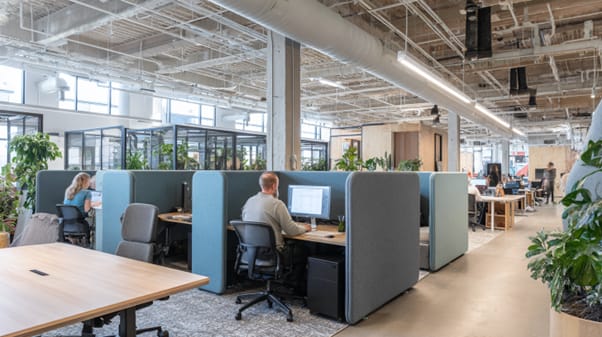
The open office was supposed to fix everything. Tear down the walls, mix the teams, let ideas flow freely. It made perfect sense on a whiteboard. In practice, it created something closer to a productivity nightmare — a space where everyone is technically together and almost nobody can actually think.
The smartest startups figured this out early. Office sound dampening panels became one of the first practical investments they made when designing spaces where real work actually happens. Not as an afterthought. Not as décor. As infrastructure.
The Open Space Myth - What the Data Actually Says
The research on open plan offices is not kind. A study from Harvard Business School found that shifting to open office layouts actually reduced face-to-face interaction by around 70 percent, while electronic communication increased. People put on headphones and retreated inward. The collaboration that open offices promised largely didn't materialize.
What did materialize was noise. Constant, unrelenting, cognitively expensive noise.
A report from Ipsos and Steelcase surveying over ten thousand workers across fourteen countries found that the inability to concentrate was the single biggest workplace complaint. Not compensation. Not management. Noise and lack of focus. Workers reported losing significant portions of their day to distraction, and the psychological toll compounded over time in the form of stress, frustration, and disengagement.
For startups, this is an especially acute problem. You're asking people to do genuinely hard cognitive work — writing code, making strategic decisions, having sensitive client conversations — in environments that were optimized for visual openness rather than mental performance. The disconnect is costly in ways that don't always show up cleanly on a spreadsheet, but absolutely show up in output quality and employee retention.
What High-Performance Offices Actually Look Like
The companies getting this right aren't building libraries. They're building layered environments that give people genuine choice over their acoustic context throughout the day.
There are zones designed for collaboration — open, energetic, tolerant of noise and cross-talk. And there are zones designed for focus — quieter, bounded, acoustically treated so that the ambient noise floor is low enough for deep work to actually happen. The best offices make moving between these zones frictionless, so people can match their environment to the kind of work they're doing at any given moment.
Phone booths and small enclosed pods have become standard in well-designed startup offices. They solve the private conversation problem without requiring full private offices. A single treated pod in the corner of an open floor can handle sensitive calls, video meetings, and deep focus sessions for dozens of people across a week.
Acoustic zoning doesn't require tearing out walls or hiring an architect. It requires intentionality. Where you place teams, how you orient workstations, what materials you use on walls and ceilings — these decisions compound. Done thoughtfully, they create an environment that supports the full range of work a modern team needs to do.
Acoustics as a Business Decision, Not an Aesthetic One
This is where a lot of companies get it wrong. They treat acoustic treatment as a design question. Something to consider once the important decisions have been made. It isn't. It's an operational decision with a measurable return.
The math isn't complicated. If noise costs a knowledge worker even thirty minutes of productive time per day, that's two and a half hours per week. Multiplied across a team of twenty, you're losing fifty hours of productive capacity every single week to an entirely solvable problem. The cost of acoustic treatment becomes trivial when you frame it that way.
Employee retention adds another layer. People leave bad environments. Not always dramatically, not always consciously connecting their decision to the noise and the inability to focus. But the correlation between poor workplace acoustic design and higher turnover is well documented. Hiring and onboarding a single mid-level employee costs between fifty and two hundred percent of their annual salary, depending on the role. Preventing even one unnecessary departure pays for a significant acoustic upgrade.
The startups that treat office acoustics as a people investment rather than a facilities expense make better decisions about it. And they make those decisions earlier, before the problems become entrenched and the fix becomes more expensive.
Practical Acoustic Upgrades Startups Are Making Right Now
The good news is that you don't need a renovation budget to meaningfully improve your office acoustics. Most of the highest-impact changes are modular, reversible, and scalable as your team grows.
Wall-mounted absorption panels are where most startups begin. They're easy to install, immediately effective, and available in formats that look intentional rather than industrial. Placed at ear height along the walls where most conversations and noise sources concentrate, they reduce reflections and bring the ambient noise floor down noticeably. People stop raising their voices to be heard. The room stops feeling exhausting to work in.
Ceiling treatment is consistently underestimated. Hard ceilings in open offices act as giant reflective surfaces, bouncing sound across the entire floor. Hanging acoustic baffles or clouds above high-traffic areas — particularly above collaborative zones and meeting spaces — delivers disproportionate results for the investment. It's one of the first things acoustic consultants recommend and one of the last things companies think of on their own.
Soft surfaces throughout the space do quiet work that adds up. Rugs absorb floor reflections. Upholstered furniture reduces reverberation. Bookshelves and plants break up sound paths in ways that are subtle but cumulative. None of these replace dedicated acoustic treatment, but they contribute to an environment that feels less harsh and fatiguing over a full workday.
Partition screens between workstations address the most direct source of distraction — the person sitting four feet away from you. Acoustic partitions don't block all sound, but they reduce the intelligibility of nearby conversations enough to allow focus. Intelligibility is the keyword here. The brain can partially tune out noise. It cannot tune out words it can understand. Reducing speech intelligibility is one of the most effective focus interventions available in an open office context.
Build the Office Your Team Deserves
The companies winning the talent game right now aren't just offering better salaries and more flexibility. They're offering better environments. Spaces that signal to employees that their cognitive experience at work actually matters to leadership.
Acoustic design is one of the clearest expressions of that signal. It's visible. It's felt immediately. And unlike a lot of workplace investments, the people inside the space experience the benefit every single day.
Startups that treat their office as a performance tool rather than a cost center make better use of it. They attract people who care about doing good work and they keep them longer because those people can actually do good work once they arrive.
The office isn't dead. The bad office is dead. The noisy, chaotic, acoustically hostile space that drains people and produces mediocre output — that version is being replaced by something more deliberate, more considered, and significantly more effective.
If you're building or redesigning a workspace right now, acoustics shouldn't be the last thing on your list. It should be one of the first conversations you have. The return is real, the cost is manageable, and the impact on your team is immediate.
More in ecommerce
Venture
Write for entrepreneurs, founders, and builders.
Share startup lessons, growth tactics, and founder stories with readers on the same journey.
One free account across In Plain English, Stackademic, Venture, and Cubed.
How it works- Startups & entrepreneurship
- Marketing & growth
- Productivity & leadership
- Founder stories & lessons learned
Sign in
Google or GitHub
Complete profile
Takes a few minutes
Get approved & publish
Start sharing
Why write for Venture?
Entrepreneurship is rarely a straight path. The lessons worth sharing are learned while building.


Comments
Loading comments…