How to Use AI to Drive Organic Traffic Without Guessing
A smarter approach to building search traffic using tools that show you exactly what to do
7 min readEddy Enoma

Most people approach SEO the same way. They write something they think is good, hit publish, wait, and then check analytics hoping for movement. Sometimes it works. Often it does not, and they have no clear idea why.
Learning how to use AI to drive organic traffic is really about replacing that cycle with a process. One where your tools validate demand before you write, help you structure content around real search intent, and flag exactly what needs to change before you ever hit publish.
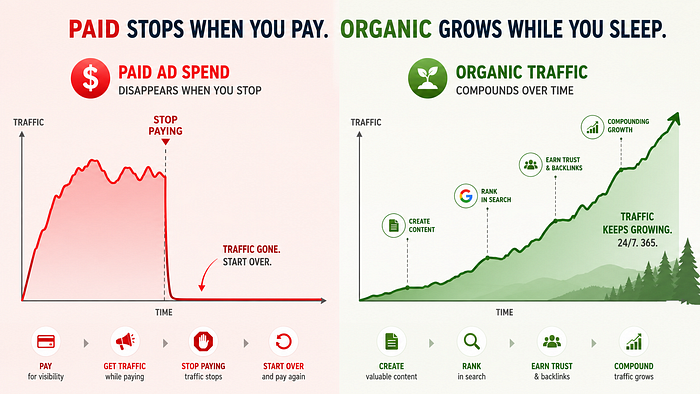
Organic search still accounts for around 53% of all website traffic across the web, more than direct, social, email, and paid combined. For online businesses that need sustained growth rather than constant ad spend, that number tells you where to focus your energy.
What AI SEO Tools Actually Do
Traditional SEO used to mean either paying an agency, becoming an expert yourself, or doing a lot of slow manual research. AI SEO tools have changed that considerably. They process large amounts of search data, competitor content, and on-page signals far faster than any manual process, and then surface specific, actionable recommendations.
Here are the four things these tools now handle that used to take hours:
- Keyword discovery: Finding terms with real search demand and manageable competition so you target what people actually search for
- Content scoring: Comparing your draft against the top-ranking pages and flagging structural, topical, and readability gaps
- Competitor gap analysis: Identifying which topics your competitors rank for that you do not, revealing quick traffic opportunities
- On-page auditing: Reviewing title tags, headers, internal links, and meta descriptions in seconds
What this means practically: you can now do in an afternoon what used to take an SEO consultant a week.
Start with Smarter Keyword Research
The single biggest SEO mistake most content creators make is starting with the content instead of the keyword. They write something valuable, structure it well, and then look for keywords to match it. That approach means you are optimizing for what you want to say rather than what people are actually searching for.
AI-assisted keyword research flips this. You start by finding real search demand, then shape your content around what people are already looking for.
Tools like Mangools make this process noticeably faster. Its KWFinder interface uses colour-coded difficulty scoring so you can identify realistic ranking opportunities without wading through complex data. For question-based queries, the kind that map directly to featured snippets and voice search, AnswerThis surfaces what people are actively asking around your topic.
What to look for in a keyword:
- Clear search intent that matches what you plan to write
- Difficulty that is realistic for your current domain authority
- Enough monthly volume to justify producing content around it
Long-tail keywords with lower competition often convert better and rank faster for newer sites than going straight for high-volume terms.
From Keyword to Content Brief
Once you have a validated keyword, the next step is turning it into a structured brief before you start writing. A good brief removes ambiguity from the process and makes sure the content you produce is structured for both readers and search engines.
A brief does not need to be long. It needs to cover:
- Target keyword: Anchors the content around a specific search signal
- Search intent: Whether the searcher wants information, a comparison, or to buy something. Mismatching intent is the most common reason good content does not rank
- Heading structure: An H1, H2, H3 map based on what competitors are using
- Related terms: Secondary and semantic keywords to weave in throughout
- Word count target: A benchmark based on what is currently ranking
- Internal link targets: Existing pages on your site the new post should connect to
Surfer SEO generates much of this brief automatically from live search data. You still make editorial decisions, but the competitor research side is handled in seconds rather than hours.

The Best AI SEO Tools by Job
Not every tool is built for the same stage of the process. Here is a breakdown of what performs best for specific SEO tasks:
Surfer SEO: Content optimization Its Content Editor scores your post against what is currently ranking and gives you specific recommendations on keyword usage, structure, and readability. The brief-building feature alone saves hours of manual competitor research.
Mangools: Keyword research and rank tracking A suite of five SEO tools including KWFinder, SERPChecker, SERPWatcher, LinkMiner, and SiteProfiler. KWFinder has one of the cleanest keyword research interfaces available, making it easy to identify opportunities without needing deep technical knowledge.
AnswerThis: Question-based keyword research Built specifically for finding question-based search queries. Particularly valuable for FAQ sections and content targeting voice search. It surfaces what people are actively asking around your topic.
SEOwriting AI: SEO content writing Combines AI writing with SEO structure in one workflow. Creates articles built around your target keyword, includes automatic internal linking, and connects directly to WordPress for publishing.
Ranked AI: Rank tracking and analytics Focuses on tracking position movement over time and surfacing insights about which content is gaining or losing ground in search. For businesses publishing regularly, that visibility matters as much as knowing what to create next.
The smartest combination for most online content businesses is Mangools for keyword research and Surfer SEO for content optimization. They complement rather than overlap, covering the two most impactful parts of the organic traffic workflow.
The Full Organic Traffic Workflow
Knowing which tools to use is only part of the picture. The bigger lever is having a consistent, repeatable process so every piece of content you produce has a real shot at ranking.
Step 1: Validate Use Mangools or AnswerThis to confirm there is real search demand and that the difficulty is realistic for your site.
Step 2: Brief Build a content brief using Surfer SEO. Define headings, semantic terms, and the search intent the post needs to match.
Step 3: Write and optimize Draft the post, then run it through Surfer’s Content Editor and address any scoring gaps before publishing.
Step 4: Publish and track Submit to Google Search Console and track position movement using Ranked AI or Mangools over the following weeks.
Common SEO Mistakes AI Helps Fix
A lot of SEO errors that used to require an audit to catch can now be flagged automatically before your content is even published:
- Mismatched search intent: Writing an opinion piece for a keyword where searchers want a how-to guide. AI tools identify the dominant intent before you start so your structure matches expectations
- Thin topical coverage: Publishing a 600-word post when every ranking competitor covers the topic in 1,800+ words. Content scoring tools catch this immediately
- Missing semantic terms: Google rewards topical depth. AI tools identify related terms your competitors use that you have not included
- No internal linking: New content that does not link to or from existing pages gets indexed more slowly and misses the opportunity to distribute authority across your site
Bringing in organic visitors and not giving them a clear next step is one of the most common missed opportunities. Once the traffic is coming in, optimizing what happens next matters just as much as the ranking itself.
For a more comprehensive breakdown of the tools, the full comparison table, and the complete workflow with time estimates at each stage, read the full guide here.
More in artificial-intelligence


Venture
Write for entrepreneurs, founders, and builders.
Share startup lessons, growth tactics, and founder stories with readers on the same journey.
One free account across In Plain English, Stackademic, Venture, and Cubed.
How it works- Startups & entrepreneurship
- Marketing & growth
- Productivity & leadership
- Founder stories & lessons learned
Sign in
Google or GitHub
Complete profile
Takes a few minutes
Get approved & publish
Start sharing
Why write for Venture?
Entrepreneurship is rarely a straight path. The lessons worth sharing are learned while building.
Comments
Loading comments…