If You Understand These 5 AI Terms, You’re Ahead of 90% of People
Understand the basics of AI without getting confused.
4 min readProgramming India
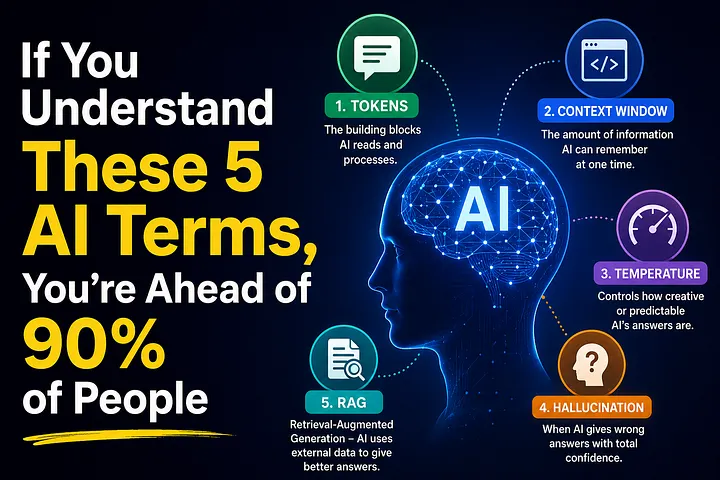
Most people talk about AI without really understanding how it works. They either repeat technical definitions or get confused when terms like LLMs and neural networks come up.
The good news? You don’t need to be an AI expert.
If you understand these 5 simple AI concepts, you’ll already know more than most people using AI today.
Let’s begin.
1. Tokens
AI doesn’t read text the way humans do. Instead, it reads small pieces of text called tokens.
A token can be a whole word, part of a word, a number, or even punctuation.
For example, the sentence “I love pizza” can be split into tokens like “I”, “ love”, and “ pizza”.
Why is this important?
Because every AI tool counts tokens. The more tokens you send and receive, the more work the AI has to do.
Tokens are also used to measure how much information an AI can remember at once. If a conversation becomes too long, older tokens may get removed, which is why AI sometimes forgets earlier messages.
Think of tokens as the building blocks of AI language.
2. Context Window
A context window is the amount of information an AI can keep in mind at one time.
Imagine talking to someone who can only remember the last part of a conversation. Once their memory is full, older details disappear.
That’s basically how a context window works.
It includes your messages, the AI’s replies, instructions, and any documents you provide.
A larger context window means the AI can work with much more information at once. A smaller one means it may lose track of earlier details more quickly.
So if an AI seems confused during a very long conversation, it may simply be running out of context space.
3. Temperature
Temperature controls how creative or predictable an AI’s answers are.
Low temperature means the AI chooses safer and more predictable responses.
High temperature means the AI takes more creative risks and may produce unusual ideas.
For example, if you ask the AI to finish the sentence “The cat sat on the…”
A low temperature might produce: “mat.”
A high temperature might produce something much more surprising.
For tasks like coding, summarizing, or answering factual questions, lower temperature is usually better.
For creative writing, brainstorming, or marketing ideas, a higher temperature can be useful.
4. Hallucination
Hallucination happens when AI gives incorrect information as if it were completely true.
For example, it might invent a book title, a statistic, or a quote that doesn’t actually exist.
Why does this happen?
Because AI doesn’t search for facts like a search engine. It predicts what answer is most likely based on patterns it learned during training.
Sometimes those predictions are correct.
Sometimes they are not.
The problem is that AI often sounds equally confident in both cases.
That’s why important information should always be checked and verified.
5. RAG
RAG stands for Retrieval-Augmented Generation.
It sounds complicated, but the idea is simple.
Suppose you upload a PDF and ask questions about it.
The AI doesn’t memorize the entire document.
Instead, the system first finds the most relevant parts of the document, then sends those parts to the AI so it can generate an answer.
This process is called RAG.
It’s used in many modern AI products, including document assistants, customer support bots, and knowledge-base search tools.
RAG helps AI work with information that wasn’t part of its original training.
Why These Terms Matter
You don’t need to become an engineer to understand AI.
But knowing these five concepts helps you use AI much more effectively.
Tokens help you understand how AI processes text.
Context windows explain why AI forgets things.
Temperature helps you control creativity.
Hallucinations remind you to verify important information.
And RAG explains how AI tools work with your documents and data.
Learn these five concepts, and you’ll understand AI better than most people using it today.
Follow for more Python tutorials, coding tips, and useful developer tools. click here:- Gemma 4 26B MoE vs Claude Opus 4.6: Which One I’m Actually Using in 2026
More in artificial-intelligence


Venture
Write for entrepreneurs, founders, and builders.
Share startup lessons, growth tactics, and founder stories with readers on the same journey.
One free account across In Plain English, Stackademic, Venture, and Cubed.
How it works- Startups & entrepreneurship
- Marketing & growth
- Productivity & leadership
- Founder stories & lessons learned
Sign in
Google or GitHub
Complete profile
Takes a few minutes
Get approved & publish
Start sharing
Why write for Venture?
Entrepreneurship is rarely a straight path. The lessons worth sharing are learned while building.
Comments
Loading comments…