The 10 Best Autonomous Pentesting Tools Compared (September, 2026)
Compare the 10 best autonomous pentesting tools of 2026. We categorize by capability—web, API, network—to match you with the right security platform.
12 min readJayden Rose
Where each AI pentesting platform fits, from continuous PTaaS to network attack-path validation
The label "autonomous pentesting" now sits on products that do very different jobs. One platform proves an attacker can chain a web flaw into full account takeover. Another walks an internal network from a single foothold to domain admin, starting with no credentials. Treating the best autonomous pentesting tools as interchangeable is how buyers shortlist a network attack-path engine when what they needed was authenticated web and API testing.
The guide below ranks 10 platforms of 2026 by the thing each proves, then sorts them into buckets so you can pair a tool to the surface where your exposure sits. Astra Security is the top pick here for breadth with proof: it spans web and API autonomous testing and hands auditors compliance-ready evidence, where most rivals cover one surface or one use case.
How the list groups autonomous pentesting tools by capability
Every platform here runs real attacks and reports what it can prove, not what it suspects. The differences show up in scope. Web-and-API tools reason about business logic behind a login, catching broken access control and IDOR across nested endpoints. Network engines chase lateral movement and Active Directory paths from a single foothold. Exposure-validation and breach-and-attack-simulation tools test whether your controls detect or block known attacker techniques.
None of these buckets is a strict upgrade on another, since a network engine and a web pentester answer different questions about the same company. The sections below read as capability buckets for that reason. Start with the surface that holds your exposure, then weigh the platforms inside it on proof quality and the evidence they give your auditors.
The 10 best autonomous pentesting tools, grouped by capability
Each entry names the platform's class and flags one documented limit. Astra Security opens the first group as the top pick. The four groups run in rough priority order for a product team, with application and API testing first because that's where most software risk lives. Read the group that matches your surface; the entries inside each one stay uniform, so you can compare like with like.
Autonomous web and API pentesting
These platforms behave like an attacker who already holds a login, probing application and API logic for the flaws a surface scanner walks past.
1. Astra Security
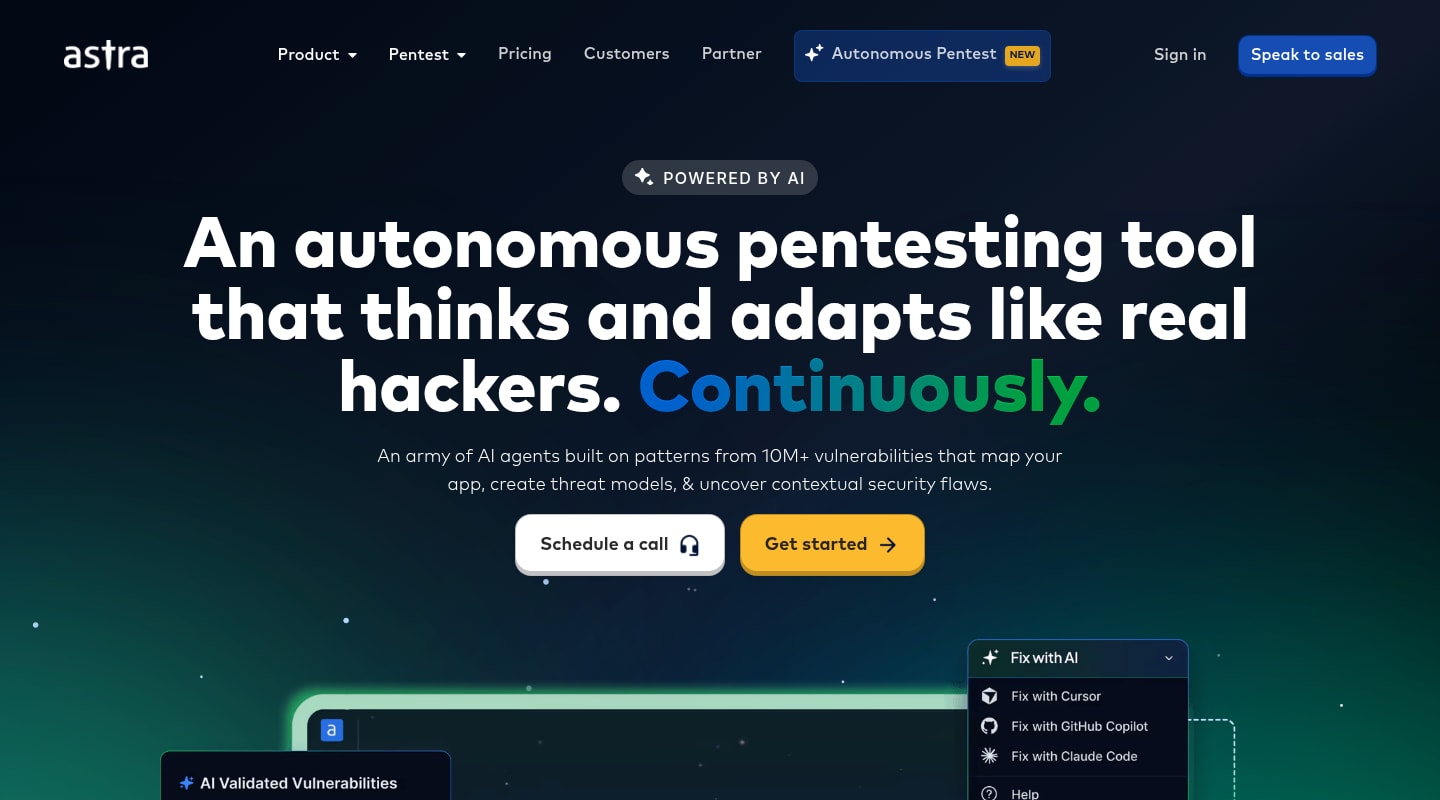
A web and API autonomous pentesting platform, Astra Autonomous Pentest from Astra Security runs two AI agent modes at once: a Structured Pentest that maps every role and endpoint, and a Bounty Hunter agent that chases high-impact paths like a researcher. A separate AI validation agent independently confirms exploitability before each finding reaches the dashboard, helping reduce false positives. A prompt tailored to the codebase can be pasted directly into Cursor, Copilot, or Claude Code so the IDE handles the actual change.
Each report lands in ISO 27001, PCI DSS, HIPAA, and SOC 2 format, carrying reproduction steps an auditor can confirm, and it draws on lessons from 5,000+ real-world pentests. For now, the autonomous engine reaches web apps and APIs, while cloud infrastructure testing remains a roadmap item.
2. XBOW

A specialist in autonomous web and API testing, XBOW coordinates hundreds of short-lived agents that string weaknesses together and confirm every finding through a deterministic validator before the finding shows up. The platform climbed to first on HackerOne's US leaderboard and, with no human help, surfaced a 9.8 critical inside Microsoft.
The limitation: XBOW focuses on web applications and APIs; it does not cover internal networks or Active Directory. While it supports multi-account authentication for improved IDOR testing, a single assessment still depends on the credentials and roles supplied for that run, so full cross-role authorization issues (such as certain IDORs or BOLA) may require multiple configured accounts or separate passes to surface completely.
3. Aikido Security
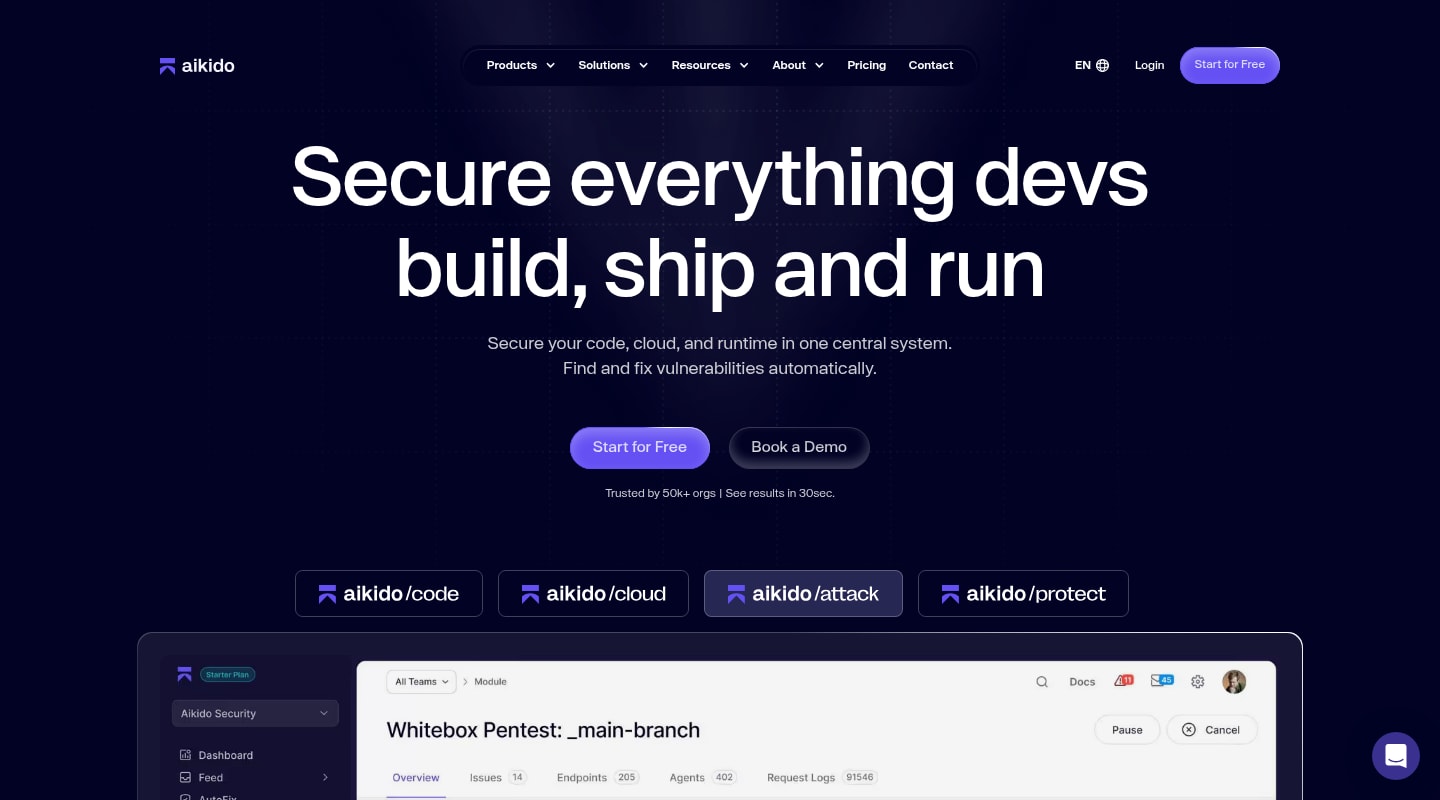
An AI pentester tucked into a consolidated AppSec suite, Aikido Security fields autonomous agents that parse source code and file remediation pull requests via AutoFix. Its developer experience and public pricing win it fans among engineering teams. Outside reviewers point to the same boundary: the pentest works as one component of a broader stack instead of the flagship offering, and out of the box it halts at a confirmed finding until a human sets off deeper chaining.
Network and Active Directory attack-path validation
These engines begin from an outsider's position or a small foothold and prove how far an attacker moves across networks and identities.
4. NodeZero
A network and Active Directory attack-path platform, NodeZero runs real network and cloud pentests with no pre-staged credentials, harvesting secrets and chaining weaknesses to demonstrate impact beyond a CVE list. NodeZero Federal carries FedRAMP High authorization, and it has run hundreds of thousands of tests against production. On the web and API side it stays in Early Access and looks underpowered against a dedicated application tool, while smaller teams call the platform heavy to run.
5. Pentera
An automated security-validation platform, Pentera emulates real attacks against production to confirm which exposures a live attacker could use, with deep internal-network and Active Directory coverage. It crossed $100M in ARR and leads Frost Radar's 2026 validation category. Under the hood it runs a deterministic engine with an AI layer bolted on, not a reasoning agent built from the ground up, so it seldom turns up novel off-playbook routes, and it forgoes deep authenticated business-logic testing across web and API.
6. RidgeBot
A network-and-web autonomous pentest platform built for budget-conscious and MSSP shops, RidgeBot fires payload-driven real-exploit testing on either a continuous or scheduled rhythm and ties its findings to frameworks such as PCI DSS and HIPAA. Against the DEFCON 2025 Benchmark Bakeoff, RidgeBot claims a score of 88%, a vendor-supplied figure you should retest on your own targets before you trust it. G2 reviewers point to holes in the documentation, and the platform's Active Directory depth stays modest beside the enterprise names listed earlier.
External exposure validation and breach-and-attack simulation
These tools answer a narrower question than a full pentest: what sits exposed at the perimeter, and whether your defenses catch the techniques attackers use.
7. Hadrian

An agentic external-attack-surface platform, Hadrian runs continuous outside-in discovery and fires event-driven tests when your perimeter changes, with its Nova add-on deploying agents that chain internet-facing weaknesses and attach reproduction steps. It reports a steep cut in mean-time-to-remediate for exposed assets. Coverage stops at the perimeter, so there's no internal network or deep authenticated business-logic testing, and Nova launched in 2026 with little track record behind it.
8. Picus
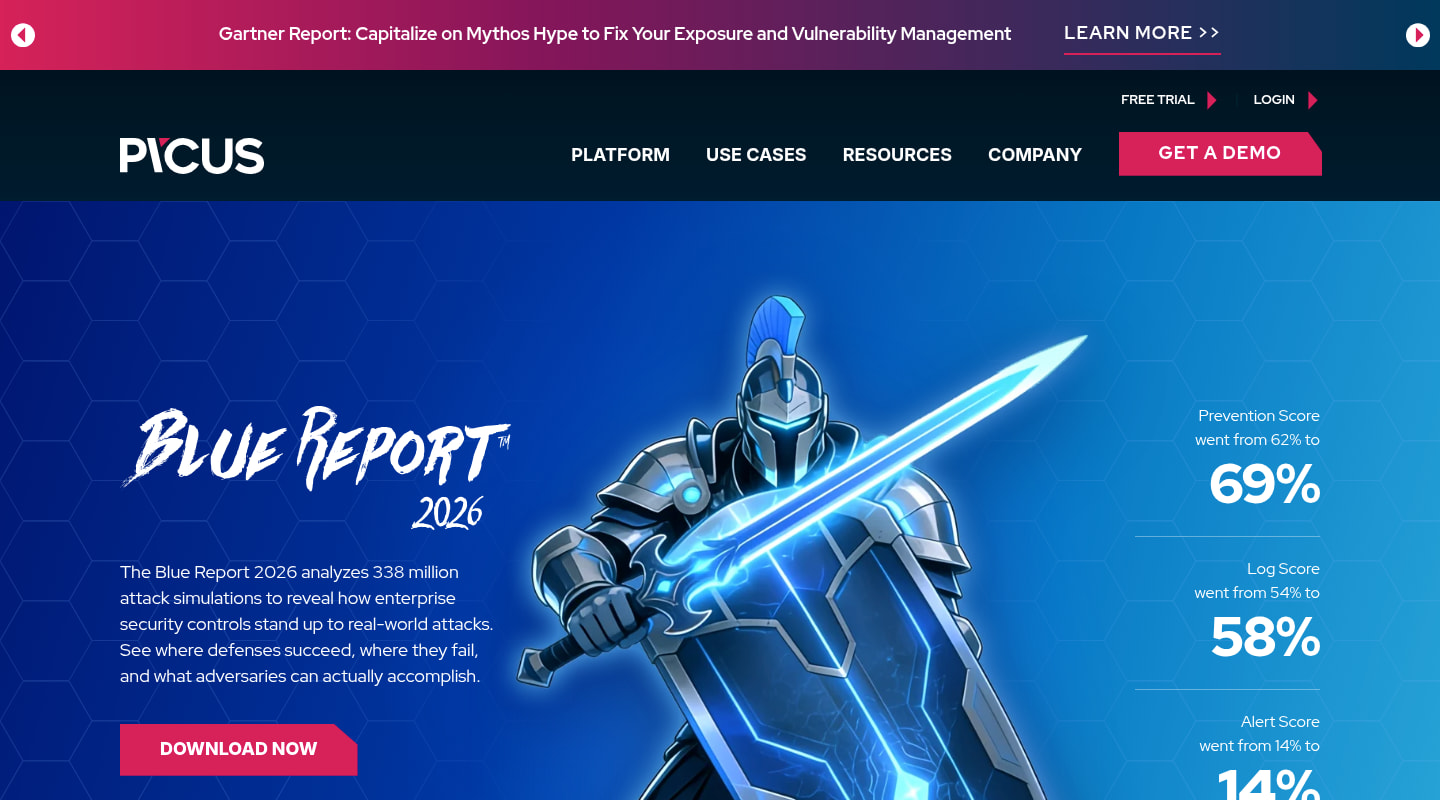
A breach-and-attack-simulation platform, Picus runs MITRE ATT&CK-aligned attacks to test whether your controls detect and block known techniques, and it adds attack-path mapping on top. That makes it strong for measuring control efficacy. Its focus is the question "are my defenses working," and it sets aside "can an attacker break in," which means the tool checks your existing stack in place of surfacing and exploiting unknown flaws as an autonomous pentester would. Use it alongside a pentest platform, not in place of one.
Continuous PTaaS and AI-system offensive testing
Two categories sit next to autonomous pentesting proper: human-led testing sold as a service, and offensive testing aimed at AI models themselves.
9. NetSPI
A human-led PTaaS platform, NetSPI combines security experts with a central platform for managing penetration tests and remediation. Its testing covers web applications and APIs alongside networks and cloud environments. Findings arrive with evidence and remediation guidance while teams can track retesting from the same interface.
Automation supports parts of the testing process but human pentesters remain responsible for the engagement. That gives NetSPI an advantage when a test calls for human judgment or deeper manual investigation. The trade-off is frequency. Testing follows an engagement schedule rather than running as an autonomous agent after every application change. NetSPI makes the most sense for teams that want expert-led pentesting with the workflow and reporting benefits of PTaaS.
10. Mindgard
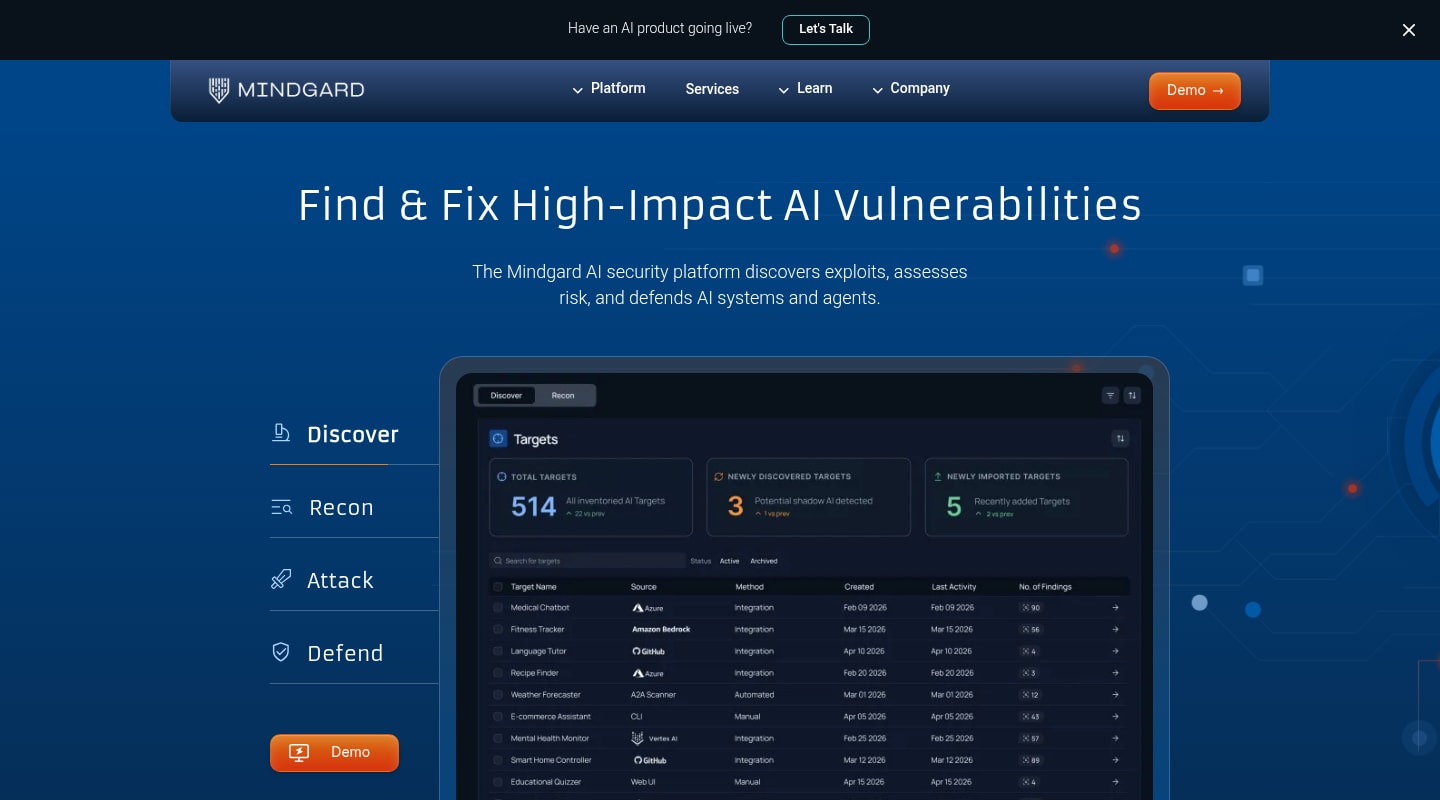
An AI-system offensive-security platform, Mindgard runs structured attacks against machine-learning models and LLM applications to surface AI-specific weaknesses like prompt injection and model evasion. For teams shipping AI features, it covers a surface that general pentest tools miss. Its scope is the catch: Mindgard targets AI and ML systems, so conventional web and network testing still needs a separate platform from the categories above.
Matching the best autonomous pentesting tools to your attack surface
The right pick follows your risk, not a leaderboard. If your exposure lives in internal networks and Active Directory, NodeZero and Pentera prove attack paths that app-focused tools can't reach. If you need to know whether your controls fire, Picus measures that. Most product teams, though, carry their risk in web apps and APIs behind a login, and they answer to auditors who want evidence. That pairing is what puts Astra's autonomous pentesting at number one: its two agent modes plus a standalone validation layer prove which flaws attackers can exploit across web and API, and its reports arrive in ISO 27001, PCI DSS, HIPAA, and SOC 2 format that your auditors can check. Astra pegs time-to-first-finding at up to 80x quicker than a manual pentest that runs two weeks, a number its own benchmark reports. Breadth with proof, backed by human review, is what sets it apart from rivals that cover one surface or one use case.
Autonomous pentesting FAQs
Can autonomous pentesting test AI models and large language models?
Some platforms do, though it's a separate discipline from testing a web app. Model-focused tools attack large language models with prompt injection, jailbreak attempts, and evasion, then line the findings up with a framework like MITRE ATLAS. A general autonomous pentester aimed at your app and network won't reach that surface, so a team shipping AI features runs a model-testing platform beside it. Ask whether a vendor tests the model itself or the app around it, since the two find different classes of weakness.
Can an MSSP or agency run autonomous pentesting for its clients?
Yes, and it's a common fit. A managed provider points the agents at each client's scope, runs testing on a schedule, and hands over proof-backed findings under its own brand. Multi-tenant controls matter here, so one client's data stays walled off from another. Look for role-based access and per-client reporting, plus pricing that spans many small engagements rather than one large estate. Budget-focused platforms court this market, since low-cost real-exploit testing lets a provider serve smaller customers at a margin.
Can autonomous pentesting miss vulnerabilities, and how do you catch the gaps?
Yes. No tool finds everything, so a false negative is a real risk, and honest vendors admit it. Agents can miss a context-heavy business-logic flaw that needs human intuition, or a bug that sits outside the scope you set. Close the gap two ways: widen coverage with authenticated, multi-role testing, and keep a human expert on the hardest cases. Astra combines autonomous testing with human-led pentesting for high-context scenarios that benefit from expert judgment.
What belongs on an autonomous pentesting procurement checklist?
Cover the points that separate a real engine from a relabeled scanner. Confirm the tool exploits a finding and attaches reproduction steps your auditor can walk through. Ask what share of its findings turn out false on a target like yours, and request the evidence behind the number. Check the coverage against your surface, the retest terms, and how fixes reach your engineers. Ask about the vendor's stance on the OWASP Autonomous Penetration Testing Standard. Astra measures itself against that standard and runs every finding past an isolated validator before it reports, which is the bar to hold each finalist to.
How does autonomous pentesting differ from human-led PTaaS?
PTaaS puts human testers behind a platform: you set the scope, the vendor assigns researchers, and findings land in a portal. That human judgment reads business logic and audit narratives well, but the rhythm stays point-in-time, since people set the calendar. Autonomous pentesting runs agents that test on every deploy and prove each finding without waiting for a person. The two work together, not against each other. Astra runs autonomous agents for continuous coverage and brings offensive-security experts in for the depth a machine can't reach, so a program gets cadence and judgment.
Does autonomous pentesting cover mobile applications?
Coverage varies, and most autonomous platforms today aim at web apps and their APIs rather than native mobile binaries. Since a mobile app talks to the same backend APIs, an agent that tests those APIs already exercises much of the risk behind the app. Reverse-engineering the client binary, checking local storage, and testing platform-specific controls still lean on a mobile specialist or a manual tester. Ask a vendor where its mobile coverage stops, and pair the agents with a dedicated mobile assessment when the app holds sensitive data.
More in cybersecurity
Venture
Write for entrepreneurs, founders, and builders.
Share startup lessons, growth tactics, and founder stories with readers on the same journey.
One free account across In Plain English, Stackademic, Venture, and Cubed.
How it works- Startups & entrepreneurship
- Marketing & growth
- Productivity & leadership
- Founder stories & lessons learned
Sign in
Google or GitHub
Complete profile
Takes a few minutes
Get approved & publish
Start sharing
Why write for Venture?
Entrepreneurship is rarely a straight path. The lessons worth sharing are learned while building.

Comments
Loading comments…