The Boardroom Case for AI-Generated Ad Video: Speed, Cost, and Scale
4 min read
Marketing budgets across the Middle East and beyond are under the same pressure every other line item faces: do more with less, and prove the return faster. Ad production has traditionally been one of the hardest costs to compress — a single campaign's creative could take weeks and consume a disproportionate share of a quarter's marketing spend. That equation is shifting as AI-generated ad video moves from experimental to operational in enterprise marketing departments.
Why Production Speed Has Become a Boardroom Metric
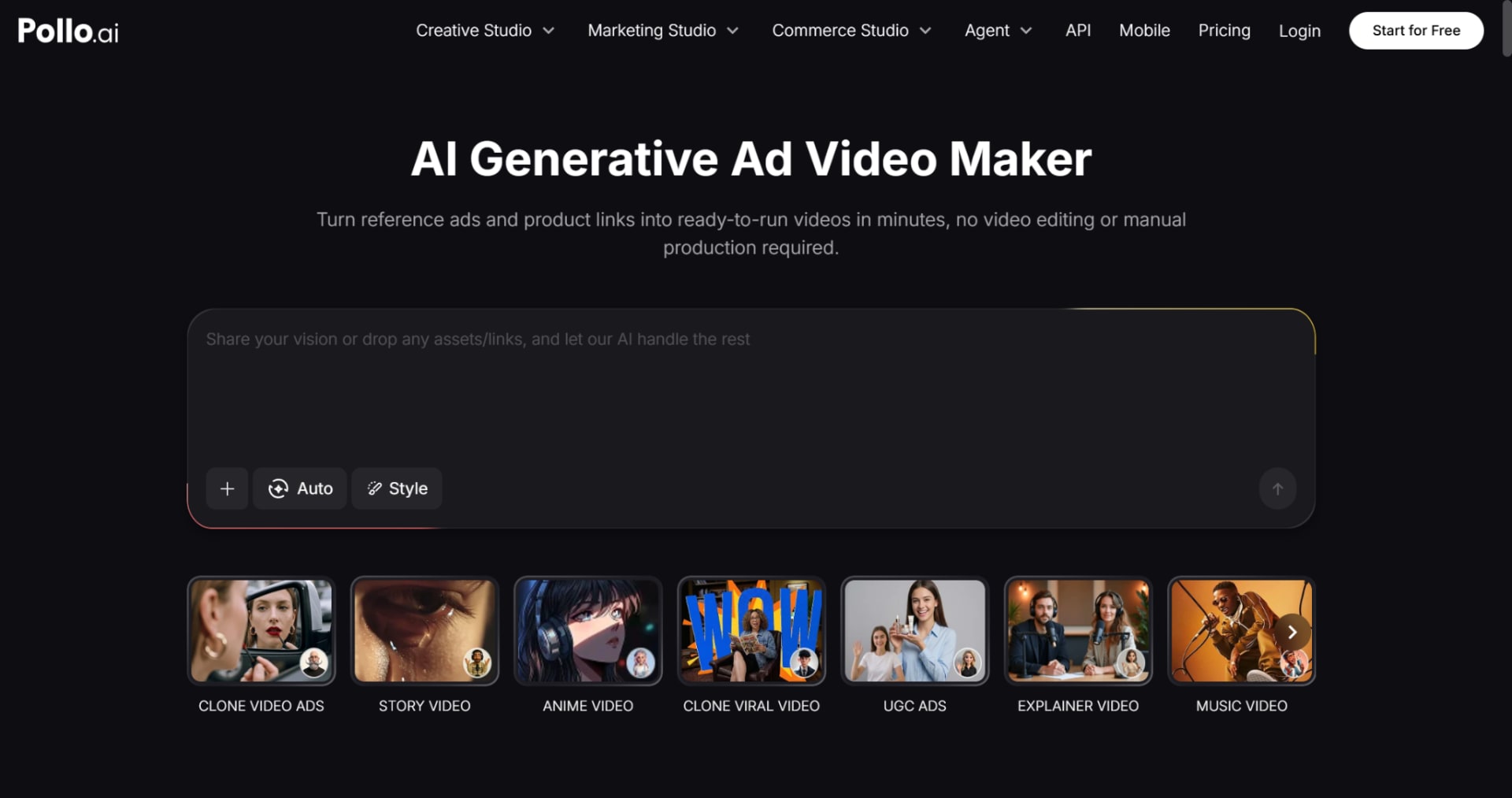
Marketing leaders increasingly report on creative velocity alongside campaign performance, because the two are linked. A campaign that can only produce one or two ad variations per launch is structurally limited in how much it can learn and optimize before budget runs out. Pollo AI's AI Generative Ad Video Maker changes that constraint directly — producing multiple campaign-ready video variations from a single product brief in a fraction of the time traditional production requires. For enterprises running campaigns across multiple markets and languages, that speed compounds quickly, since one brief can generate localized variations without re-running the entire production process for each region.
The Economics That Matter to Finance, Not Just Marketing
The case for AI-generated ad video isn't purely a marketing efficiency story — it has a direct cost profile that finance teams care about. Traditional video production scales linearly with output: more variations means more shoots, more editing hours, more vendor invoices. Generative production breaks that relationship, making additional creative variations dramatically cheaper to produce than the first one. This matters most for enterprises running performance marketing at scale, where testing more creative directly correlates with better-optimized ad spend.
For companies operating across the GCC and wider MENA region specifically, this also addresses a longstanding production bottleneck: producing distinct creative for different markets and languages traditionally meant near-duplicate production costs for each variant. Generating regional variations from the same core brief compresses that cost significantly, without sacrificing the localized feel each market expects.
Where This Fits Into an Enterprise Marketing Stack
Enterprise marketing teams typically need creative across several categories simultaneously: performance ads for paid social and search, brand awareness content for broader campaigns, and product-specific creative for launches. Generating these directly from existing product assets and brand guidelines means a marketing team can maintain creative consistency across all three categories without each one running through a separate production pipeline with its own timeline and cost structure.
This also changes how marketing teams approach testing. Rather than committing significant budget to one creative direction because production constraints only allow for a single polished version, teams can generate several distinct approaches and let early performance data determine which one deserves further ad spend — a meaningfully different way of allocating a campaign budget.
Handling Stylized Brand Visuals Alongside Video
Not every piece of campaign creative calls for photorealistic video. Brand campaigns, particularly in categories like fintech, consumer products, and lifestyle, increasingly use stylized or illustrated visuals alongside standard product video to stand out in crowded feeds. PicLumen AI is a well-regarded tool for this kind of stylized image generation, and Pollo AI connects directly into it, letting a marketing team generate both photorealistic ad video and illustrated supporting visuals from the same workflow rather than managing entirely separate production tracks for each visual style.
Using PicLumen AI alongside a dedicated ad video tool gives enterprise teams more creative range without adding operational complexity — a single campaign can pair a straightforward product video with a more distinctive, stylized brand asset, both produced through the same overall workflow Pollo AI provides.
What This Means for Marketing Leadership
The practical takeaway for marketing and brand leaders isn't that AI generation replaces creative strategy or agency partnerships — the direction, positioning, and brand judgment still require experienced marketers. What changes is the production bottleneck that used to limit how much of that strategic thinking could actually be tested and executed within a given budget and timeline. Teams that build AI-generated video into their standard production process are simply able to test more, iterate faster, and allocate spend toward what's actually working rather than what fit within a limited production schedule.
For enterprises evaluating where to invest next in their marketing technology stack, ad video generation is increasingly one of the clearer near-term returns — not because it replaces the creative function, but because it removes a cost and time constraint that has shaped marketing production for decades.
More in artificial-intelligence


Venture
Write for entrepreneurs, founders, and builders.
Share startup lessons, growth tactics, and founder stories with readers on the same journey.
One free account across In Plain English, Stackademic, Venture, and Cubed.
How it works- Startups & entrepreneurship
- Marketing & growth
- Productivity & leadership
- Founder stories & lessons learned
Sign in
Google or GitHub
Complete profile
Takes a few minutes
Get approved & publish
Start sharing
Why write for Venture?
Entrepreneurship is rarely a straight path. The lessons worth sharing are learned while building.
Comments
Loading comments…