The Execution Layer: The Missing Architecture for Autonomous AI
5 min readJonathan Capriola
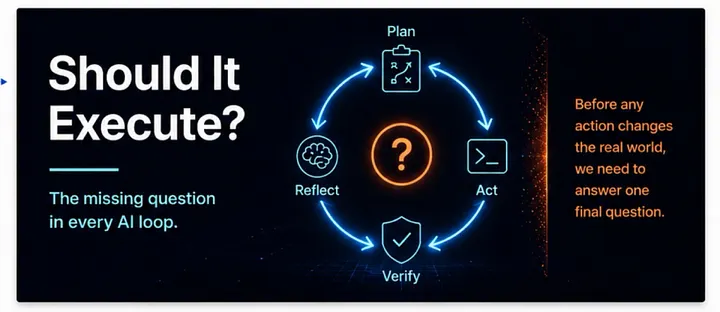
Your AI passed every test.
It generated the correct code.
The verifier approved it.
The security scan passed.
The unit tests passed.
The integration tests passed.
Everything says the output is correct.
Now answer one question.
Should it execute?
That isn’t a quality question.
It isn’t a reasoning question.
It isn’t even a verification question.
It is an execution question.
As autonomous AI begins deploying infrastructure, transferring money, modifying production systems, negotiating contracts, and operating critical business workflows, it may become the single most important question enterprises have to answer.
Yet most conversations about autonomous AI never ask it.
The Industry Is Solving One Half of the Problem
AI engineering is evolving at an incredible pace.
Not long ago, the conversation centered on prompt engineering.
Today it’s about agent loops, planning, reflection, verification, memory, and autonomous systems that continuously improve their own work.
That evolution is exactly what should be happening.
Modern AI agents no longer stop after producing an answer.
They plan.
They act.
They evaluate.
They improve.
They repeat until they achieve an objective.
This dramatically improves quality.
But it also changes the security problem.
The industry has invested enormous effort into helping AI decide what to do.
Far less attention has been given to deciding whether the next action should happen at all.
Verification Solves One Problem
Verification loops are becoming one of the defining patterns of autonomous AI.
They ask questions like:
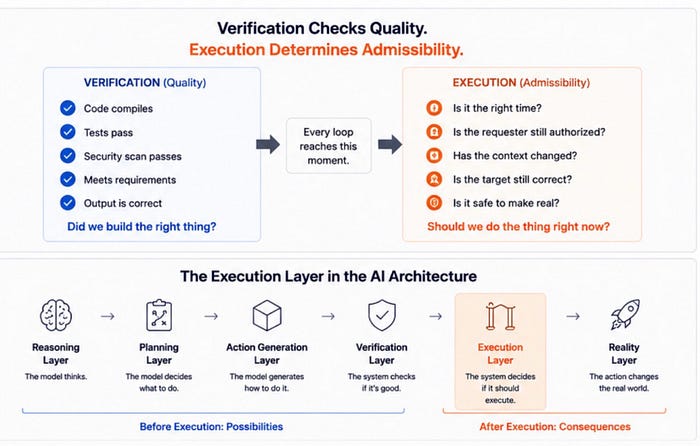
- Did the code compile?
- * Did the tests pass?
- * Did the output satisfy the objective?
- * Is the reasoning sound?
- * Did the model meet the success criteria?
These are essential controls.
Without verification, autonomous systems become unreliable.
Verification improves quality.
Verification improves confidence.
Verification improves outcomes.
But verification answers only one question.
Did the AI produce the correct result?
That is fundamentally different from asking:
Should this result become reality?
Quality Is Not Authorization
Imagine an autonomous AI responsible for deploying production infrastructure.
The verification loop reports:
✓ Security checks passed.
✓ Unit tests passed.
✓ Performance targets met.
✓ Compliance rules satisfied.
Everything looks perfect.
The deployment is technically flawless.
Now the enterprise faces a completely different decision.
Should this deployment execute right now?
Perhaps the maintenance window hasn’t started.
Perhaps executive approval expired.
Perhaps the deployment target changed from staging to production.
Perhaps the requesting identity no longer has permission.
Perhaps the payload no longer matches the one originally approved.
The deployment can be technically perfect.
Executing it can still be the wrong decision.
Verification measured correctness.
Authorization determines admissibility.
Those are different architectural responsibilities.
Every AI Loop Reaches the Same Boundary
Every autonomous loop eventually reaches the same moment.
Execution.
Reasoning ends.
Consequences begin.
That boundary exists whenever an AI:
- Executes code
- * Calls external APIs
- * Creates cloud infrastructure
- * Deletes production data
- * Transfers money
- * Grants permissions
- * Controls physical devices
Before execution, software is evaluating possibilities.
After execution, software has changed reality.
That transition deserves its own control point.
The Missing Question
If you read enough articles about AI loops, you’ll notice the same themes.
How do we improve reasoning?
How do we reduce hallucinations?
How do we make verification stronger?
How do we improve reflection?
All worthwhile questions.
But there is another question that deserves equal attention.
Should this exact action execute right now?
Not:
“Did the AI think correctly?”
Not:
“Did the verifier approve the output?”
But:
“Should this specific action be allowed to cross the execution boundary?”
That is not another verification step.
It is a different architectural concern.
The Execution Layer
Every mature computing platform eventually develops layers.
Networking evolved beyond cables into transport layers.
Identity evolved beyond passwords into authentication and authorization.
Cloud computing evolved beyond virtual machines into orchestration, policy, and governance.
Autonomous AI appears to be following the same pattern.
Reasoning is one layer.
Planning is another.
Memory is another.
Verification is another.
Execution may deserve its own layer.
The purpose of that layer is straightforward:
Determine whether an autonomous action should become reality.
Not whether it is intelligent.
Not whether it is useful.
Not whether it passed verification.
Whether it is admissible at the moment it executes.
That decision belongs neither to the language model nor to the verification loop.
It belongs at execution.
Why This Matters
Imagine arriving at work tomorrow morning.
Your AI agent completed every assigned task.
Every verification check passed.
Every quality metric was satisfied.
It also deployed code to production instead of staging because the execution context changed after approval.
The software behaved exactly as instructed.
The problem wasn’t intelligence.
The problem wasn’t quality.
The problem was that no system answered one final question:
Should this exact action execute right now?
As autonomous AI gains authority over financial systems, infrastructure, healthcare, manufacturing, and critical business operations, that distinction becomes increasingly important.
The more capable AI becomes, the more important execution becomes.
The Future of Autonomous AI
Authentication establishes who is acting.
Authorization defines what is permitted.
Verification evaluates quality.
Execution determines whether an action should become reality.
These are complementary responsibilities.
None replaces another.
Together they create trust.
The next generation of autonomous AI will not be defined only by better reasoning.
It will also be defined by better execution.
Whether the industry ultimately calls this the Execution Layer or something else, I believe execution deserves to be treated as its own architectural concern.
Because in autonomous systems, every meaningful decision eventually becomes an action.
And before that action changes the real world, every organization will need an answer to one question:
Should this exact action execute right now?
More in artificial-intelligence


Venture
Write for entrepreneurs, founders, and builders.
Share startup lessons, growth tactics, and founder stories with readers on the same journey.
One free account across In Plain English, Stackademic, Venture, and Cubed.
How it works- Startups & entrepreneurship
- Marketing & growth
- Productivity & leadership
- Founder stories & lessons learned
Sign in
Google or GitHub
Complete profile
Takes a few minutes
Get approved & publish
Start sharing
Why write for Venture?
Entrepreneurship is rarely a straight path. The lessons worth sharing are learned while building.
Comments
Loading comments…