Why “Edge AI” Still Struggles in Real Deployment Environments
11 min readTony Somerset
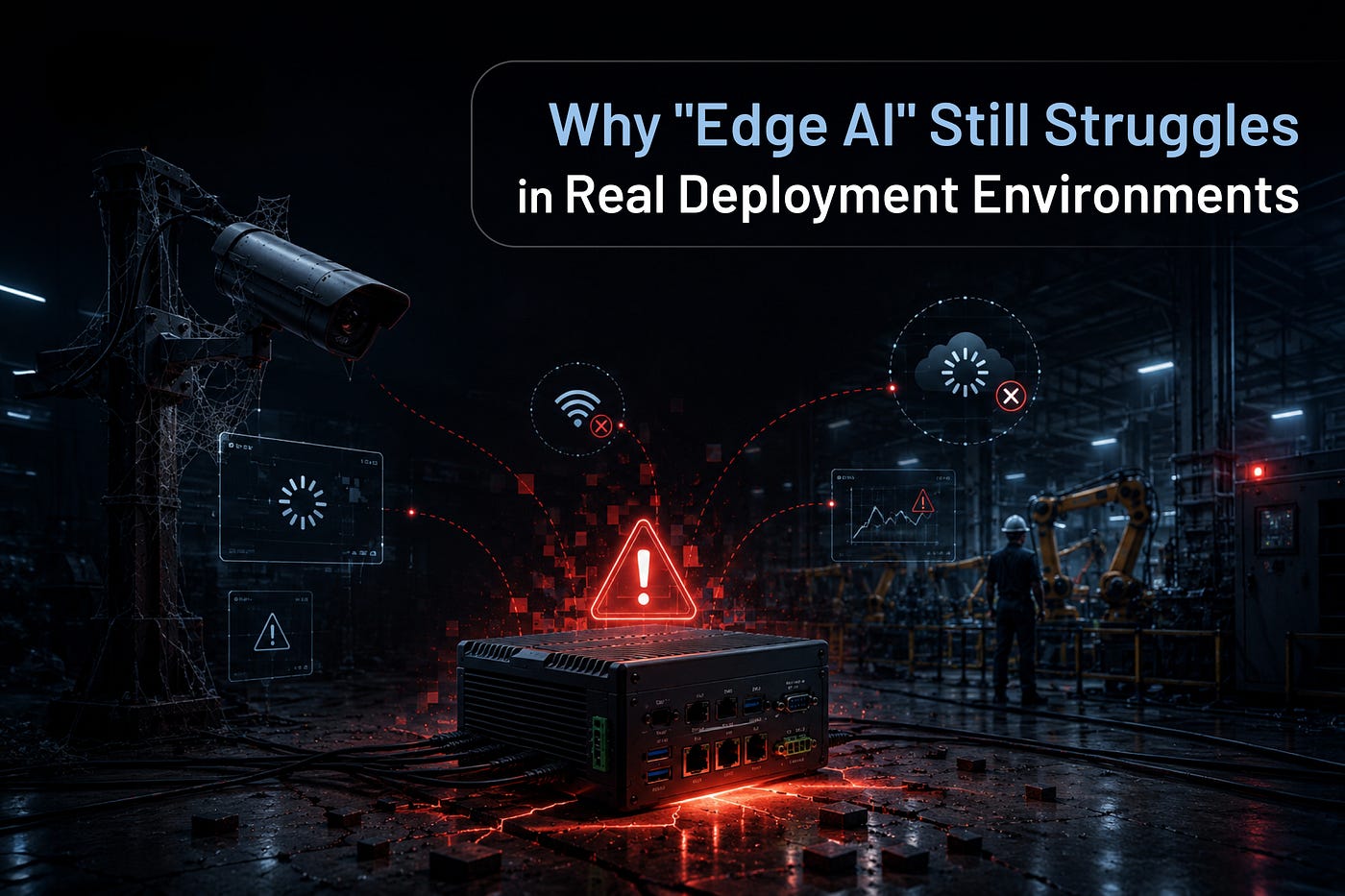
Edge AI offers the potential for quicker decisions, reduced latency, and intelligence where it’s needed most. The promise for most large organizations, however, is colliding with a wall — one that is not technological. It’s the environments the technology has to live in.
When it comes to enterprise AI, most teams have at least one successful edge pilot in their pipeline. Quality inspection system in a manufacturing plant for real-time inspection. The energy site has a predictive maintenance model monitoring equipment. A computer vision system that identifies miscounted items in a warehouse. These pilots work. They produce results that can be measured. But when leadership starts asking to roll them out at ten more sites, the project slowly spirals out of control with one-off configurations, scope creep and higher costs.
This article dissects the reasons that this trend continues and what it takes to transition edge AI from a one-off experiment to repeatable, governed operation. Whether you’re in operations, IT, AI strategy or digital transformation, you’ve probably experienced this friction. The following describes the origins and what shifts when you work on the root cause.
What is Edge AI and why is deployment complexity important?
Edge AI means to run AI models and AI inference on-device, on-site, or in nearby compute infrastructure, instead of uploading data to a central cloud for processing. The upside justifies the name: lower latency, decreased bandwidth reliance, quicker responses, and the capacity to take actions on information before a round trip to a data center.
In reality, edge AI has a vast spectrum of applications. A hospital is operating image analysis near MRI equipment to prevent the outbound transfer of sensitive patient information. Logistics hub with local inference for routing of vehicles and highlighting anomalies in real time. Retailer with demand forecasting model at the store level to pick up hyper local signals.
Because unlike cloud, an edge deployment does not have a standardized operating environment, the deployment complexity is important. All sites have different histories of infrastructure, hardware, network limitations and sometimes their own IT staff with their own agendas. It is acceptable to have that variation at one facility. It is the main issue at 50.
Why Edge AI Deployments Fail at Scale Not in the Pilot
What most technical roadmaps don’t understand is that edge AI doesn’t fail in the proof-of-concept. It breaks if the second (or third) site attempts to duplicate what the first site constructed.
The pilot environment is monitored. The team has a positive attitude. The configuration is customized. When it does, the business case is obvious. What is not properly recorded is how much of that success was due to the local conditions that would not necessarily be in place at the next location.
The Fragmented Edge Environment Problem
Most companies already live on the edge — they just don’t live it on a consistent basis. Over time, each site has evolved its own configuration based on when it was constructed, who were the vendors involved, what issues it addressed and who controlled the budget. Multiple departments can operate independent edge environments in one location that can differ in terms of procurement, configuration, and management.
This results in a kind of patchwork architecture. All pieces are local effect. However, when attempting to move a successful application from one environment to another you are not deploying an application; you are rebuilding the foundations it runs on, again, from scratch.
The signs manifest in sectors:
- A real-time production dashboard is validated by a manufacturing plant to assist operators in reducing downtime. When you roll it out to the next factory, it’s a multi-month project, not because the dashboard itself is complex, but because the environment is going to be vastly different between each site.
- A hospital network is looking to do analytics closer to the imaging equipment to lower latency and comply with rules around data residency. However, each hospital in the network has its own infrastructure and each integration is a separate negotiation.
- A retail chain develops a local forecasting model, which is better than the centralized forecasting model. When deployed across 200 stores, it turns out that the results of the local setups are not consistent, which means that the localized inference approach doesn’t really work.
In every instance, the use case is valid. The issue is the environment just can’t scale.
The Hidden Costs of Treating Every Site as a One-Off
When costs are managed outside of the project, whether it is by site or by department, they certainly add up when it comes to total organizational spend.
Each site is unique and needs its own work in configuration, integration testing, rollout cycle. In the case of an application that has been successfully deployed, this can represent a 6 figure deployment cost per site, most of which would be environmental work and not application development. You are paying over and over again for the same foundations.
There’s an operating cost in addition to the budget. Teams that should be focusing on building their capabilities are dealing with exceptions. All deployments are technical negotiations, not rote operations. There is no common baseline to enforce policies against, making governance more difficult. Security patching, model updates and performance monitoring all need to be handled on an individual basis for each environment.
There’s also a more nuanced effect that has a disproportionate impact on AI initiatives: Reproducibility becomes a thing of the past. One AI system may behave well in one environment, but differently in another with just slightly different hardware, different OS versions, different data pipelines or different network latency profiles.
If there is a difference in the environment, there is a difference in the results and if results differ, trust is lost. Business stakeholders who contributed to the pilot began to doubt the scaling of edge AI.
Why Architecture Standardization Is the Prerequisite, Not the Afterthought
Successful organizations to scale edge AI share one trait: they intentionally choose to standardize the environment where these applications will run before scaling pilots to the standard environment.
This is not to say that all sites have the same hardware. It implies that the software layer, deployment logic, governance model and operational baseline are all consistent, which helps to enable the deployment of an application built for one environment to another without rebuilding the foundation.
It is sometimes referred to as a unified edge layer. It’s sort of like containerization for cloud deployments: a shared, controlled, baseline from which to remove the specifics of the environment from the application logic. With that layer in place, deployment no longer becomes a “one-off” engineering project but a “known” operation.
The tangible business impact is:
- Teams don’t have to reconfigure from scratch at each new rollout location, so rollout time is reduced.
- This makes governance enforceable, as there is a common baseline to which policies can be applied.
- TCO is not linear with every additional site, as shared infrastructure eliminates redundant local investments.
- AI is more consistent because the environments it operates in are consistent.
This is where operational autonomy is possible as well. Yet, a 100% uniform edge layer allows critical workloads and data to operate under the control of the organization, even if access to the central cloud environment is unavailable or limited — something that won’t work in many industrial and regulated environments.
Observability: The Missing Layer That Makes or Breaks Production AI
Looking beyond the architecture standardization, another challenge that pilots don’t often mention remains for edge AI deployments: You can’t manage what you can’t see.
Monitoring is a core challenge in a distributed edge architecture, compared to centralized cloud. Models are executed on a set of nodes, which can be in the dozens or in the hundreds. Data inputs are site specific. Over time, hardware performance declines. Network conditions change. When something begins to break down, a model that’s slowly losing its accuracy, a deployment that’s still running on legacy infrastructure, a site that hasn’t been in sync with the last deployment a model was part of, the problem only becomes apparent once a business outcome is impacted.
It’s where observability doesn’t just become a technical luxury but a strategic necessity.
A successful observability system in an edge AI system is more than an uptime dashboard. It is not only about monitoring whether a service is running or not, but also about monitoring how well your model is performing over time. It implies surfacing deployment health on distributed nodes, alerting on drift before it becomes an operational issue, and providing a single pane of glass for teams to see what is really going on in a fractured estate.
If you can’t see it, then you have to take a chance when it comes to scale. It provides evidence-based answers to expansion decisions: Where are things going well? Where are things going in the wrong direction? Where do they need to be addressed before they become an issue?
This is where platforms can fill in the void. AI security cameras offer the operational transparency that organizations require as AI shifts from pilot to production in distributed, often disparate environments. It identifies blind spots for surface deployment, aids in monitoring throughout nodes, and provides a decision maker with the signal they need instead of “managing by exception”.
What Leaders Should Prioritize Before Expanding Edge AI
The order of decisions is as important as the technology choices if you’re moving past pilots. That’s how operations, IT, and AI strategy stakeholders should present the growth opportunity:
1. Before adding, take an inventory of your existing edge estate.
Have an awareness of what is in place, the site environment variations, and the major architectural gaps. Without this map, expansion leads to a quick increase in complexity.
2. Set your edge baseline prior to your deployment.
What is your standard edge environment for your organization? Once it is defined, make it a planned part of every deployment from then on, not a project-by-project decision.
3. Design for observability; don’t add it on.
The deployment model should include monitoring and visibility as part of the plan. Observability is much more expensive (costly) when it’s retrofitted into a distributed estate than when it’s designed in up front.
4. Moving from project to platform funding.
Edge will be funded as a series of individual projects, and as such, each deployment will be considered a standalone project. Making it shared infrastructure alters the economics and governance model, with positive effects that accumulate over time.
5. Select repeatability of the operation in preference to novelty of the pilot.
It’s not about the most advanced AI application. It’s the one that’s easiest to repeat, the application that can be tested once and then used consistently in all of the pertinent locations without being reinvented.
The Real Turning Point for Edge AI at Scale
Edge AI is not held back by the lack of readiness. It slows down because the environments it has to run on weren’t designed to scale. Fragmented architectures, site-by-site deployment logic and a lack of observability are just a few of those factors that make every expansion a problem to solve, not a process to repeat.
Those making strides on this challenge do not necessarily have more pilots. They’re doing it by constructing the base layer that makes pilots redundant, an open, regulation and visible edge layer, in which applications can move, models can be monitored and scaling is just a decision, not a negotiation.
That is the inflection point to shoot for. No more experimentation, but a structure that makes what works actually travel.
Having visibility is the first step: knowing where your environments are, what gaps you have, and what you would need to fill them. AI CCTV cameras are designed to provide that clarity, providing teams with deployment health monitoring and operational insight to eliminate the management of exceptions and focus on scalable AI operations.
Repeatable edge AI infrastructure is in place. The bottom line is that what most organizations need now is the visibility to govern it.
More in artificial-intelligence


Venture
Write for entrepreneurs, founders, and builders.
Share startup lessons, growth tactics, and founder stories with readers on the same journey.
One free account across In Plain English, Stackademic, Venture, and Cubed.
How it works- Startups & entrepreneurship
- Marketing & growth
- Productivity & leadership
- Founder stories & lessons learned
Sign in
Google or GitHub
Complete profile
Takes a few minutes
Get approved & publish
Start sharing
Why write for Venture?
Entrepreneurship is rarely a straight path. The lessons worth sharing are learned while building.
Comments
Loading comments…