Why Reliability Beats Talent When Building Creative Teams
5 min readUjjwal Verma
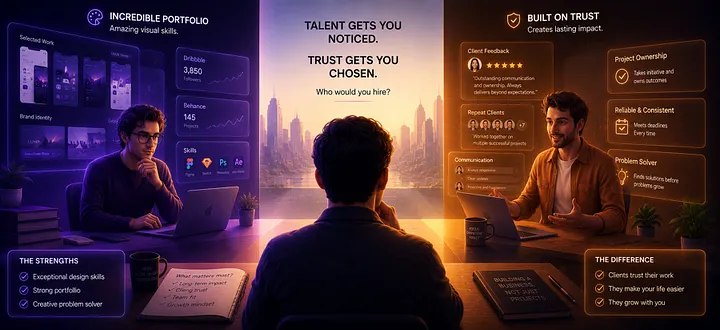
Great portfolios get attention. Reliability earns trust.
When founders hire creative talent, they usually start by looking at the visible things.
A strong portfolio.
Polished case studies.
Beautiful visual work.
Maybe even a list of impressive clients.
That’s understandable. Portfolios are easy to compare. They’re concrete. They give the feeling that hiring decisions can be made objectively.
But after enough projects, most founders learn something surprising.
The people who create the most value aren’t always the most talented.
They’re often the most reliable.
And that distinction matters far more than many teams realize.
Why Talent Is Easier to Measure Than Reliability
Creative skill is visible.
You can review a portfolio in ten minutes and quickly understand whether someone has strong visual instincts or technical ability.
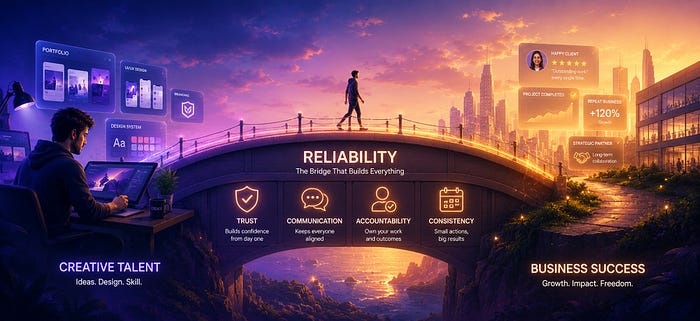
Reliability works differently.
You can’t see it in a Behance project.
You can’t measure it from a Dribbble shot.
You only discover it once the work begins.
Does the person communicate when timelines change?
Do they raise concerns before problems become expensive?
Do they handle feedback professionally?
Do they care about the outcome — or only about delivering files?
Those answers often determine whether a project succeeds.
Not the portfolio.
The Hidden Cost of Unreliability
Most hiring mistakes don’t happen because someone lacks skill.
They happen because expectations break down.
Deadlines slip.
Communication disappears.
Ownership becomes unclear.
Feedback turns into conflict.
A founder rarely loses sleep because a button radius was wrong.
They lose sleep because critical work is delayed and nobody knows what’s happening.
That’s why reliability becomes such a valuable trait.
It reduces uncertainty.
And business runs on reducing uncertainty.
The Best Creative Partners Think Beyond Deliverables
One thing I’ve noticed about the strongest creative professionals is that they think differently about their role.
Average freelancers focus on deliverables.
Exceptional freelancers focus on outcomes.
One asks:
“What files do you need?”
The other asks:
That shift sounds small.
But it changes the entire relationship.
Because clients don’t hire designers to receive files.
They hire them to achieve results.
Why GitLab’s Remote Culture Is Built on Reliability
GitLab is one of the world’s largest fully remote companies.
When teams operate across different countries and time zones, constant supervision becomes impossible.
The company relies heavily on documentation, transparency, accountability, and asynchronous communication.
In other words, reliability becomes part of the operating system.
Business Impact
GitLab’s ability to scale globally wasn’t built on monitoring people more closely.
It was built on creating an environment where people could be trusted to follow through on commitments.
The same principle applies to creative partnerships.
The more uncertainty a project contains, the more valuable reliability becomes.
Why Communication Is a Business Skill
Communication is often treated as a soft skill.
In reality, it’s one of the most valuable business skills creative professionals can develop.
Good communication prevents misunderstandings.
It accelerates decision-making.
It creates confidence.
And confidence is what allows clients to trust someone with larger responsibilities.
The most respected creative professionals rarely communicate more.
They communicate earlier.
That’s an important difference.
Reliability Creates Repeat Business
The easiest client to win is often the one you’ve already worked with.

Yet many creatives spend all their energy chasing new opportunities while neglecting the relationships they’ve already built.
Reliable professionals create repeat business because clients know what to expect.
No surprises.
No disappearing acts.
No last-minute chaos.
Just consistent execution.
And consistency compounds.
What Shopify Teaches About Ownership
One reason Shopify grew into one of the world’s most successful technology companies is its emphasis on ownership.
Employees are encouraged to think like builders rather than task executors.
The expectation isn’t simply to complete work.
It’s to improve outcomes.
That mindset is incredibly valuable in creative work as well.
The best creative professionals don’t wait for instructions.
They identify problems and take responsibility for solving them.
Business Impact
Ownership reduces management overhead and increases trust.
Teams move faster when people don’t need constant supervision.
Shopify Leadership Principles or Shopify Engineering Culture

Why Reliability Will Matter Even More in the AI Era
As creative tools become more accessible, technical skills become easier to acquire.
AI can generate concepts.
Templates can accelerate execution.
Software becomes more powerful every year.
What remains difficult to automate is trust.
Trust comes from:
- accountability
- communication
- judgment
- ownership
- consistency
Those qualities create long-term professional relationships.
And long-term relationships create sustainable careers.
Final Thoughts
Great design gets attention.
Reliability earns opportunity.
Over time, founders stop remembering who had the most impressive portfolio.
They remember who consistently delivered.
Who communicated clearly.
Who solved problems without creating new ones.
Because the best creative partnerships aren’t built on talent alone.
They’re built on trust.
And trust is simply reliability repeated over time.
More in entrepreneurship



Venture
Write for entrepreneurs, founders, and builders.
Share startup lessons, growth tactics, and founder stories with readers on the same journey.
One free account across In Plain English, Stackademic, Venture, and Cubed.
How it works- Startups & entrepreneurship
- Marketing & growth
- Productivity & leadership
- Founder stories & lessons learned
Sign in
Google or GitHub
Complete profile
Takes a few minutes
Get approved & publish
Start sharing
Why write for Venture?
Entrepreneurship is rarely a straight path. The lessons worth sharing are learned while building.
Comments
Loading comments…