What 1,200 Ads Taught Me About Why “Data-Driven Creative” Usually Isn’t.
Most “data-driven creative” is just creative with a dashboard taped to the side. Real data changes the ad. Here is what it kept telling us to change.
3 min readOussama Nakhil
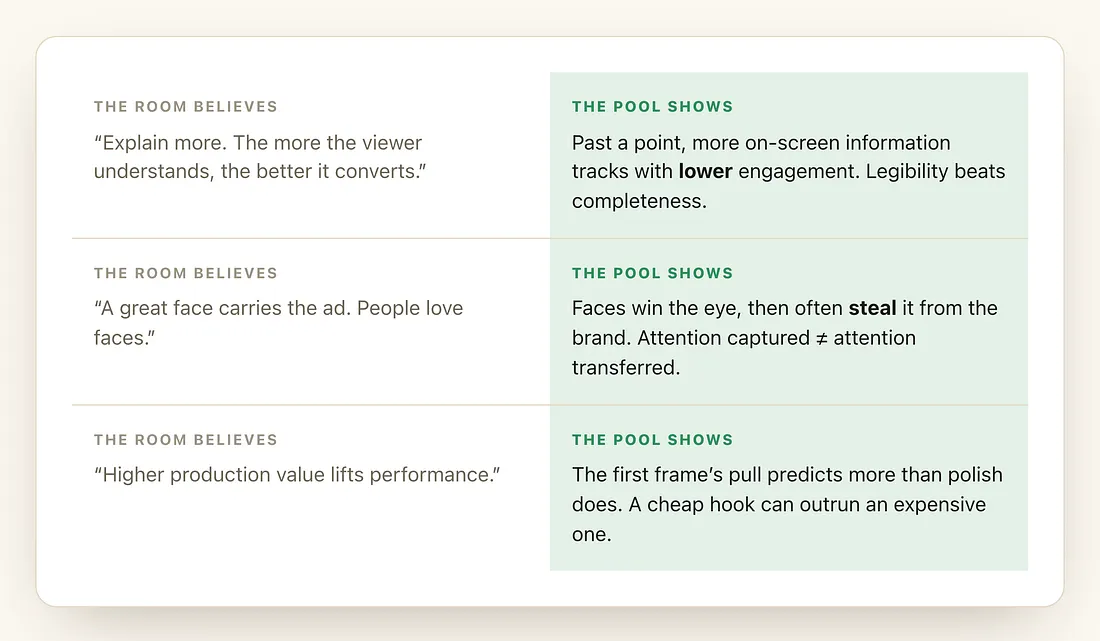
There is a difference between making creative with data and making data-driven creative, and almost everyone confuses the two.
The first means you reported on the ad after it ran. The second means the data changed the ad before it ran. After scoring more than 1,200 ads with public outcome data, the second kind kept disagreeing with the conventional wisdom of the room. Not occasionally. Consistently. Here are the patterns that surprised me most, with the honest caveat attached to all of them: these are correlations with public engagement and click-intent outcomes, not laws, and not measures of sales.
The “more is worse” problem
The most expensive instinct in advertising is the urge to add. One more proof point, one more feature, one more line of supers. Each addition feels like it lowers the risk of being misunderstood. Across the pool, it often does the opposite. An ad competing for two seconds of a moving thumb is not penalized for saying too little. It is penalized for being unreadable in the window it actually gets.
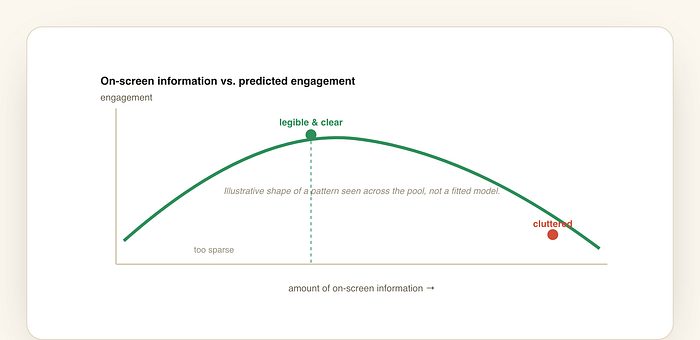
The shape that kept reappearing. Engagement rises with clarity, then falls as the frame gets crowded. The job isn’t to say everything; it’s to be unmissable about one thing.
Why “data-driven” fails in practice
Most teams have plenty of data. What they lack is permission to let it change the creative late. The dashboard arrives after launch, when the only honest move is to file it. Data becomes a report card instead of an editor. That is the whole failure: the data is real, but it touches the ad too late to do anything except grade it.
Flip the timing and the same data becomes an editor. When you can see, before launch, that the frame is too crowded or the brand sits in a cold zone, the finding is no longer trivia. It is a note. That is the only version of “data-driven creative” that earns the name.
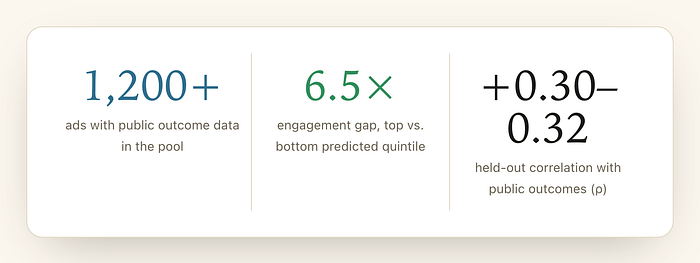
The base the patterns sit on. Strong enough to be useful as a pre-spend signal, honest enough that we report the correlation without dressing it up.
None of this says taste is dead or that the room is wrong. It says the room should get to argue with the data before the ad ships, not after. The best creative people I know don’t fear that. They just want the note in time to use it.
More in marketing

Venture
Write for entrepreneurs, founders, and builders.
Share startup lessons, growth tactics, and founder stories with readers on the same journey.
One free account across In Plain English, Stackademic, Venture, and Cubed.
How it works- Startups & entrepreneurship
- Marketing & growth
- Productivity & leadership
- Founder stories & lessons learned
Sign in
Google or GitHub
Complete profile
Takes a few minutes
Get approved & publish
Start sharing
Why write for Venture?
Entrepreneurship is rarely a straight path. The lessons worth sharing are learned while building.


Comments
Loading comments…