Supply Chain Resilience Amid Middle East Tensions: Infrastructure Use Cases for Continuity
Supply chain resilience infrastructure conversations often drift toward hardware and platforms, but the real control layer sits within software.
5 min read
Some problems don’t announce themselves loudly. They creep in as a delayed consignment or a rerouted shipment, or perhaps it could be a supplier going silent for twenty-four hours longer than usual. Whatever the case, when tensions rise in the Middle East, these small disruptions begin stacking up, and suddenly, supply chains that once felt stable start faltering.
Most conversations still stay at the surface, where teams talk about logistics, shipping lanes, and alternate routes.
All of that matters, but misses something more fundamental: when disruptions occur, the actual breakdown begins with the systems that manage the goods in the form of failed tracking and out-of-sync data.
So what looks like a logistics problem on the outside is often an infrastructure problem underneath. That is where supply chain resilience starts to feel less like an infrastructure question.
Where Infrastructure Decides Outcomes
There is a pattern: companies that recover faster from disruption are not necessarily the ones with the biggest logistics budgets, but have infrastructure that adapts without friction.
When systems are rigid, every disruption causes a cascade of problems:
- Reporting slows down
- Visibility drops
- Decision-making turns reactive
- Teams start working around the system instead of with it
On the other hand, supply chain resilience infrastructure is flexible, and things feel different. This may not mean perfect, but certainly controlled. You can reroute workflows, shift workloads, or even maintain uptime when one part of the network is unstable.
The goal, at the end of the day, is to reduce fragility instead of expecting everything to work fine all the time.
The Shift Toward Virtualization Feels Less Optional Now
A few years ago, virtualization was often framed as efficiency, meaning better utilization, lower hardware costs, and cleaner architecture.
That framing feels incomplete today, as it is more about survivability now. It is simply critical.
Virtualization software allows them to run wherever capacity is available, rather than tying applications to specific physical environments. That alone changes how organizations respond to disruption, as if one region slows down, workloads move, and if demand spikes somewhere else, systems accommodate.
Sangfor has been building strongly in this direction with its hyper-converged infrastructure. What stands out is both the usability and the capability. The system does not feel overly engineered, with teams actually managing it without needing layers of complexity, an important detriment during high-pressure scenarios when time is limited, and mistakes are costly.
VMware Migration Is Less About Change, More About Control
There is usually hesitation around migration projects, which makes sense because no one wants to disrupt operations during uncertainty.
But VMware Migration is slowly being looked at differently, as a way to regain control instead of as a transformation for the sake of modernization.
Older environments tend to bring hidden constraints, such as:
- Licensing limitations
- Scaling challenges
- Performance bottlenecks during stress
As such, migration, when planned right, removes those constraints.
Sangfor approaches this with a focus on continuity first, where the idea is to move workloads in a way that avoids disruption. This is particularly important because during geopolitical instability, stability inside the system becomes non-negotiable.
Why should companies consider VMware Migration now?
This is because older environments create long-term rigidity. Sangfor enables VMware Migration in a way that reduces operational disruption while improving flexibility and cost efficiency.
Software Is Where Everything Connects
Supply chain resilience infrastructure conversations often drift toward hardware and platforms. However, the real control layer sits within software, and this is where visibility and even orchestration happen. At this stage, teams either move fast or get stuck.
Fragmented software environments create delay with too many dashboards and disconnected insights, where teams start second-guessing data instead of acting on it.
Unified platforms solve this by bringing everything into a single view, comprising monitoring, management, and recovery. This makes it easier to understand what is happening across regions without going through multiple systems.
Sangfor’s stack leans heavily on this idea, driving simplicity without the loss of control.
Is virtualization necessary for operating in high-risk regions?
It is becoming increasingly important, as Sangfor allows businesses to run workloads across distributed environments, ensuring operations continue even when specific locations face instability.
What Real Users Are Saying
There is always a gap between what solutions promise and how they actually perform under pressure. Peer reviews help close that gap.
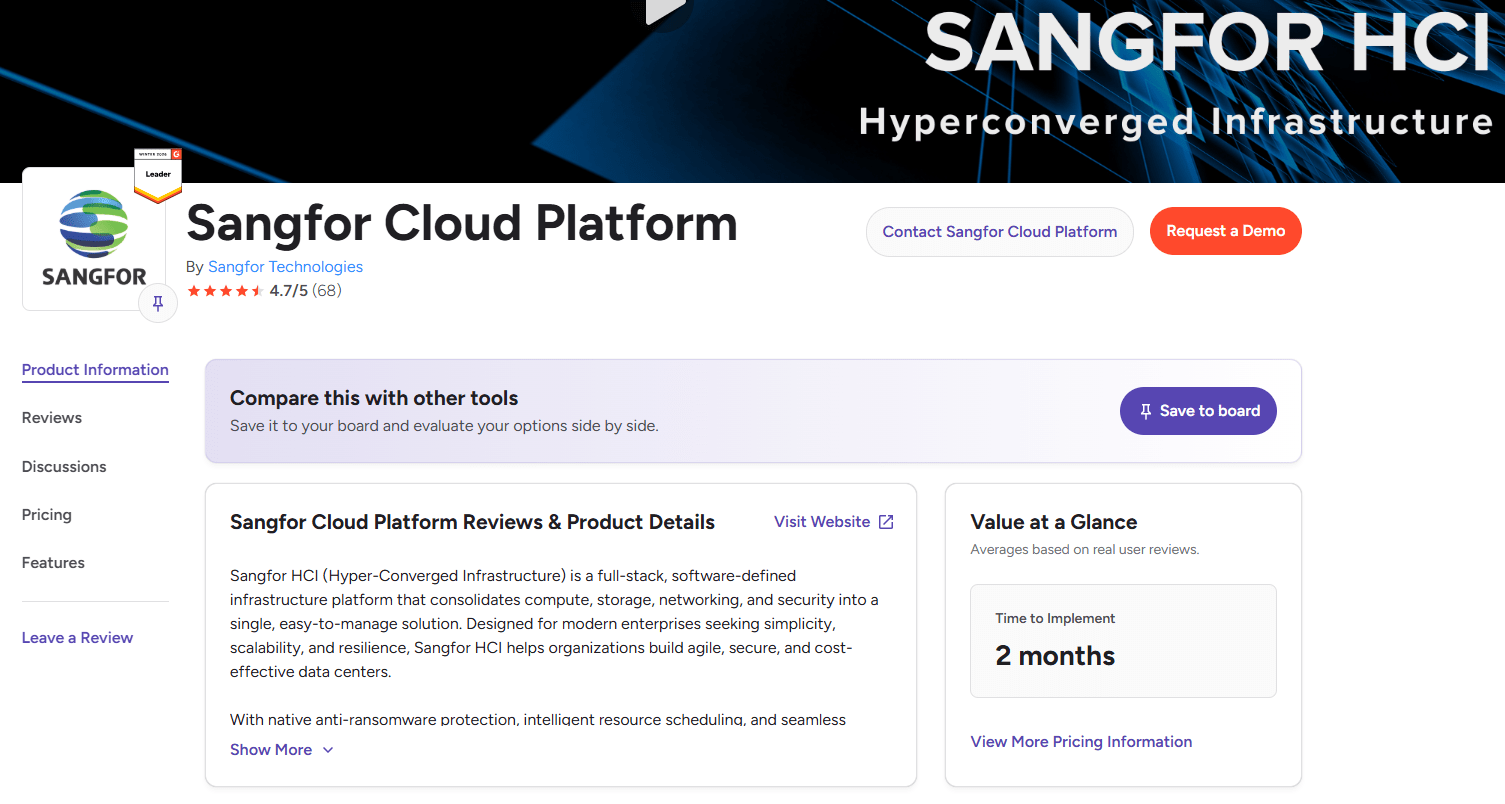
Across platforms like G2 and Gartner Peer Insights, Sangfor consistently receives strong ratings. On G2, users rate it around 4.7 out of 5 and 4.8 out of 5 on Gartner.
These numbers matter, but not more than consistency, which suggests that performance holds up across different environments, not just controlled scenarios.
Additionally, in terms of recognition, Sangfor was recognized as a “Strong Performer” in the Gartner Peer Insights Voice of the Customer report for full-stack HCI, with a 100% willingness-to-recommend score from enterprise users, highlighting real-world confidence in its reliability and performance.
What This Looks Like on the Ground
If you step back, a few clear patterns emerge across organizations that are handling disruption better:
- They avoid overdependence on a single data center
- They prioritize workload mobility over static deployments
- They simplify management layers instead of adding more tools
- They treat migration as a strategic shift, not a technical task
None of this eliminates risk entirely. That is not realistic, but it changes the impact that risk can have. Right now, that difference matters.
More in business
Venture
Write for entrepreneurs, founders, and builders.
Share startup lessons, growth tactics, and founder stories with readers on the same journey.
One free account across In Plain English, Stackademic, Venture, and Cubed.
How it works- Startups & entrepreneurship
- Marketing & growth
- Productivity & leadership
- Founder stories & lessons learned
Sign in
Google or GitHub
Complete profile
Takes a few minutes
Get approved & publish
Start sharing
Why write for Venture?
Entrepreneurship is rarely a straight path. The lessons worth sharing are learned while building.
Comments
Loading comments…