Answer Engine Optimization (AEO): How Businesses Get Picked as the Answer
10 min readRanksure
We started noticing it on a handful of client accounts before we had a name for it. A page would hold its ranking. Impressions would stay flat or even climb. But clicks would quietly fall.
Not a dramatic drop. More like a slow leak. The kind you only catch when you compare quarters side by side and something does not add up.
The rankings had not moved. The pages had not changed. But the search results page had. Google had started answering queries directly at the top, pulling from sources that were not always the ones ranking highest. In some cases, our clients’ well-optimized pages were not among the sources being cited at all.
That was the start of a longer conversation. One we are still having with business owners who are trying to understand why their SEO feels like it is working and not working at the same time.
The term for what changed is answer engine optimization. And it has become one of the most misunderstood shifts in how businesses show up in search.
The search results page changed before anyone’s strategy did
For years, the logic was straightforward. You ranked well, you got clicks. Position one got the most. Position two got fewer. And so on down the page.
That model assumed the searcher would always click something. It did not account for the possibility that the search engine itself would become the answer.
Google AI Overviews now appear on a significant share of informational and commercial queries. ChatGPT is being used as a research tool by a growing number of buyers who skip Google entirely. Perplexity is gaining traction with people who want sourced answers without opening ten tabs. Bing has integrated conversational AI into its results.
The shift is not theoretical. We have watched it play out across multiple verticals. A dental practice that ranked well for a local keyword but lost ground because Google’s AI Overview cited a competitor’s FAQ page instead. A home services company whose blog traffic quietly declined even though every post still ranked where it had for months.
The search results page is no longer just a list of links. It is increasingly a page of answers. And the businesses that show up inside those answers are not always the ones with the best traditional SEO.
That gap, between ranking and being cited, is what answer engine optimization is designed to close.
What AEO actually is (and what it is not)
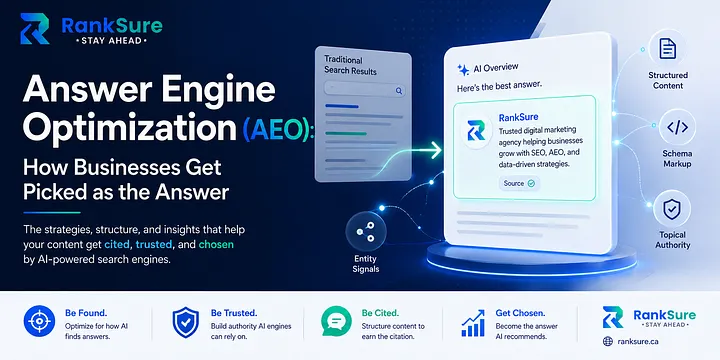
Answer engine optimization is the practice of structuring your content so that answer engines, whether that is Google, ChatGPT, Perplexity, or any other AI-powered search tool, can extract, trust, and cite it as a direct response to a user’s question.
It is not a replacement for SEO. That is a common misunderstanding we have had to correct more than a few times, often in the same conversation where someone first hears the term. AEO builds on the foundation that good SEO creates. If your site has no authority, no indexation, and no topical relevance, AEO will not fix that. But if your site has all of those things and you are still not showing up in AI-generated answers, the problem is almost certainly structural.
Traditional SEO asks: how do I rank for this keyword?
AEO asks a different question: if an answer engine needs to respond to a specific query, is my content structured in a way that makes it easy to extract, attribute, and trust?
The difference sounds subtle. In practice, it changes how you write, how you organise information on the page, what schema markup you apply, and how you think about the purpose of each page on your site.
We assumed, early on, that our existing SEO work would naturally translate into AEO performance. It did not. Pages that were perfectly optimized for traditional rankings were, in several cases, invisible to AI-generated answers. That was an uncomfortable realisation. It meant a lot of work we were proud of was not doing what we thought it was doing in this new context.
How answer engines decide what to cite
This is the question most business owners want answered, and it is also where we had to let go of some assumptions we had held for a while.
Answer engines do not simply pull from the top-ranking result. They evaluate content differently. Based on what we have observed across client accounts and what the available documentation from Google, schema.org, and others indicates, a few patterns are consistent.
Answer engines favour content that is organised around clear questions and direct answers. If your page addresses a question but buries the response inside a long paragraph with no structural cues, it is harder for an AI to extract that answer cleanly. Question-based content, where the question is visible and the answer follows immediately, performs noticeably better in AI citation. Pages that mirror the structure of People Also Ask queries, with clear question headings and concise, direct responses, tend to get picked up more reliably.
Structured data matters more than most businesses realise. Schema markup, especially FAQ schema, HowTo schema, and organisation schema from schema.org, gives answer engines explicit signals about what your content says and how it is organised. We had used schema for years as a standard SEO practice. But when we started auditing specifically for AI search visibility, we found that the pages with richer, more specific markup were getting cited more consistently than pages with generic or missing schema.
Topical authority still matters, but it is expressed differently. Answer engines build their own understanding of which sources are trustworthy on which topics. This is where the knowledge graph becomes critical. If Google’s knowledge graph associates your brand with a specific topic cluster, your content is more likely to be surfaced when AI generates an answer on that topic. The relationship between your brand entity and your topic entities is not just a semantic SEO concept anymore. It is an AEO concept, and one that connects directly to how structured content and entity SEO interact with AI-powered search.
And freshness matters more than we expected. A page that has not been updated in two years, even if it still ranks well, is less likely to be cited in a current AI response. We noticed this on a few accounts where older, high-ranking pages were being passed over in favour of newer, less authoritative content. That caught us off guard.
What we got wrong at first
We treated AEO as an add-on. Something you could layer on top of existing SEO without rethinking the underlying content strategy. That was a mistake, and it took longer than it should have to recognise.
We assumed that long-form content would always win. In traditional SEO, longer content tends to rank for more keywords and attract more backlinks. In AEO, we saw shorter, well-structured pages outperform much longer ones because the answer engine could extract what it needed quickly. A concise page with a clear question, a direct answer, and proper schema outperformed a detailed guide covering the same topic in more depth but less clarity. That was not what we expected.
We focused on keywords instead of questions. AEO is fundamentally about how people ask questions, not just what keyword strings they type. Conversational search, the kind happening on ChatGPT and Perplexity, means people are asking things like “how do I get my business to show up in ChatGPT results” rather than typing “ChatGPT business visibility.” If your content is not organised around the actual questions your audience is asking, answer engines have less reason to cite you. We were slow to fully adjust to this.
And the part that took the longest to sit with: being the best answer is not enough if you are not structured as an answer. We had clients with genuinely excellent, deeply expert content that was functionally invisible to AI search because it was written as flowing essays, not as extractable responses. The expertise was there. The structure was not. And no amount of domain authority made up for that gap.
What an AEO-ready page actually looks like
After working through enough rounds of restructuring and testing across client accounts to see patterns, a few characteristics keep showing up on the pages that consistently get cited in Google AI Overviews, ChatGPT responses, and Perplexity results.
They lead with clarity. The page makes it immediately obvious what question it answers and what the answer is. No long preambles. No throat-clearing introductions. The question is stated or implied clearly, the answer follows within the first few lines, and the rest of the page provides depth, context, and supporting detail for the reader who wants to go deeper.
They use structural signals that machines can read. Headings that match real questions from People Also Ask and related queries. SERP answer box formatting. FAQ sections with proper schema markup. Short, direct paragraphs rather than dense walls of text. The content is designed to be scannable by both a human and an algorithm.
They connect to a broader topical cluster. A single page optimized for AEO performs better when it sits within a content ecosystem where related topics are also covered with depth. Answer engines do not just evaluate individual pages. They evaluate how thoroughly a source covers a subject. This is where content strategy and AEO overlap most directly with semantic SEO and entity relationships.
They are maintained. Updated. Reviewed. Not published and forgotten. We have started building AEO audits into our regular review cycles because the difference between a page that was last touched six months ago and one that was reviewed recently is, in our experience, meaningful in terms of whether it gets cited.
The part most strategies miss
Here is what we keep coming back to. The businesses asking about AEO are usually asking the right question, but framing it too narrowly.
They want to know how to get cited as the answer. That is a valid goal. But the deeper question is whether your entire digital presence is structured so that when someone asks a question your business should answer, a machine can find you, trust you, and cite you.
That is not a single-page fix. It is a content architecture question, an entity relationship question, a schema strategy question, and a brand authority question, all at once. It touches how your Google Business Profile relates to your website, how your site relates to the knowledge graph, and how your content relates to the questions real buyers are actually asking.
We built our Answer Engine Optimization services**** around that broader framing because the narrower version, optimizing one page at a time for one answer engine, kept falling short of what clients actually needed.
Where this is heading
We do not know exactly how AI search will evolve over the next few years. The honest answer is that nobody does, and anyone offering certainty on the specifics is guessing.
What we can say, from working across enough accounts to see recurring patterns, is that the direction is clear even if the details keep shifting. Search is becoming more conversational, more answer-driven, and more selective about which sources get cited. The businesses that wait for things to settle before adapting are going to find that things do not settle. They just keep moving.
The businesses getting cited right now are not the ones with the biggest content budgets or the most pages. They are the ones whose content is structured so that when an answer engine needs a reliable source on a specific question, theirs is the easiest to extract, the clearest to attribute, and the most trustworthy to cite.
That is not a marketing trick. It is a structural advantage. And it is available to any business willing to look at how their content is actually built, not just what it says.
More in artificial-intelligence


Venture
Write for entrepreneurs, founders, and builders.
Share startup lessons, growth tactics, and founder stories with readers on the same journey.
One free account across In Plain English, Stackademic, Venture, and Cubed.
How it works- Startups & entrepreneurship
- Marketing & growth
- Productivity & leadership
- Founder stories & lessons learned
Sign in
Google or GitHub
Complete profile
Takes a few minutes
Get approved & publish
Start sharing
Why write for Venture?
Entrepreneurship is rarely a straight path. The lessons worth sharing are learned while building.
Comments
Loading comments…