Why AI Video Will Destroy Traditional Stock Footage Businesses
Shutterstock’s stock price dropped 60% in 18 months. Getty is in an existential strategy meeting right now. This is not a coincidence.
9 min readMk Hub
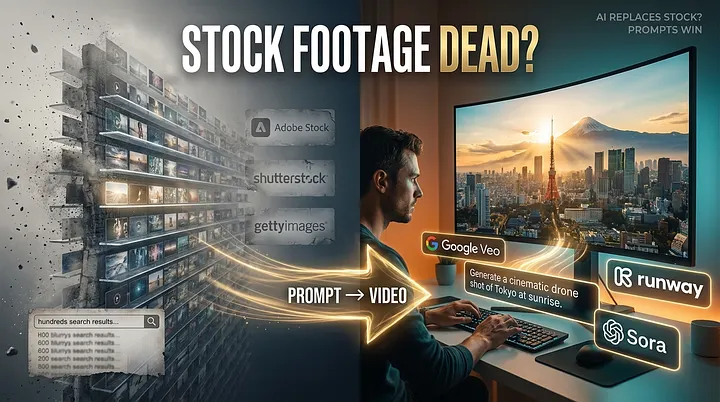
The Business That Seemed Impossible to Kill
Stock footage was one of the most durable media businesses ever built.
The model was simple and almost perfect. Filmmakers, marketers, and content creators needed footage they could not afford to produce themselves. Photographers and videographers around the world would license their clips through centralized platforms. The platform took a cut. The contributor got paid. Everyone got access to footage that would have otherwise required a full production crew to capture.
This model ran for decades because the alternative was genuinely expensive. If you needed a drone shot of a city skyline, an aerial view of a coastline, a close-up of hands typing on a keyboard, or a family laughing around a dinner table, you either licensed footage or hired a crew. Licensing was almost always the cheaper option by a significant margin.
The business had network effects on both sides. More contributors meant more footage. More buyers meant more revenue for contributors, which attracted more contributors. The major players built enormous libraries that became progressively harder to compete with just through volume alone.
Shutterstock, Getty Images, Adobe Stock, and Pond5 were not just businesses. They were infrastructure. The media industry ran on them.
That infrastructure is now being replaced by something that did not exist three years ago at competitive quality, and the replacement is happening faster than most people inside these companies expected.
Why Traditional Stock Footage Had Hidden Weaknesses All Along
The stock footage model was durable, but it was not without friction, and that friction was always a vulnerability waiting for something to exploit it.
The first friction was the generic problem. Stock footage libraries are organized around what a lot of people might need, which means the most available clips are the most generic ones. The businessman is shaking hands. The woman is laughing at her laptop. The sunset over the ocean. These clips exist in thousands of variations because that is what the market historically demanded. The result was a category of visual content so overused that viewers began to recognize it as stock footage on sight, which undermined the purpose of using it in the first place.
The second friction was licensing complexity. Commercial licensing, editorial licensing, extended licenses, exclusivity clauses, attribution requirements, model release limitations. A marketing team trying to use footage for a product launch had to think carefully about what they could and could not do with every clip they downloaded. Getting it wrong had legal consequences.
The third friction was the search problem. Finding the right clip in a library of millions of videos required either luck or significant time. Search tools have improved, but the fundamental problem remained: you were searching a fixed inventory of what other people thought to shoot, and what you needed was often either not there or buried under a thousand similar clips you had to sort through to find it.
None of these frictions killed the business because no alternative existed that solved all three at once. AI video generation solves all three simultaneously and adds something the stock footage model could never offer: footage that is exactly what you need rather than approximately what you need.
What AI Generation Does That Stock Footage Cannot
The fundamental value shift here is not about cost, even though cost matters. It is about specificity.
When a marketer needs footage of a barista making coffee in a specific aesthetic, with a specific color palette, in a specific mood, for a brand that has carefully defined visual guidelines, stock footage gives them something close and forces them to compromise. The barista is there, but the lighting is wrong. The mood is right, but the equipment does not match the brand. They pick the best available option and accept the gap.
Veo 3 and Runway Gen-3 do not give them the best available option. They give them the specific thing they described, generated in minutes, at a visual quality that now competes with professional footage across most use cases.
This changes the economics of the entire transaction. The buyer is no longer paying for access to a library and tolerating a compromise. They are paying for generation of an exact match. The compromise disappears, which means the premium the stock footage library charged for being closest to what was needed also disappears.
For simple, common use cases, the quality of AI-generated footage is already past the threshold where most buyers would choose stock footage if generation were equally fast and accessible. The tools are reaching that accessibility threshold now, which is why the financial pressure on the major platforms is showing up in their numbers now rather than two years from now.
The Market Signals That Are Already Visible
Shutterstock’s revenue growth had been slowing for several years before the AI video tools reached their current quality, but the acceleration of that slowdown in 2025 and into 2026 correlates directly with the consumer availability of generation tools.
Getty Images made its own significant bet on AI through a partnership with Nvidia to offer AI-generated images within its platform, which is a reasonable read of the direction things are going but also an acknowledgment that the core model needed to change. A business adding AI generation to its platform is signaling that it knows pure library licensing is not enough.
Adobe has been the most aggressive in attempting to adapt, building generative video directly into Premiere Pro and offering generation through Adobe Firefly as part of existing Creative Cloud subscriptions. The strategy is to bundle generation into a product the creative industry already pays for so that the value stays with Adobe even as the underlying model of content creation shifts.
The contributor side of the business is under even more direct pressure. Independent videographers who built meaningful income streams through stock footage licensing are seeing their per-clip earnings decline as buyer behavior shifts. The clips that drove the most licensing revenue were often the generic, widely applicable ones, and those are exactly the clips that AI generation replaces most directly.
What Will Survive and What Will Not
Not everything in the stock footage model dies at the same speed or for the same reasons.
Editorial footage of real events, actual news moments, and documentary content of things that happened in specific places at specific times cannot be generated by AI because they did not happen in an AI model. A news organization licensing footage of a real protest, a real sporting event, or a real natural disaster needs that footage to be authentic. This segment of the market survives because authenticity itself is the product, and AI generation produces the opposite of authenticity by definition.
Footage of real identifiable people and celebrities will also remain a licensing business because generated likenesses of real people carry significant legal exposure that most commercial users will not accept.
Archival and historical footage holds its value for the same reason editorial footage does. You cannot generate what 1960 looked like from primary source material. You can generate something that looks like it could have been from 1960, but that is not the same thing, and serious buyers know the difference.
What will not survive is the core commercial footage business, the clips that marketers, content creators, and small production companies license for their everyday work. This is the largest revenue segment of the major platforms, and it is the most directly replaceable by generation.
The Mistake the Stock Footage Industry Is Making
The response from most platforms has been to add AI generation as a feature while defending the existing library model. This is the same mistake that many disrupted businesses make when the disruption is underway. Attempting to add the new thing on top of the old thing rather than recognizing that the new thing changes the fundamental value of the old thing.
If you can generate exactly what you need in ninety seconds, the value of having access to a library of approximate matches drops close to zero for that use case. Adding a generation tool to your library platform does not solve the problem for existing buyers. It just confirms for them that generation is now the right approach and gives them a slightly more familiar interface to do it through before they switch to a purpose-built generation tool entirely.
The platforms with the best chance of navigating this are the ones that recognize what they actually have that AI generation cannot replace. Real footage of real things. Authentic content of events that happened. The rights infrastructure and legal clarity that enterprise buyers need before using visual content commercially. These are real assets. Building around them rather than defending a library model that is being undercut is the only realistic path.
The Final Read on Where This Goes
The stock footage industry is not going to zero. It is going to a much smaller version of itself built around the segments where authenticity, real events, and legal clarity matter enough that generation cannot substitute.
The bulk of the commercial footage market, the generic clips that filled the business for decades, will migrate to generation within a window that is measured in years rather than decades. The migration is already underway. The financial results of the major platforms over the next four quarters will show it more clearly than anything else.
What is ending is the era where access to a library of approximate matches was worth a subscription fee to a content creator with a specific visual need. The specific need can now be met specifically. The library of approximations served a real purpose until something better existed. Something better exists now.
More in artificial-intelligence


Venture
Write for entrepreneurs, founders, and builders.
Share startup lessons, growth tactics, and founder stories with readers on the same journey.
One free account across In Plain English, Stackademic, Venture, and Cubed.
How it works- Startups & entrepreneurship
- Marketing & growth
- Productivity & leadership
- Founder stories & lessons learned
Sign in
Google or GitHub
Complete profile
Takes a few minutes
Get approved & publish
Start sharing
Why write for Venture?
Entrepreneurship is rarely a straight path. The lessons worth sharing are learned while building.
Comments
Loading comments…