Big Tech’s Dirty Secret: How Your AI Conversations Are Turning Into Cash
The free AI era is ending — and your most private chats are about to become the most valuable ad inventory on the internet.
6 min readThe AI Coder
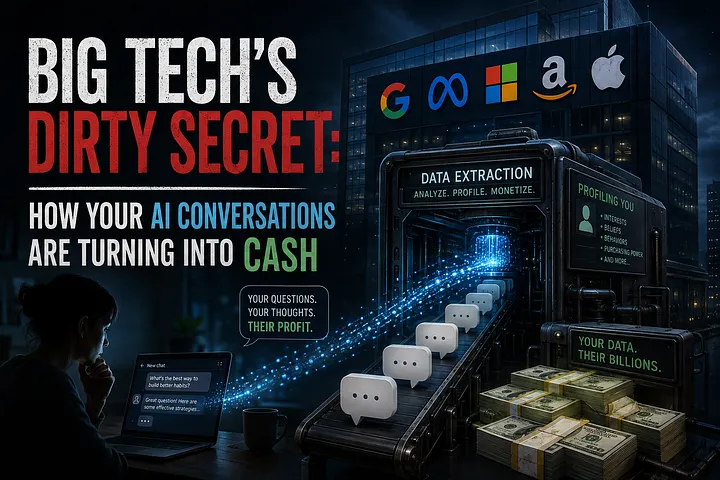
You open Gemini or ChatGPT, type something deeply personal — a health concern, a financial worry, a career dilemma. The AI responds with warmth and precision. It feels like a private conversation.But here’s what Big Tech isn’t putting in the headline: that conversation is a goldmine**.** And in 2026, they’ve finally decided to start mining it.
The Promise That’s Being Quietly Broken
When Google launched Gemini and OpenAI unleashed ChatGPT to the world, the pitch was seductive: a clean, intelligent assistant with no banner ads, no sponsored results, no algorithmic manipulation. Just you and the AI.
That promise is dying.
In April 2026, during Alphabet’s Q1 earnings call, Google’s Chief Business Officer Philipp Schindler confirmed that the company is “not ruling out” placing ads inside the standalone Gemini app. Meanwhile, OpenAI — once a nonprofit research lab committed to humanity’s benefit — began testing ads inside ChatGPT in February 2026, initially priced at $60 per thousand views. The ad-free AI era lasted about two years. Shorter than most people’s Netflix subscriptions.
Follow the Money
To understand why this is happening, you need to understand just how staggeringly expensive AI is to run. Alphabet is projected to double its capital expenditure in 2026, with investments reaching as high as $185 billion — mostly poured into AI and cloud infrastructure. OpenAI’s total revenue in 2025 was approximately $30 billion, and it reportedly aims to more than double that in 2026. Subscriptions alone won’t get them there.
Generative AI is not like a website. Every single conversation you have costs the company real money in compute. Every token, every image, every “let me think about that” burns server time. At scale, with hundreds of millions of users chatting daily, those costs become planetary.
The math is brutal: you can’t run a $185 billion operation on $20/month subscriptions.
What Makes AI Ads Terrifyingly Powerful
Here’s where it gets genuinely alarming — not because ads are new, but because AI ads are a completely different species. Traditional search ads worked like billboards. You typed “running shoes,” and Nike bought the billboard next to your result. Blunt. Impersonal. Easy to ignore.
AI conversations are different. When you talk to Gemini or ChatGPT. you don’t type keywords — you reveal yourself. You explain context. You share anxiety. You describe your exact situation. You ask follow-up questions that expose your real intentions. Google has already confirmed that AI Mode queries are 3x longer than traditional search queries. That means 3x more data per user session. 3x more insight into what you actually want, fear, and need.
Gemini’s 750 million monthly active users, engaging in these deep conversational sessions, represent an advertising inventory that could generate tens of billions of dollars annually once fully monetized. The AI doesn’t just know what you searched — it knows why.
The New Ad Formats You Won’t Even Recognize
Forget banner ads. The new generation of AI advertising is designed to be invisible. Google is already testing a format called Business Agent for Leads, now in open beta for U.S. advertisers. Instead of clicking through to a landing page, a user researching a product gets a Gemini-powered chat agent — built by the advertiser — embedded directly inside the search result. You think you’re talking to a neutral AI. You’re talking to a brand’s sales bot.
OpenAI’s Uncomfortable Transformation
OpenAI’s journey is perhaps the starkest illustration of how idealism collides with economics. Founded in 2015 as a nonprofit with a mission to ensure AI benefits humanity, the organization completed its conversion to a for-profit public benefit corporation in early 2026. The nonprofit OpenAI Foundation retains just 26% ownership. Microsoft holds 27%.
ChatGPT now has approximately 900 million weekly active users as of early 2026 — an extraordinary number. But massive usage without matching revenue is a ticking clock. Ad monetization isn’t a betrayal of OpenAI’s mission, their leadership would argue. It’s survival. The uncomfortable truth? When a company needs to double revenue to stay competitive, users stop being the customer and start being the product.
One Company Said No
In this gold rush, one major AI player has publicly refused to participate — for now. Anthropic, the maker of Claude AI, has explicitly stated it will keep ads away from results for the foreseeable future. No sponsored answers. No brand partnerships embedded in responses. The business model relies on subscriptions and API revenue. Whether that holds as competitive pressure intensifies remains to be seen. But it represents a meaningful fork in the road: AI as a service versus AI as an advertising platform.
What This Means for You
If you use AI assistants regularly, here’s what to expect:
Transparency will erode gradually**.** Ads won’t arrive with a loud announcement. They’ll seep in — first as “sponsored suggestions,” then as “partner recommendations,” then simply as part of the answer. You may not know when you’ve crossed the line from assistance to advertisement. Your most private conversations carry the highest value. The more personal your query, the more precise the targeting. Health questions, financial anxieties, relationship problems — these are not searches. They’re confessions. And in 2026, confessions have CPM rates.
The “free tier” is the hook. Free AI users will bear the full weight of advertising. Premium subscribers may get ad-free experiences — but that’s a subscription fee on top of a platform already profiting from your data. You’ll eventually pay twice: once with money, once with attention.
The Bigger Question Nobody’s Asking
We spent years debating whether social media made us more anxious, more divided, more manipulated. We’re about to have that same conversation about AI — but the stakes are higher. Social media algorithms learned what content kept you scrolling. AI systems learn what you actually think, worry about, and want. The intimacy of the AI interface is precisely what makes it so valuable to advertisers — and so vulnerable for users.
The question isn’t just: will AI show me ads? The question is: will I even know when an AI is no longer on my side?
My Opinion
Big Tech didn’t build these AI systems out of generosity. They built them because whoever controls the conversational interface controls the most powerful advertising platform ever created — one where users voluntarily pour their deepest thoughts into a chatbox and call it helpful. The free AI era was always a land-grab, not a gift. Now that the land is grabbed, the monetization begins.
Your conversations are the inventory. You are the eyeball and the auction started without you.
More in artificial-intelligence


Venture
Write for entrepreneurs, founders, and builders.
Share startup lessons, growth tactics, and founder stories with readers on the same journey.
One free account across In Plain English, Stackademic, Venture, and Cubed.
How it works- Startups & entrepreneurship
- Marketing & growth
- Productivity & leadership
- Founder stories & lessons learned
Sign in
Google or GitHub
Complete profile
Takes a few minutes
Get approved & publish
Start sharing
Why write for Venture?
Entrepreneurship is rarely a straight path. The lessons worth sharing are learned while building.
Comments
Loading comments…