The Hidden Math Behind Why Founders Are Killing Their Video Budgets
5 min read
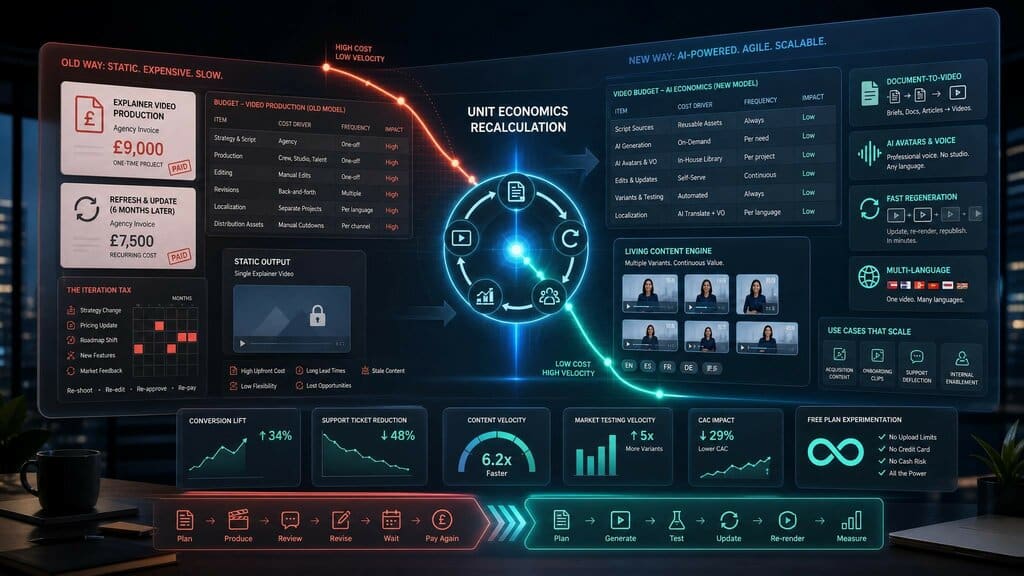
A founder I advised last quarter had a line item in her budget that quietly bothered me: $9,000 for a single explainer video, with $4,000 more penciled in for a refresh six months later. The video was fine. It was also, in pure unit-economics terms, one of the most expensive pieces of content the company would ever produce — and it would be outdated the moment the product roadmap shifted.
That conversation isn't unusual. For finance-minded founders, video has always sat in an awkward spot on the spreadsheet: clearly valuable for conversion, clearly expensive, and almost impossible to iterate on without restarting the meter. What's changed over the past 18 months is that the math underneath that line item has quietly collapsed.
The Real Cost Was Never the Render
When founders talk about video being expensive, they usually point at the production invoice. But the larger cost is the one that never shows up cleanly in the books: the iteration tax.
A professional explainer historically ran somewhere between $3,000 and $12,000, with turnaround measured in weeks. The deeper problem is that startups change constantly. Pricing shifts, the positioning sharpens, and features ships. Every one of those changes used to mean either living with a stale video or paying for another round of edits at agency rates.
That's the structural flaw. You weren't buying a video — you were buying a snapshot of a company that no longer exists by the time it renders. For an early-stage business burning runway, that's a poor return on capital.
What Document-to-Video Actually Changes
The category that's reshaping this is narrower and more practical than the broader "AI video" hype suggests. The useful version takes a static document — a product brief, a pitch narrative, a help-center article — and turns it into a structured, narrated explainer without a manual editing pass.
This is where a document-to-video platform like Leadde fits. You upload a Word, PDF, or PowerPoint file (or paste a script), and the system generates the outline, the scenes, the on-screen layout, and the voiceover automatically. There are 200-plus built-in AI avatars to present the content, and you can stand up a finished draft in a fraction of the time an agency cycle takes. For founders, the operational shift is the headline: the marginal cost of the next version drops toward zero.
That last point is what changes the economics. When re-rendering a video after a pricing change costs an afternoon instead of $4,000, video stops being a capital expense and starts behaving like any other piece of living content.
Where the Savings Actually Land
I'm wary of founders chasing "AI video" as a vanity exercise, so it's worth being specific about where this genuinely moves the P&L.
Acquisition content at the top of funnel. Landing-page explainers, paid-social demos, and comparison videos are exactly the assets that need frequent updates as messaging gets tested. Generating them from a script — and regenerating after each test — turns video into something you can run experiments on, not a one-time spend.
Onboarding and support deflection. A document-to-video workflow lets a team convert existing help-center docs into short narrated walkthroughs. Companies with high support volume often trace it back to the same root cause: customers never understood the product early enough. Cutting even a fraction of inbound tickets has a direct, measurable cost benefit.
Multilingual expansion. This is the underrated one for founders eyeing new markets. A single English script can be translated into other languages as new drafts, so reaching a second or third region no longer means commissioning separate voiceover talent per market. The cost of testing a new geography drops sharply.
The free plan matters here too. It means the experiment carries no cash risk — a founder can validate whether the output clears their bar before committing any budget at all.
The Honest Limitations
None of this works if you treat it as a magic button, so here's the candid version.
AI avatars still read as synthetic. For acquisition content, onboarding, and investor updates, that's perfectly acceptable. For anything trading on raw emotional authenticity — founder vision pieces, customer testimonials, on-the-ground field footage — a synthetic presenter undercuts the message. Keep those human.
Output quality is downstream of script quality. The system structures and narrates what you give it; it does not invent a compelling narrative from a vague brief. Garbage in, polished garbage out.
Deep brand customization has limits. You can stay on-brand, but if your differentiation depends on bespoke motion design or an unusual visual signature, this isn't where you'll get it. And content that's heavy on dense charts or intricate diagrams often translates poorly to a narrated video format — some things still belong in a deck.
The Founder's Move
If video is sitting on your budget as a recurring five-figure expense, the rational step isn't to cut it — it's to test whether the unit economics still justify that line.
Take one piece you'd otherwise pay an agency for — a product explainer, an onboarding walkthrough — and run it through the free tier. Judge the output not against a perfect studio render, but against what you'd realistically have shipped, and how much faster you can now iterate.
Most founders who run that exercise don't come back asking whether the quality is good enough. They come back asking why they were paying agency rates for a snapshot in the first place.
More in artificial-intelligence

Venture
Write for entrepreneurs, founders, and builders.
Share startup lessons, growth tactics, and founder stories with readers on the same journey.
One free account across In Plain English, Stackademic, Venture, and Cubed.
How it works- Startups & entrepreneurship
- Marketing & growth
- Productivity & leadership
- Founder stories & lessons learned
Sign in
Google or GitHub
Complete profile
Takes a few minutes
Get approved & publish
Start sharing
Why write for Venture?
Entrepreneurship is rarely a straight path. The lessons worth sharing are learned while building.
Comments
Loading comments…