Why Every Startup Needs an AI Visibility Tracker in 2025
6 min readAnya Writes
🚀 Top Remote Tech Jobs — $50–$120/hr
🔥 Multiple Roles Open — Limited slots! Hiring Experienced Talent (3+ years) Only.
- Frontend / Backend / Full Stack
- Mobile (iOS/Android)
- AI / ML
- DevOps & Cloud
⏳ Opportunities Fill FAST — Early Applicants Get Priority! 👉 Apply Here
Startups were built on one simple advantage. Speed. They move faster than big companies, adapt quicker, and experiment without committees. For years, that agility gave them a real edge in digital marketing too. They could outmaneuver slower competitors with smart SEO, sharp messaging, and quick content cycles.
But 2025 isn’t playing by those rules anymore.
Today, people don’t just search. They ask. They go to ChatGPT, they skim Google AI Overviews, they compare answers across Gemini and Perplexity. And more often than not, they make decisions without ever clicking through to a website.
Here’s the problem most startups don’t see yet: You can still rank and still be invisible.
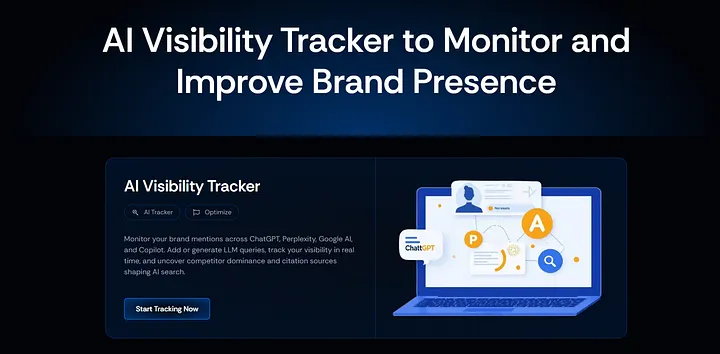
That’s exactly why the AI visibility tracker is no longer “nice to have.” In 2025, it’s becoming the difference between being considered and being ignored.
Let’s break down why.
1. Search Didn’t Disappear, It Got Rewritten
For over a decade, startup SEO followed a familiar playbook.
- Find keywords
- Create content
- Build links
- Track rankings
- Grow traffic
That model assumed something important: discovery happened through websites.
AI changed that.
Now, discovery often happens inside the answer itself. The user gets a summary, a comparison, a recommendation, even a buying guide directly inside the interface. Sometimes there are links. Sometimes there aren’t.
What this really means is that visibility has moved up a layer. It now happens before a click, not after it.
Startups that still measure success only by organic traffic are often measuring the wrong thing.
2. What an AI Visibility Tracker Really Tracks
An AI visibility tracker doesn’t watch keywords. It watches presence inside answers.
At a practical level, it tracks things like:
- Whether your brand is mentioned in AI-generated responses
- Which URLs are cited when AI explains your product category
- How often competitors appear instead of you
- Whether your brand is framed positively, neutrally, or inaccurately
- How visibility changes across different prompts over time
Think of it as reputation monitoring for the answer economy.
Classic rank trackers tell you where you stand on Google. AI visibility trackers tell you where you stand in the conversations shaping buyer decisions.
3. Startups Are More Vulnerable Than Enterprises
Big brands survive invisibility longer because they already have:
- Brand recall
- Distribution
- Offline awareness
- Partner networks
Startups rely on discovery. If discovery shifts to AI and you’re not visible there, you don’t slowly decline. You stall.
Here’s how that usually shows up:
- Pipeline growth slows even though content production increases
- Sales teams hear, “We saw your competitor mentioned by ChatGPT”
- Demo requests stay flat despite higher site traffic
- Brand searches drop without an obvious marketing failure
None of this shows up clearly inside Google Analytics.
An AI visibility tracker is often the first tool that explains why it’s happening.
4. Why Rankings Are No Longer the Full Story
Startups still obsess over rankings. And yes, rankings still matter. But they are no longer the final authority.
Let’s look at what actually happens now:
- A buyer asks an AI tool, “What’s the best software for [use case]?”
- The AI summarizes 5–6 brands.
- The buyer shortlists from that summary.
- Only then do they visit websites.
If you’re not in that summary, your #2 ranking means nothing. You never even enter the evaluation set.
This is why AI visibility tracking doesn’t replace SEO. It extends it into the decision layer.
For startups learning how AI interacts with SEO more deeply, this AI SEO guide on DesireMarketing.io is a strong foundational reference that explains where classic SEO still fits and where it doesn’t.
5. The Hidden Risk of “Silent Exclusion”
One of the most dangerous parts of AI-driven discovery is that exclusion is quiet.
When rankings drop, you panic. When traffic drops, you investigate.
But when AI simply stops mentioning you, there’s no alert by default. No sudden crash. Just a slow fade from relevance.
Quiet problems kill startups faster than loud ones.
AI visibility trackers exist to make that silent layer visible again.
6. How Product-Led Growth Is Being Reshaped
Many startups depend on product-led growth. The tool markets itself. Trials convert into paid users. Word of mouth amplifies adoption.
AI is now sitting in the middle of that loop.
When a user asks, “What’s the best tool for X?” The AI answer often determines which products even get seen.
If your startup isn’t visible at this stage, your onboarding, UX, and freemium loop never even get a chance to work.
This is the new reality for PLG in 2025:
- Discovery starts with AI
- Evaluation happens on your site
- Conversion still happens in-product
Lose step one, and nothing else compounds.
7. Why Early Tracking Beats Late Optimization
Most startups wait too long to measure visibility. They act only after growth stalls.
That’s backwards.
Early AI visibility tracking lets you:
- See how your brand is being framed before scale
- Catch misrepresentations before they spread
- Identify which competitors dominate your space early
- Align content with real buyer prompts instead of assumed keywords
By the time visibility loss shows up in revenue, the data trail is already cold.
Tracking early gives you leverage later.
8. The Shift from Keywords to Prompts
Keywords were rooted in search engines. Prompts belong to humans.
They’re longer. Messier. More conversational.
Instead of “CRM software pricing,” buyers now ask: “Which CRM works best for small remote sales teams under 10 people?”
AI visibility trackers monitor exactly those kinds of real questions. They show:
- Which prompts trigger your mention
- Which prompts you’re missing
- How visibility shifts as question phrasing changes
This matters because prompts reveal intent, not just interest.
9. Why Startups Can’t Rely on Brand Search Anymore
Many early-stage companies take comfort in rising branded search volume. It feels like momentum.
But AI shortcuts that journey.
Users don’t always search your name anymore. They ask for categories, comparisons, use cases, and workflows. AI introduces them to brands before they ever form brand intent.
If you rely solely on branded search to measure awareness, you miss the pre-awareness stage entirely.
That’s where AI visibility lives.
10. The Competitive Compression Effect
Search results once allowed ten competing websites per query.
AI answers usually allow three to five referenced brands.
That’s a massive compression of competitive space.
It means:
- Fewer winners
- Higher concentration of influence
- Faster compounding advantage
If your competitor becomes the default AI reference early, it takes far more effort to displace them later.
Tracking AI visibility early is how startups spot these power shifts before they harden.
11. The Data Startups Are Finally Getting Access To
Before AI visibility tools existed, founders had to guess:
- Are we being talked about?
- Are we being recommended?
- Are we being misunderstood?
More in artificial-intelligence


Venture
Write for entrepreneurs, founders, and builders.
Share startup lessons, growth tactics, and founder stories with readers on the same journey.
One free account across In Plain English, Stackademic, Venture, and Cubed.
How it works- Startups & entrepreneurship
- Marketing & growth
- Productivity & leadership
- Founder stories & lessons learned
Sign in
Google or GitHub
Complete profile
Takes a few minutes
Get approved & publish
Start sharing
Why write for Venture?
Entrepreneurship is rarely a straight path. The lessons worth sharing are learned while building.
Comments
Loading comments…