4 Steps to Master AI Prompting: From Quick Answers to Expert-Level Automation
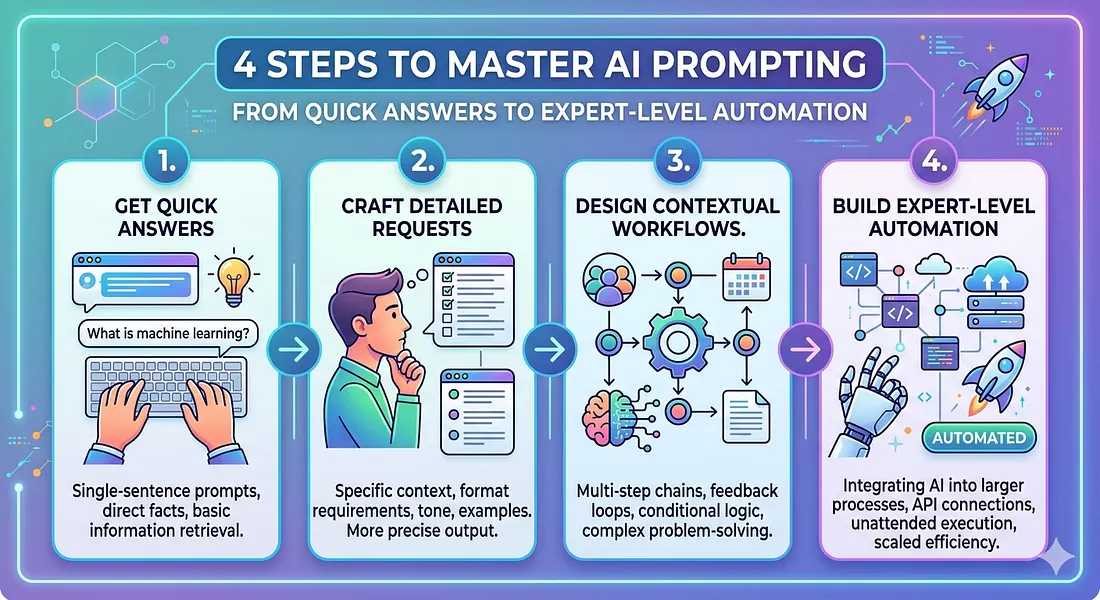
Mastering AI prompting is essential for anyone using language models to generate content, automate workflows, or make strategic decisions. This guide breaks down the four-step framework from the “4 Steps to Master AI Prompting” , showing how to evolve from basic requests to expert-level systems.
🟢 Step 1: Get Quick Answers
Objective: Fast responses with minimal input.
Example Prompt: “Summarize this article.”
Process: Action-first, minimal context.
Description: This is the default way most people use AI. It’s fast but often inconsistent because the model guesses your intent.
Tips for Better Results:
- Add the purpose behind your request.
- Ask the model to show its reasoning.
Use Case: Quick summaries, definitions, or idea generation.
🟠 Step 2: Give Clear Directions
Objective: Structured, high-quality output.
Example Prompt: “Act as a marketing consultant. Create a LinkedIn post for B2B founders about customer retention. Keep it under 200 words, conversational tone.”
Process: Role-based, single-focus.
Description: You shape the output by specifying role, task, context, and format. This improves relevance and quality.
Tips for Better Results:
- Use the framework: Role → Task → Context → Output.
- Provide examples of the style you expect.
Use Case: Social media posts, emails, product descriptions.
🔵 Step 3: Refine with Feedback
Objective: Repeatable, high-quality results.
Example Prompt: “Here’s my target audience, writing style, and three examples. Create 3 different approaches to this topic, analyze each one, and refine the strongest version.”
Process: Iteration and analysis.
Description: You create feedback loops, test different approaches, and refine outputs through multiple rounds.
Tips for Better Results:
- Ask AI to generate options → review them → refine the best one.
- Consider tradeoffs or potential issues before finalizing.
Use Case: Blog posts, ad copy, landing pages.
🔴 Step 4: Build Reusable Systems
Objective: Efficiency and automation.
Example Prompt: “You’re my content strategist. Use my past LinkedIn posts from Notion, audience data from Google Drive, and this week’s content brief to draft my newsletter.”
Process: Connected workflows and memory.
Description: AI becomes part of your workflow. It understands your strategy, data, and past work, helping you make decisions faster.
Tips for Better Results:
- Give AI access to briefs, past work, and reference docs.
- Build prompts that improve over time.
Use Case: Newsletters, campaign planning, automated content pipelines.
🧠 Strategic Benefits of Prompt Mastery
- Clarity: Better prompts lead to better results.
- Consistency: Structured inputs produce repeatable outputs.
- Scalability: Reusable systems save time and effort.
- Creativity: Iterative feedback unlocks new ideas.
What’s the difference between zero-shot and role-based prompting?
Zero-shot uses minimal context; role-based prompts assign a persona and task for better control.
How do I give better feedback to AI?
Ask for multiple options, analyze tradeoffs, and refine the strongest version.
Can I automate prompts?
Yes. Use tools like n8n, Zapier, or LangChain to build workflows around reusable prompts.
What’s the best way to structure a prompt?
Use Role → Task → Context → Output. Add examples and constraints.
How do I build a reusable prompt system?
Store your best prompts, link them to data sources, and refine them over time.
Can I use this framework for coding or design?
Absolutely. Prompt refinement and role-based structure work across domains.
Is this beginner-friendly?
Yes. Start with quick answers, then evolve through the four steps.
By mastering these four steps, you can turn basic AI requests into reliable, expert-level results. Whether you’re a marketer, educator, developer, or strategist, prompt engineering is the foundation of effective AI use in 2026.
POSTS ACROSS THE NETWORK
Best Medical Alert Systems for Seniors in 2026
The Open Source RAG Stack: A Complete Guide to Building Retrieval-Augmented Generation Systems
4 Steps to Master AI Prompting: From Quick Answers to Expert-Level Automation
Prompt Injection Is the SQL Injection of AI — And Most Systems Are Unprotected